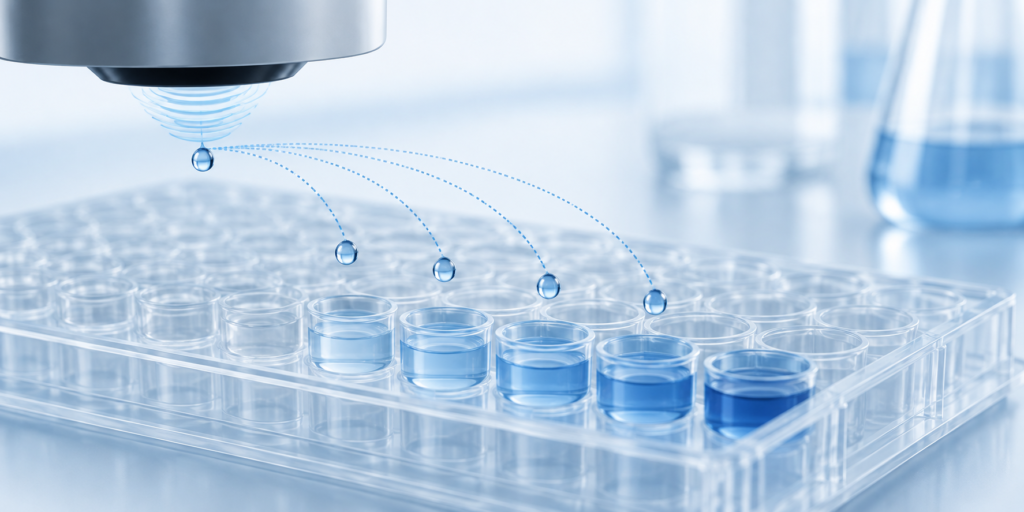
A serial dilution calculator can produce exact nominal concentrations while the assay wells receive something else. Peptides can contact tips, reservoirs and plates, and incomplete mixing can propagate error through a dilution chain. For a concentration-response experiment, the relevant question is whether the delivered concentration series is sufficiently close to the planned one for the scientific decision.
A published peptide assay workflow
Naylor and colleagues described a non-contact acoustic-dispensing workflow for peptide agonists measured in a mouse GLP-1 receptor cell assay. Their protocol prepared intermediate peptide stocks and then a concentration series in acoustically qualified microplates. In the published example, a 384-well plate held an 11-point concentration range for 16 peptides in duplicate; transfer to the assay plate used a constant 100 nL per well. The procedure also used backfill and centrifugation to mix intermediate solutions. These are protocol and demonstration dimensions, not recovery percentages or an estimate that every peptide retains potency. [1, Protocol; Figures 1–2]
| Published design element | Reported setting | Why it matters |
|---|---|---|
| Assay plate | 384 wells | Layout, edge effects and available controls need planning. |
| Concentration range | 11 points | A curve needs coverage above and below its transition region. |
| Example analytes | 16 peptides in duplicate | Replicate positions permit an initial reproducibility check. |
| Final acoustic transfer | 100 nL per well | Small transfer demands qualified source plates and instrument verification. |
The authors’ motivation was to reduce sample contact with plastic tips. That is a plausible control for adsorption, but an acoustic transfer can introduce its own requirements for source-plate geometry, fluid properties and mixing. Their report is a protocol paper, not a universal head-to-head recovery study for all peptide chemistries. [1]
Validate the delivered series
Begin with the serial dilution planner to record intended concentrations and volumes. Then separate three checks: calculation, liquid transfer, and biological/analytical readout. Recalculate the series independently; verify delivered volume with a suitable gravimetric or dye method where possible; and assess a peptide-specific control series with replicates across the plate. For a tip-based process, fresh tips and controlled prewetting may matter. For an acoustic process, check fluid compatibility and mixing after backfill. Neither approach fixes a wrongly assigned stock concentration.
If the apparent potency changes when only the dispensing method changes, do not immediately infer a change in receptor pharmacology. Recheck concentration assignment, surfaces, matrix additives, final solvent fraction, plate position and assay timing. Some additives used to reduce adsorption may alter the assay itself, so each requires a control. The complete trail from stock to well should remain available alongside the final fitted curve.
An earlier separate experimental report by Naylor and colleagues compared acoustic and tip-based preparation for GLP-1 and glucagon peptide analogues and reported changes in apparent potency curves with handling method. Its publisher abstract supports that direction of concern but provides no transferable effect size; no numerical acoustic benefit is claimed here. [2] The later protocol also states that its automated series used less than 1 µL of sample across a nominal 3 × 10⁶ concentration range. Those are workflow dimensions, not evidence that the delivered concentrations were correct in another laboratory. [1, Discussion]
Before accepting a fitted curve
- Confirm stock content basis and independently recalculate at least the first, middle and last nominal points.
- Check transfer performance and mixing at the smallest delivery volume, not only at a convenient high volume.
- Place a reference peptide/control curve in more than one plate region and inspect replicate scatter and top/bottom asymptotes.
- If dispensing modes disagree, compare measured concentration or recovery as well as fitted EC50; curve shifts alone cannot locate the error.
What the source does and does not show
This is cell-based assay method evidence, with a GLP-1R readout. Its 11-point, 16-peptide layout demonstrates an implementation; it supplies no universal accuracy factor and no clinical or product-lot claim. The article is useful when selecting consumables and liquid-handling validation for a peptide assay, but each laboratory must measure its own transfer accuracy, peptide recovery and fit quality.
Primary source and claim trail
- Naylor J, et al. Automated Acoustic Dispensing for the Serial Dilution of Peptide Agonists in Potency Determination Assays. Journal of Visualized Experiments. 2016;(117):54542. DOI 10.3791/54542, PMID 27911362. Locations: Abstract (scope); Protocol (source plate, backfill and mixing); Figure 1 caption (100 nL final transfer); Figure 2 caption (11 points, 16 peptides in duplicate). Primary full text inspected. No comparative recovery percentage is reported here or claimed in this draft.
- Naylor J, Rossi A, Hornigold DC. Acoustic Dispensing Preserves the Potency of Therapeutic Peptides throughout the Entire Drug Discovery Workflow. SLAS Technology. 2016;21(1):90–96. DOI 10.1177/2211068215587915. Location: publisher abstract. Original comparative peptide study; abstract-only access in this review, used solely for the direction of the handling-method concern and no numeric claim.
Sources & editorial method
AI-assisted editorial draft; independent Codex source, image and seven-language review; human professional review not claimed
2 linked records are listed in the references below. Read the editorial and AI-assistance policy.
How to interpret this article
This article summarizes third-party records and does not establish the identity, quality, safety or efficacy of any catalog lot.
Research-use boundary: Catalog materials discussed on this website are for laboratory research, development and manufacturing use only, not for human or veterinary use. This content is not medical advice and does not provide administration instructions.
Primary records and authoritative sources
- Naylor J, et al. Automated Acoustic Dispensing for the Serial Dilution of Peptide Agonists in Potency Determination Assays. Journal of Visualized Experiments. 2016;(117):54542.Source 1. Abstract (scope); Protocol (source plate, backfill and mixing); Figure 1 caption (100 nL final transfer); Figure 2 caption (11 points, 16 peptides in duplicate). Primary full text inspected. No comparative recovery perce
- Naylor J, Rossi A, Hornigold DC. Acoustic Dispensing Preserves the Potency of Therapeutic Peptides throughout the Entire Drug Discovery Workflow. SLAS Technology. 2016;21(1):90–96.Source 2. publisher abstract. Original comparative peptide study; abstract-only access in this review, used solely for the direction of the handling-method concern and no numeric claim.