


 Packaging mockup
Longevity & Bioregulators · Source-reviewed dossier
Epitalon
Source-Reviewed Research Dossier
Packaging mockup
Longevity & Bioregulators · Source-reviewed dossier
Epitalon
Source-Reviewed Research Dossier
Longevity, Mitochondrial & Bioregulator Research
Longevity is a broad research theme rather than a single measurable indication. Families here are organized around mitochondrial signaling, cellular stress, bioregulation or aging-related experimental models, with the model and endpoint stated explicitly.
8 families found for “Longevity & Bioregulators”
Clear filterPackaging mockup
Longevity & Bioregulators · Source-reviewed dossier
Epitalon
Source-Reviewed Research Dossier
 Packaging mockup
Longevity & Bioregulators · Source-reviewed dossier
FOXO4-DRI
Source-Reviewed Research Dossier
Packaging mockup
Longevity & Bioregulators · Source-reviewed dossier
FOXO4-DRI
Source-Reviewed Research Dossier
 Packaging mockup
Longevity & Bioregulators · Source-reviewed dossier
NAD+
Source-Reviewed Research Dossier
Packaging mockup
Longevity & Bioregulators · Source-reviewed dossier
NAD+
Source-Reviewed Research Dossier
 Packaging mockup
Longevity & Bioregulators · Source-reviewed dossier
Pinealon
Source-Reviewed Research Dossier
Packaging mockup
Longevity & Bioregulators · Source-reviewed dossier
Pinealon
Source-Reviewed Research Dossier
 Packaging mockup
Longevity & Bioregulators · Source-reviewed dossier
PNC-27
Source-Reviewed Research Dossier
Packaging mockup
Longevity & Bioregulators · Source-reviewed dossier
PNC-27
Source-Reviewed Research Dossier
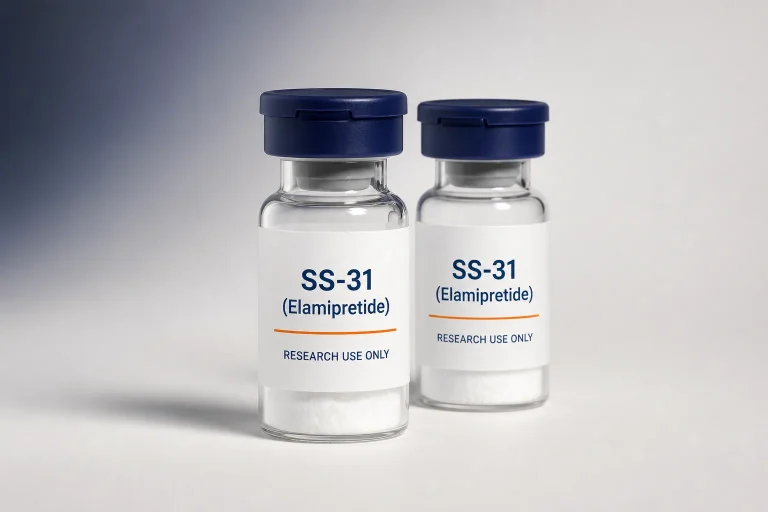 Packaging mockup
Mitochondrial research · Elamipretide / SS-31
SS-31 (Elamipretide)
Scientific Product Dossier
Packaging mockup
Mitochondrial research · Elamipretide / SS-31
SS-31 (Elamipretide)
Scientific Product Dossier
 Packaging mockup
Longevity & Bioregulators · Source-reviewed dossier
Thymalin
Source-Reviewed Research Dossier
Packaging mockup
Longevity & Bioregulators · Source-reviewed dossier
Thymalin
Source-Reviewed Research Dossier
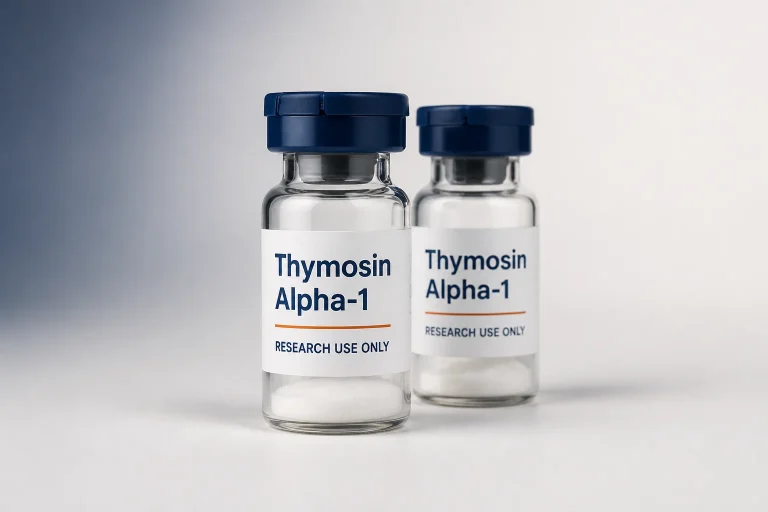 Packaging mockup
Longevity & Bioregulators · Source-reviewed dossier
Thymosin Alpha-1
Source-Reviewed Research Dossier
Packaging mockup
Longevity & Bioregulators · Source-reviewed dossier
Thymosin Alpha-1
Source-Reviewed Research Dossier
Category knowledge center
How to evaluate this research category
This hub separates molecular identity, study design and lot documentation so related families can be explored without turning unlike evidence into a single claim.
- 8
- canonical families
- 14
- catalog variants
- 8
- reviewed dossiers
- 16
- linked source records
What this category includes
- Mitochondrial and cellular-stress research peptides
- Short bioregulator and tissue-derived peptide families
- Experimental senescence, lifespan or function models
- Identity, analytical and evidence-boundary documentation
Identity and interpretation checks
- A biomarker change is not proof of longer life or improved clinical function.
- Mitochondrial mechanism claims must stay attached to the studied model and intervention.
- Names derived from tissue sources may not define one reproducible molecular entity.
Endpoint precision
Lifespan, healthspan, biomarker change, mitochondrial function and stress resistance are not interchangeable outcomes.
Translation level
Separate cell, invertebrate, rodent and human observations and preserve the limits of each model.
Material provenance
For bioregulators, confirm sequence, composition and source instead of relying on a broad tissue or organ label.
Continue the research
Comparisons and editorial analysis
Use fixed, reviewed comparison pages for defined questions and articles for deeper source context. Product dossiers remain the source for catalog identity and variants.
Thymosin Alpha-1 in Sepsis: The 2025 TESTS Phase 3 Result
The 2025 TESTS trial is more informative than earlier small sepsis reports: 1,106 adults were randomized across 22 centers, and thymosin alpha-1 did not…
Read analysis →Thymalfasin Identity: Thymosin Alpha-1 Sequence and Acetylation
Thymalfasin is synthetic thymosin alpha-1: a defined 28-amino-acid peptide with an N-terminal acetyl group. Sequence and acetylation are part of identity, not optional catalog…
Read analysis →Elamipretide in Barth Syndrome: What the 12-Patient Trial and FDA Record Show
Elamipretide now has an FDA-approved finished product for a narrow Barth syndrome indication, but the approval rests on an unusual rare-disease dataset. The randomized…
Read analysis →SS-31, Elamipretide and Forzinity: Why the Finished-Drug Distinction Matters
SS-31 and elamipretide are names used around the same mitochondrial-targeted peptide, but Forzinity is a specific FDA-approved finished drug with an approved application, formulation,…
Read analysis →NAD+ Homeostasis Evidence Map: From Cell Biology to Human Claims
NAD+ is both a redox cofactor and a consumed substrate for signaling enzymes. That broad biology is well established, but it does not make…
Read analysis →NAD+ vs NADH: Identity, Measurement and Stability Guide
The plus sign is not decorative: NAD+ is the oxidized form and NADH is the reduced form. Their formulas, spectra, redox behavior and assay…
Read analysis →Category questions
Evidence and identity FAQ
These answers define how the category is organized. They do not replace the product specification, lot documents or the cited study record.
What does “longevity evidence” mean on this site?
It means evidence attached to a stated aging-related model or endpoint, not a general claim that a product extends human life.
Why is material identity especially important for bioregulators?
Broad source-based names can cover different sequences or mixtures; reproducibility requires a defined composition and specification.
Are mitochondrial findings automatically clinical?
No. Cell or animal mitochondrial outcomes require separate human studies and clinically meaningful endpoints.