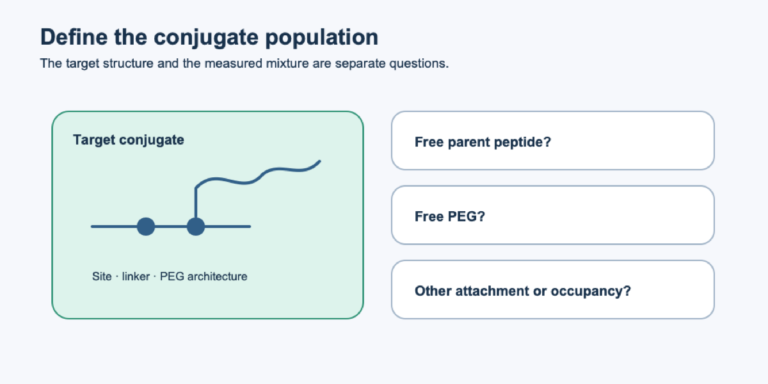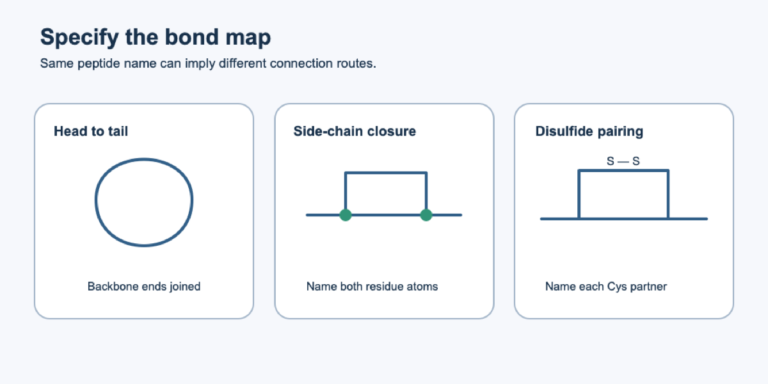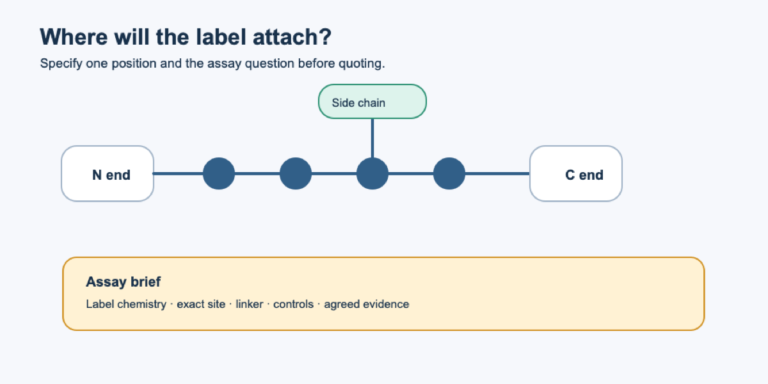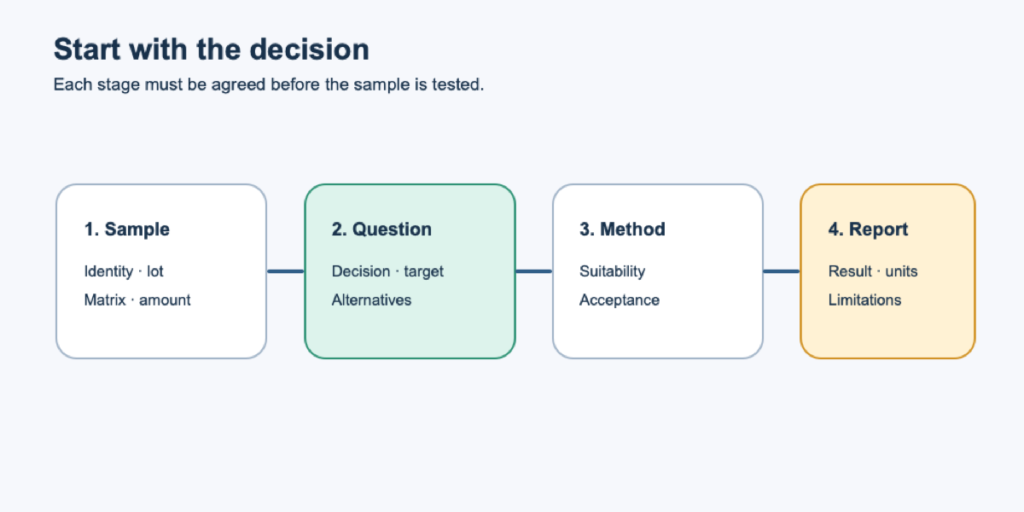
An analytical testing request should tell the laboratory what decision the result must support. “Test this peptide” leaves the identity of the sample, the matrix, the intended measurement and the acceptable report open. Even “HPLC and MS” names techniques without saying whether the buyer needs identity confirmation, a chromatographic comparison, a concentration value or evidence about a particular structural feature. NHD’s analytical and QC testing page asks for method, sample, matrix, acceptance criteria and report scope before work begins; external samples and method suitability are reviewed before acceptance.
Work backward from the receiving decision. If the team wants to compare two research lots, specify the lot identifiers, the quantity submitted and the difference that would change the team’s choice. If a stock concentration calculation is the goal, define the basis of concentration and reference material. If a modified peptide must be distinguished from its parent, name the alternative species that matters. A method may be able to answer one of these questions but not all. The proposed work order should record the question in ordinary language first, then the chosen technique.
Fillable analytical work order
| Field | Buyer entry | Why the laboratory needs it |
|---|---|---|
| Material identity | Name, exact sequence or structure, modifications, lot, source and available prior records | Prevents testing the wrong target or interpreting an unknown structure. |
| Sample state | Mass or volume available, container, solvent, concentration if known, storage and shipment history | Determines whether a method is feasible for the submitted material. |
| Matrix | Neat peptide, buffer, formulation, biological matrix or another specified environment | Interference and preparation depend on what surrounds the analyte. |
| Primary question | Identity, relative chromatographic profile, amount/content, site/linkage, or another defined question | Keeps the method tied to a decision. |
| Target and alternatives | Expected analyte and relevant parent, free label, related peptide or other species | Makes specificity and interpretation reviewable. |
| Acceptance | Decision limit or comparison rule, who set it and its rationale | Avoids inventing a pass/fail rule after results are seen. |
| Deliverable | Results, units, method summary, representative data, calculations and limitations required | Defines what the receiving scientist can audit. |
Write “to be proposed” when the buyer lacks a suitable method or limit. An ungrounded number can turn a useful exploratory result into an arbitrary acceptance failure. The laboratory should be able to explain whether the proposed result is qualitative, relative or quantitative. A quantitative result needs an appropriate reference and value-assignment basis; NHD says such requirements and traceability are reviewed per project.
Agree on suitability before submitting scarce material
Ask what sample amount is needed, whether the matrix requires preparation, what controls or reference materials are required, and whether the target can be distinguished from the named alternatives. Confirm what happens if the first proposed method cannot answer the question: will the team receive a limitation statement, a revised proposal or an agreed stop point? Set the same expectations for remaining sample and data retention in the written scope where those details matter to the project. Do not infer that a listed analytical technique is automatically suitable for every modified peptide or formulation.
The official ICH Q2(R2) guideline describes analytical-procedure validation concepts such as specificity, accuracy and precision in a pharmaceutical quality context. Those concepts can sharpen questions about method fitness, but this article does not impose that regulatory framework on every research sample or claim that NHD offers a validated or accredited method. If regulated evidence is required, name the regulatory purpose and request written confirmation of what can be supported.
Report review: a buyer’s acceptance table
| Report element | Review question |
|---|---|
| Sample traceability | Does the report identify the exact submitted lot and condition? |
| Method identification | Does it say which method and preparation produced each result? |
| Result and units | Is the value or observation interpretable for the intended decision? |
| Acceptance decision | Does the conclusion use criteria agreed before testing? |
| Supporting evidence | Are the agreed chromatograms, spectra, calculations or reference details present? |
| Limitations | Are unresolved peaks, interferences or method constraints stated plainly? |
For example, a buyer may ask: “Can this submitted research lot be used for a concentration-sensitive assay?” That question requires more than a vial weight. The request should define the intended calculation, matrix and needed content basis. NHD’s analytical page warns that gross vial mass can include peptide, water, counterions, salts and other components; a fit-for-purpose content method and interpretation must be agreed. This is a scope question for the laboratory, not permission to substitute an assumed catalog-wide content factor.
Send an actionable request
We request feasibility review for analytical testing of [exact material and lot], supplied in [matrix and container] at [available quantity]. Our decision is [specific research decision]. Please propose a method that addresses [target and named alternatives], required sample/reference materials, results and units, acceptance criteria or a process to agree them, report contents and limitations. Confirm whether this external sample can be accepted and whether the proposed evidence is qualitative, relative or quantitative. Research use only.
Submit the request through NHD’s quote form and reference the analytical and QC testing service. The form requires a product-and-quantity entry even for a service: identify it as an analytical testing request with the sample amount there, then put the work-order details in the optional free-text field or an agreed business channel. The form does not promise file upload. Scope and deliverables should be accepted in writing before material is sent. Research products and services are for research use, not human or veterinary use.
Sources and scope
- NHD analytical and QC testing states its sample, method, matrix, acceptance and report review approach; external-sample acceptance is conditional.
- ICH Q2(R2) addresses pharmaceutical analytical-procedure validation. Its concepts inform questions here; they do not make every research-peptide test regulated or establish NHD accreditation or validation.
- The work order and report review table are editorial procurement tools. They set no universal acceptance limit.
Sources & editorial method
AI-assisted source-reviewed editorial; published after user confirmation. Human technical review not recorded.
2 linked records are listed in the references below. Read the editorial and AI-assistance policy.
How to interpret this article
This article summarizes third-party records and does not establish the identity, quality, safety or efficacy of any catalog lot.
Research-use boundary: Catalog materials discussed on this website are for laboratory research, development and manufacturing use only, not for human or veterinary use. This content is not medical advice and does not provide administration instructions.
Primary records and authoritative sources
- NHD analytical and QC testingSource 1. [NHD analytical and QC testing](https://nhdbio.com/services/analytical-qc-testing/) states its sample, method, matrix, acceptance and report review approach; external-sample acceptance is conditional.
- ICH Q2(R2)Source 2. [ICH Q2(R2)](https://database.ich.org/sites/default/files/ICH_Q2R2_Guideline_2023_1130_ErrorCorrection_2025.pdf) addresses pharmaceutical analytical-procedure validation. Its concepts inform questions here; they do