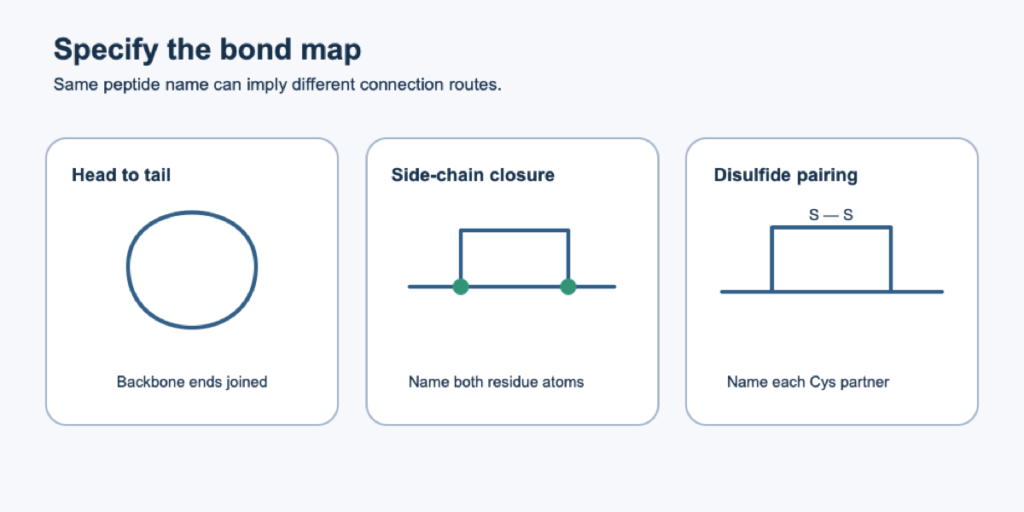
“Cyclic peptide” describes a family of structures, not a complete order. A backbone closed head to tail, a side-chain-to-side-chain link, and a disulfide between selected cysteines are different connection maps. Even within disulfide products, a sequence with several cysteines can permit different pairings. A procurement file must identify the intended bonds, as well as the sequence. NHD’s custom synthesis page states that cyclization route and disulfide connectivity need project-specific confirmation.
The buyer’s first task is to draw or tabulate the molecule. Write the linear N-to-C sequence, number every residue, state which termini remain free or blocked, then list each bond that turns that sequence into the target product. If the design comes from a publication or an internal structure record, attach the exact reference and verify that residue numbering aligns with the sequence being quoted. Do not assume that a sequence name, an acronym or a molecular weight communicates the topology.
A connectivity sheet for the order
| Required field | Example of the information to provide | Acceptance question |
|---|---|---|
| Linear sequence | N-to-C residues with modifications and stereochemistry | Does the supplier’s drawing match the intended residue order? |
| Terminal state | Free, amidated, acetylated or involved in a closure, as applicable | Is a terminal group still available after cyclization? |
| Closure type | Head-to-tail backbone, side-chain-to-side-chain, side-chain-to-terminus, or disulfide | Which atoms form the new bond? |
| Bond endpoints | Residue numbers and functional groups for every new bond | Can an alternative topology be mistaken for the target? |
| Disulfide pairing | Each Cys position paired with its intended partner | Is the pairing explicit when multiple cysteines exist? |
| Analytical purpose | Confirm composition, confirm connectivity, or both | What level of evidence is actually needed? |
| Documentation | Structure drawing, methods, results and any limits | Can the receiving scientist review the evidence? |
This table is an instruction sheet, not a promise that every topology is feasible. NHD reviews difficult sequences and constrained structures before acceptance. A quote should explicitly identify an alternative synthetic route or analytical compromise if the submitted structure cannot be accepted as written.
Match the evidence to the structural claim
An intact-mass result can support molecular composition, but mass alone does not specify which cysteine is connected to which in a same-composition pairing isomer. A chromatographic result can show separation under the stated conditions, but it does not automatically name the bond pattern. If pairing is decision-critical, ask which connectivity-directed evidence is appropriate: for example, fragmentation of a disulfide-intact analyte or a mapped product after an agreed preparation. A primary mass spectrometry study demonstrates direct fragmentation strategies for assigning disulfide connections in its studied peptides and proteins. The paper is evidence that such structural questions can be investigated, not a guarantee of one universal method or an NHD standard deliverable.
| Claim on the release document | Evidence to discuss before ordering | What remains open |
|---|---|---|
| Expected composition | Suitable mass assessment of the requested molecule | Positional connectivity may still be unresolved. |
| Target-rich chromatographic profile | Named chromatographic method and interpretation | Coelution and structural assignment may need other evidence. |
| Specified disulfide pairing | A fit-for-purpose linkage-mapping strategy with interpretable data | Feasibility depends on sequence, pairing and method. |
| Agreed topology accepted | Drawing, bond list, analytical results and stated limitations reviewed together | The buyer should approve any unresolved structural ambiguity. |
The required proof level depends on the experiment. A screening assay may accept one level of characterization, while a structure–activity comparison may require more direct evidence of the linkage pattern. Specify that level before pricing. Otherwise two quotes might appear to offer the same peptide while funding different analytical packages.
Worked request pattern
Please evaluate synthesis of the attached peptide drawing. The attached N-to-C sequence includes residue numbering and all terminal groups. The requested closure is [bond type] between [atom/group at residue X] and [atom/group at residue Y]. The intended disulfide pairings, if any, are [Cys position ↔ Cys position]. Please confirm the product structure used for the quote and identify any competing connectivity concern. Quote the requested quantity and an analytical package that supports [composition only / specified connectivity], listing methods, acceptance limits and report content. State any structure or evidence limitation before order acceptance. Research use only.
If the molecule is called a “cyclic disulfide peptide,” specify whether the disulfide is the sole closure or one of several closures. If there are multiple disulfides, ask whether the proposed analytical data can resolve the exact pairing. Do not let a generic “MS confirmed” line silently substitute for a topology-specific requirement.
The final receiving check compares three representations: buyer drawing, accepted quote and final structure/report. Any changed bond endpoint is a changed product. Any reduced analytical scope is a changed evidentiary basis. Capture both changes in writing before purchase order approval.
Submit the structure sheet through NHD’s quote form with the custom peptide synthesis service as the scope reference. NHD evaluates feasibility and documents per project. Research products and services are for research use, not human or veterinary use.
Sources and scope
- NHD custom peptide synthesis says cyclization route and disulfide pairing are confirmed per project.
- Bhattacharyya et al. is primary evidence for a disulfide-connectivity MS strategy in the studied peptides and proteins; it is an example method, not an NHD deliverable or universal proof.
- The connectivity sheet and evidence ladder are editorial tools. No universal purity or yield threshold is inferred.
Sources & editorial method
AI-assisted source-reviewed editorial; published after user confirmation. Human technical review not recorded.
2 linked records are listed in the references below. Read the editorial and AI-assistance policy.
How to interpret this article
This article summarizes third-party records and does not establish the identity, quality, safety or efficacy of any catalog lot.
Research-use boundary: Catalog materials discussed on this website are for laboratory research, development and manufacturing use only, not for human or veterinary use. This content is not medical advice and does not provide administration instructions.
Primary records and authoritative sources
- NHD custom peptide synthesisSource 1. [NHD custom peptide synthesis](https://nhdbio.com/services/custom-peptide-synthesis/) says cyclization route and disulfide pairing are confirmed per project.
- Bhattacharyya et al.Source 2. [Bhattacharyya et al.](https://pubmed.ncbi.nlm.nih.gov/23467691/) is primary evidence for a disulfide-connectivity MS strategy in the studied peptides and proteins; it is an example method, not an NHD deliverable or univ