


Understand the study
BPC-157 and TB-500: Did the Combination Help Rat Tendons More?
A small rat study shows why “combined” does not automatically mean “better.”
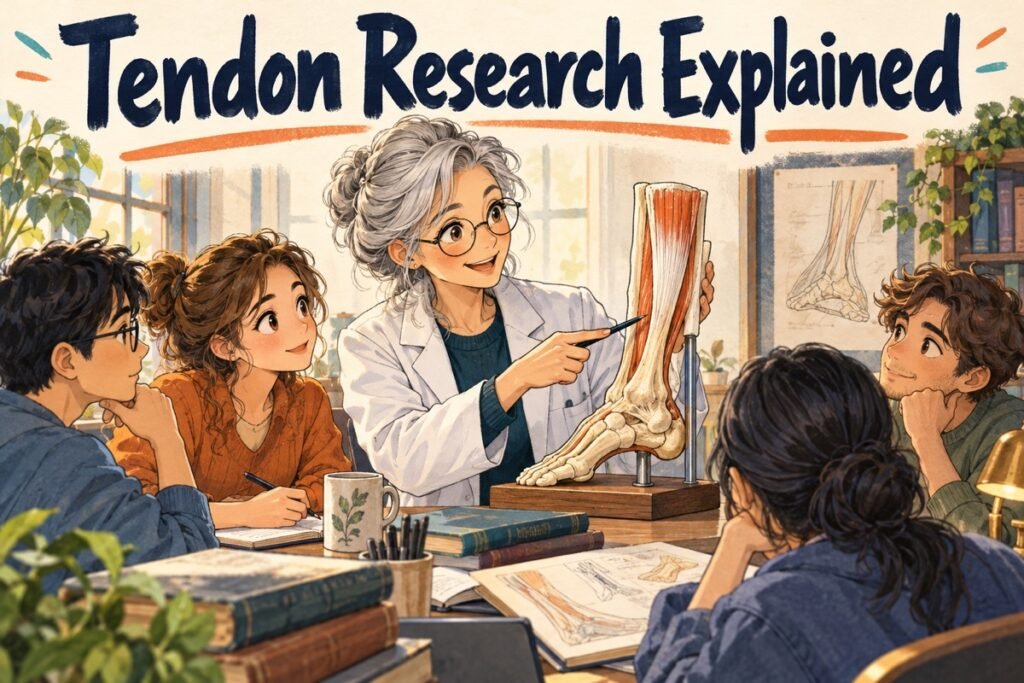
What was the experiment about?
The researchers used a rat Achilles tendon injury-and-repair model. The Achilles tendon is the strong tissue connecting calf muscle to the heel. Testing repaired tendons can reveal how tissue behaves during healing. It is different from following people returning to work or sport after an injury.
Why four groups?
The 32 rats were divided among control, BPC-157, TB-500 and combination groups, eight in each. This lets researchers compare each single agent with control and examine whether combining them adds anything. At assessment, only four tendons per group went to mechanical testing and four to tissue analysis. [1]
- 01Control
- 02BPC-157 / TB-500
- 03Combination comparison
What does a pulling test tell us?
A maximum-load-to-failure test measures how much pulling force the tissue tolerates before failing. It addresses mechanical strength under that test. Both single-agent groups had higher measured values than control, but only TB-500 reached statistical significance for this outcome. A higher observed average and a statistically supported difference are not identical statements. [1]
Why can tissue scores look different?
Tissue scoring asks how the repaired structure looks under a microscope. It can examine organization rather than pulling strength. The study’s Bonar and Movin scores did not yield identical group comparisons. Think of judging a repaired rope by its fiber arrangement and separately by how much weight it holds: the two tests supply different information.
Was the combination better?
The paper did not find additional benefit from combining BPC-157 and TB-500 over the individual agents. Calling this study proof of synergy would reverse its conclusion. The small sample and one model also limit certainty. It cannot establish how an injury in a person would respond. [1]
Why identify each material separately?
Separate product links help readers distinguish the materials before requesting a blend or designing a comparison. The paper’s TB-500 naming should be checked against its actual tested material, including sequence and form. Neither an NHD single-agent material nor a blend was validated by this experiment.
Explore the research topic
Related research products
BPC-157
Tissue-repair research
View product
TB-500 (Thymosin β4 Acetate)
Tissue-repair research
View product
GHK-Cu
Tissue-repair research
View productImages illustrate the catalog. Related products are further reading, not claims of equal effects or interchangeability.
Original research and reading notes
Study amounts and preparations identify experimental conditions, not recommended use. AI-assisted research explanation; sources checked 11 October 2026. NHD catalog materials are for research, development and manufacturing, not human or veterinary use.