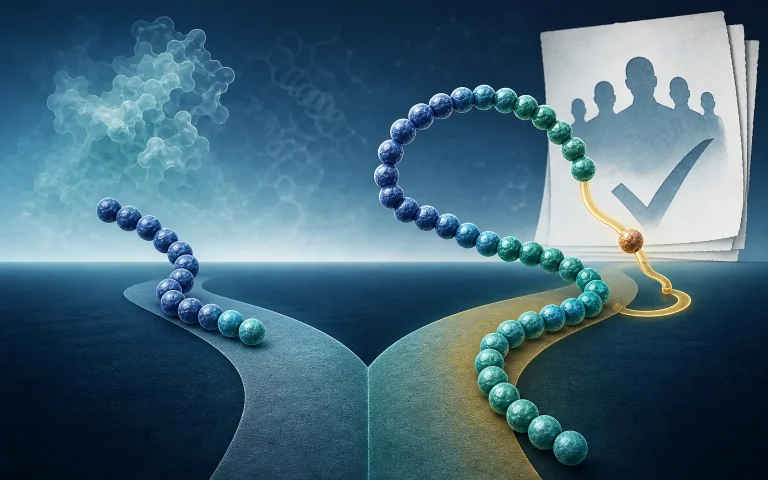
The phrase “without DAC” tells the reader what is absent, but it may not fully tell them what is present. Reproducible research requires an explicit sequence and terminal-modification record.
What the record shows
- State the complete sequence and terminal form.
- Do not use DAC pharmacokinetics or albumin-binding descriptions.
- Match molecular mass and assay calculations to the actual form.

The identity and evidence boundary
If “modified GRF 1-29” is used as a synonym, define which substitutions and amidation state are meant. Different analogs were specifically designed to change stability and activity.
What belongs in the material record
Keep the family page separate from CJC-1295 with DAC and link between them with a comparison explaining the distinction. This prevents duplicate copy while satisfying the user’s actual search intent.
Editorial rule
Use the exact intervention name, model, population and endpoint from the cited record. Do not convert an association, mechanism, animal result, approved finished-drug record or analytical test into a claim about an unrelated catalog lot.
Identity correction (reviewed 2026-08-28): “CJC-1295 without DAC” is a commercial naming convention, not proof of one exact sequence, counterion or terminal form. The classic DAC pharmacokinetic record cannot be transferred, and a current specification plus lot-specific analytical record is required before assigning molecular identity.
Sources & editorial method
The editorial workflow starts with linked peer-reviewed papers, trial registries or regulatory records; extracts the population or model, endpoints, numerical results and limitations; and separates the studied intervention from catalog material. AI-assisted drafting was used to structure the first version. Claims, figures, evidence labels and limitations were checked against the linked records in the site editorial workflow. This is not independent peer review.
5 linked records are listed in the references below. Read the editorial and AI-assistance policy.
How to interpret this article
Source-checked on 2026-08-28. Null findings and study limitations are retained. This is not independent peer review, medical advice, a customer case, or validation of a catalog lot.
Research-use boundary: Catalog materials discussed on this website are for laboratory research, development and manufacturing use only, not for human or veterinary use. This content is not medical advice and does not provide administration instructions.
Primary records and authoritative sources
- GRF1-29 compared with longer human GRF fragmentsLosa M, et al. Klin Wochenschr. 1984. PMID 6240568.
- Potent long-acting GRF analoguesRivier J, et al. Ann N Y Acad Sci. 1988. PMID 3133968.
- Prolonged stimulation of GH and IGF-I secretion by CJC-1295Teichman SL, et al. J Clin Endocrinol Metab. 2006. PMID 16352683.
- ICH Q2(R2): Validation of Analytical ProceduresOfficial analytical-validation framework; not evidence that a specific catalog lot has been tested.
- ICH Q14: Analytical Procedure DevelopmentOfficial analytical-development framework; included as general method guidance only.
Continue with structured records
Move from this editorial analysis to the product identity, filtered evidence and controlled terminology behind it.