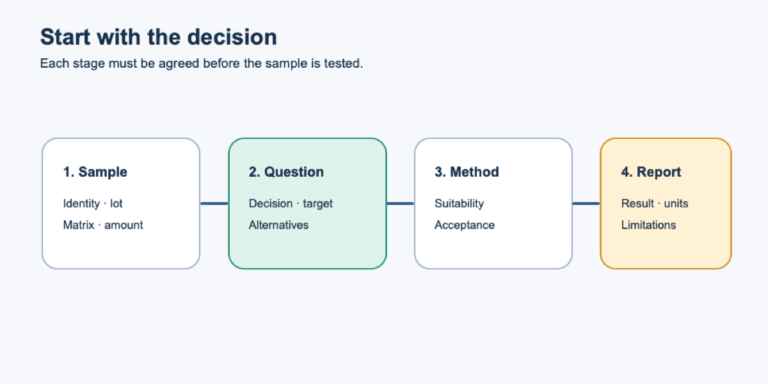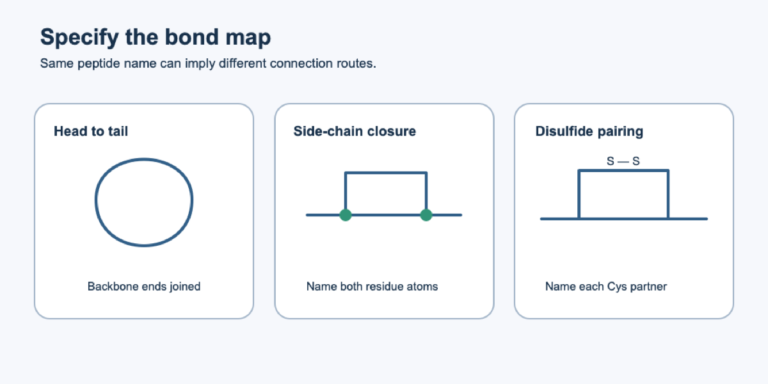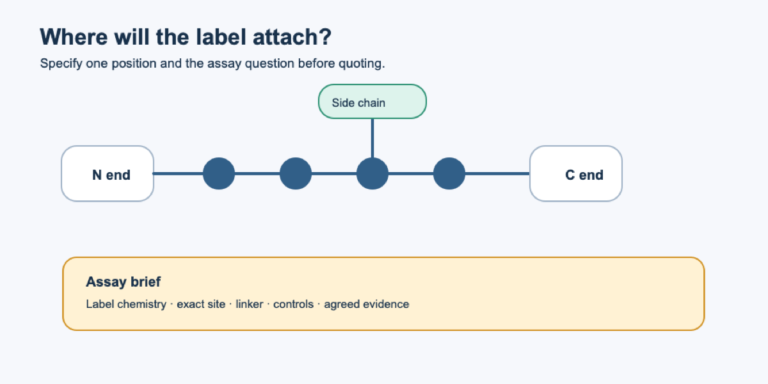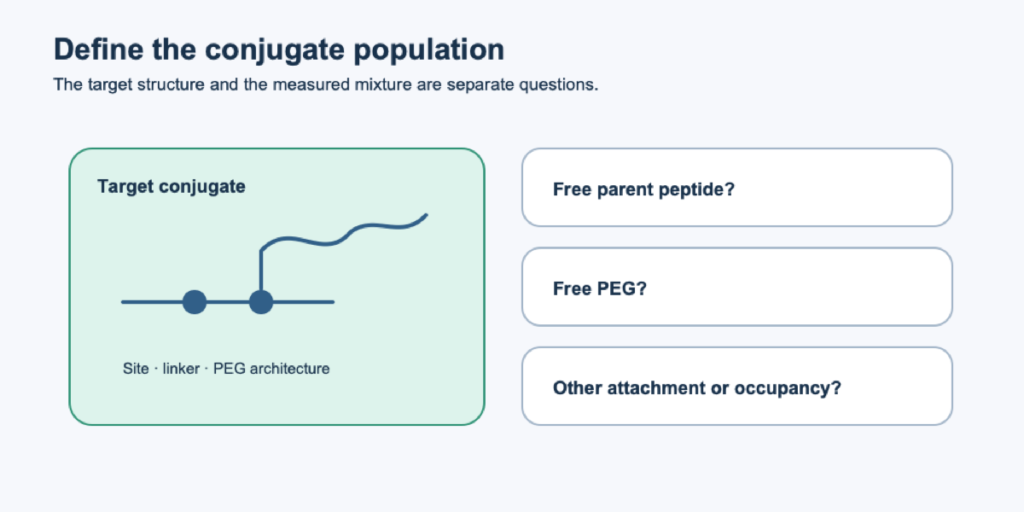
“PEGylated peptide” leaves several purchase decisions open. A buyer needs to define the peptide sequence and termini, the PEG reagent and architecture, the intended attachment atom, and how many PEG chains are desired per peptide. The request must also say what analytical distinction matters: the target conjugate versus unconjugated peptide, free PEG, alternate attachment sites or multiply modified material. NHD lists PEGylation among modified-peptide enquiries on its custom peptide synthesis page, with feasibility and documentation to be confirmed for the specific project.
Do not treat a nominal PEG size as a complete chemical identity. State whether the reagent is linear or branched, its end groups and reactive chemistry, the intended molecular-weight description and whether a defined or distributed chain-length material is required. Ask the supplier to state how the PEG reagent is identified in the quote. A 2024 primary study found that a defined-molecular-weight PEG improved site mapping in a PEGylated protein model compared with a disperse reagent. That experiment used bovine serum albumin; it supports an analytical caution about dispersity, not a performance claim for PEGylated peptides or an NHD specification.
Structure-to-analysis order sheet
| Design element | Buyer specification | Analytical or documentary question |
|---|---|---|
| Peptide | Exact N-to-C sequence, stereochemistry, terminal groups and any other modifications | Which species is the unmodified reference? |
| PEG reagent | Architecture, end groups, nominal or exact mass description and supplier-grade requirement if material | What distribution or defined composition is expected? |
| Linkage | Target residue/atom or terminus, linker identity and stable bond description | How will the attachment site be supported? |
| Occupancy | One PEG per peptide or another explicitly described target | How will non-target occupancy be reported? |
| Product population | Target conjugate and relevant alternatives to distinguish | Can free peptide, free PEG and alternate conjugates be assessed with proposed methods? |
| Delivery | Requested amount, aliquots, form and handling constraints | Does the delivered form preserve the intended research calculation? |
| Report | Named methods, units, acceptance criteria and limitations | Does the report support the actual receiving decision? |
A peptide-specific illustration is useful here: in one PEG–growth hormone-releasing factor (1–29) study, researchers separated the unmodified peptide and seven different PEG-conjugate isomers by reversed-phase HPLC, then identified attachment sites using Lys-C fragments and MALDI-TOF mass spectrometry. Seven is a result for that studied system, not a default count for PEGylated peptides or an NHD process.
This sheet separates molecular identity from sample composition. An assay may be sensitive to unconjugated peptide even if it tolerates a PEG chain-length distribution; another study may need narrow site assignment for structure–activity comparison. Those are different analytical purchases. A published PEGylated dual-acting peptide study describes a particular peptide process with purification and analysis. It is an example of project-specific method development, not a general yield, purity, process or clinical claim that can be copied into an RFQ.
Decide which heterogeneity matters
Before requesting an acceptance limit, write down the reason for it. If the experiment compares a PEG conjugate with a parent peptide, the presence of free parent could bias interpretation. If the experiment compares attachment positions, positional isomers matter. If the experiment requires an amount in moles of conjugate, the basis of the mass and concentration calculation matters. Ask the analyst which methods can distinguish the relevant populations and how results will be expressed. Avoid assuming that a single chromatographic percentage, a mass spectrum or a PEG vendor’s nominal molecular weight answers all three questions.
The quote may need to distinguish composition from site assignment. Composition asks how much material appears to be target conjugate under a stated method. Site assignment asks where PEG is attached. The selected method and evidence strength will depend on the actual peptide and PEG chemistry. A site-mapping approach demonstrated for a protein cannot simply be promised for every peptide. If site cannot be directly established by the proposed package, the limitation should be written into the quote so the receiving team can decide whether that evidence is sufficient.
A request the receiving scientist can approve
Please review the attached N-to-C peptide structure and propose a PEGylated conjugate at [named site/atom]. The requested PEG reagent is [architecture, end groups, reactive group and molecular-weight description], with [intended occupancy]. Please state the exact proposed structure, PEG reagent definition and any expected distribution in the quote. We need to distinguish [target conjugate] from [free parent, free PEG, alternate-site or multi-PEG species as applicable]. Propose suitable purification and analytical methods, acceptance criteria, units and report content, and state where site assignment or distribution cannot be resolved. Requested amount and delivery form: [insert]. Research use only.
Keep alternate chemical designs as separate quoted options. A branched PEG, a different attachment position, or a different linker changes the molecular product; a different analytical package changes what the buyer can verify. The purchase order should refer to the accepted structure drawing and analytical schedule, not only to a product nickname.
For review, submit the completed sheet through NHD’s quote form and reference the custom synthesis service. Confirm feasibility, specification and documentation in the written quote. Research products and services are for research use, not human or veterinary use.
Sources and scope
- NHD custom peptide synthesis lists PEGylation as a project enquiry, with no fixed capability or specification implied.
- Youn et al. is the peptide-specific example: seven PEG-GRF(1–29) isomers were separated in that experiment, not a count expected for other peptides.
- Burggraef et al. studied PEGylated bovine serum albumin, a protein; its dispersity and site-mapping finding is only an analytical caution here.
- Tom et al. is one PEGylated peptide process case, not a transferable NHD yield, purity or method specification.
Sources & editorial method
AI-assisted source-reviewed editorial; published after user confirmation. Human technical review not recorded.
4 linked records are listed in the references below. Read the editorial and AI-assistance policy.
How to interpret this article
This article summarizes third-party records and does not establish the identity, quality, safety or efficacy of any catalog lot.
Research-use boundary: Catalog materials discussed on this website are for laboratory research, development and manufacturing use only, not for human or veterinary use. This content is not medical advice and does not provide administration instructions.
Primary records and authoritative sources
- NHD custom peptide synthesisSource 1. [NHD custom peptide synthesis](https://nhdbio.com/services/custom-peptide-synthesis/) lists PEGylation as a project enquiry, with no fixed capability or specification implied.
- Youn et al.Source 2. [Youn et al.](https://pubmed.ncbi.nlm.nih.gov/15633743/) is the peptide-specific example: seven PEG-GRF(1–29) isomers were separated in that experiment, not a count expected for other peptides.
- Burggraef et al.Source 3. [Burggraef et al.](https://pubmed.ncbi.nlm.nih.gov/39537591/) studied PEGylated bovine serum albumin, a protein; its dispersity and site-mapping finding is only an analytical caution here.
- Tom et al.Source 4. [Tom et al.](https://pubmed.ncbi.nlm.nih.gov/17907763/) is one PEGylated peptide process case, not a transferable NHD yield, purity or method specification.