A one-letter sequence does not fully specify a peptide that contains D-amino acids. It usually omits the stereochemistry of each residue and can hide a second error: confusing a same-order all-D peptide with a retro-inverso analogue. In the conventional description, a retro-inverso peptide contains D residues in the reverse order of a parent L sequence. That definition is stated in a published research account and is the starting point for procurement, not a claim that the analogue will behave like the parent.
For ordering, write every peptide from N terminus to C terminus and label each chiral position. Treat the parent, a partially D-substituted version, an all-D version in the same order, and a retro-inverso version as distinct molecules. If a residue is achiral, such as glycine, record that explicitly rather than marking it D or L. Then state terminal groups, labels, linkers, cyclization and salts separately. A supplier cannot safely infer all of those from “D version” or “RI version.” NHD’s custom synthesis service reviews non-natural residues and modifications by project.
The order sheet that prevents direction errors
The symbolic example below is an editorial teaching example only; it is not a research product or biological sequence.
| Requested construct, written N → C | Position 1 | Position 2 | Position 3 | What changed from parent? |
|---|---|---|---|---|
| Parent L sequence | L-Ala | L-Lys | Gly (achiral) | Reference order and chirality. |
| Same-order D analogue | D-Ala | D-Lys | Gly (achiral) | Chiral residues inverted; order retained. |
| Retro-inverso analogue | Gly (achiral) | D-Lys | D-Ala | Order reversed and chiral residues inverted. |
The example is intentionally small so the transformation is visible. In a real order, include every residue and position, including noncanonical residues with a full name or structural identifier. An instrument file or a paper may number the parent in the opposite orientation from the final synthesis instruction; verify numbering against the printed N-to-C line. A “reverse” peptide composed of L residues is not the same order line as the D retro-inverso product.
Terminal chemistry is a separate decision
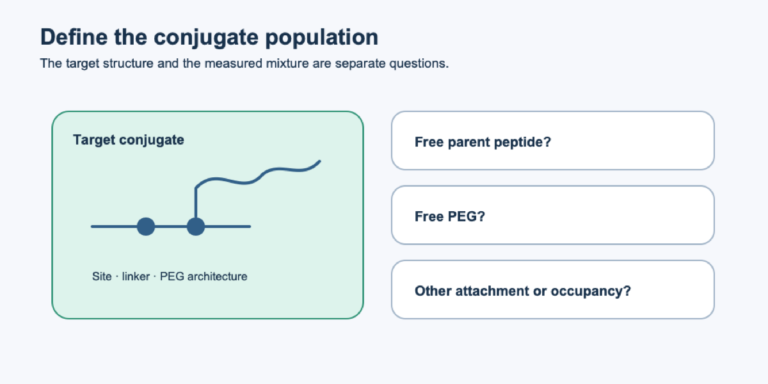
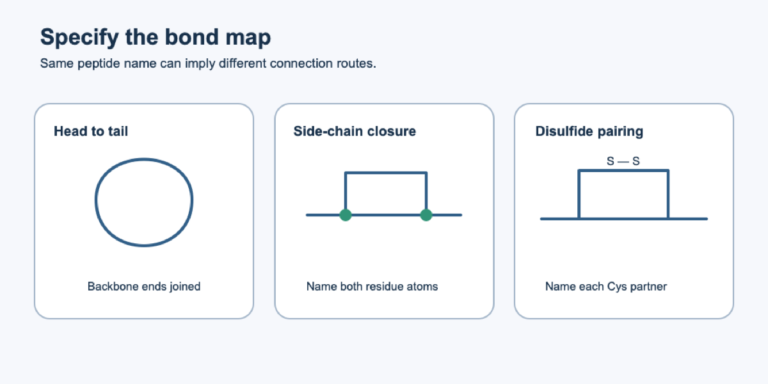
Reversing the order changes which residue sits at each end, but it does not automatically decide whether an end is free, amidated, acetylated or linked to a reporter. Copying a parent peptide’s shorthand terminal decoration onto a retro-inverso line may therefore produce a different design from the one intended. If the analogue is meant to present a particular terminal group or epitope orientation, draw the complete structure or annotate both ends. If the parent is cyclic, define its closure endpoints anew for the analogue; do not assume the word “retro-inverso” uniquely specifies the cyclic topology.
The buyer should also decide whether a stereochemical claim needs direct verification beyond a sequence identity report. Ordinary composition and mass evidence cannot by themselves establish the D/L identity of every residue, because enantiomeric substitutions can leave mass unchanged. Ask the supplier which evidence can support the intended chirality at the required level for the experiment, and include that method and its limits in the quote. A case that compares activity of several stereochemical variants may warrant a different evidence package from a simple exploratory screen.
Why the analogue must be tested as its own molecule
Retro-inverso design can produce a similar side-chain presentation in some extended conformations, but reversing backbone direction and chirality changes the peptide-bond geometry. A primary structural and binding study found that retro-inverso analogues in its helical peptide systems did not reproduce the parent peptides’ protein-binding behavior. That finding is a caution against assuming equivalence; it does not predict the outcome for every sequence or assay. Accordingly, the order should request the actual analogue and relevant comparison controls rather than attach a claimed potency or stability benefit.
Before sending a purchase order
| Review point | Buyer acceptance test |
|---|---|
| Sequence direction | Each product is printed N → C, with separate lines for parent and analogues. |
| Residue identity | Every nonstandard residue has an unambiguous name or structure. |
| Stereochemistry | D/L or achiral status is marked at each position, not implied by a product title. |
| Termini and extra changes | End groups, labels, linkers and closures are separately annotated. |
| Comparison plan | Parent/control products are separately identified and priced, if requested. |
| Evidence | The accepted analytical package states what it can and cannot verify. |
Send the position sheet and, where relevant, a structure drawing through NHD’s quote form. Request explicit confirmation of the N-to-C line and the chirality annotations in the written custom synthesis quote. Research products and services are for research use, not human or veterinary use.
Sources and scope
- Muller et al. supplies the conventional retro-inverso definition; its immunology case does not predict this buyer’s assay.
- Li et al. is a primary structural and binding study of particular helical systems; its limitation warns against assuming equivalence, rather than proving all retro-inverso peptides fail.
- NHD custom peptide synthesis treats non-natural residues as project-review subjects. The three-residue order sheet is an invented teaching notation, with no activity claim.
Sources & editorial method
AI-assisted source-reviewed editorial; published after user confirmation. Human technical review not recorded.
3 linked records are listed in the references below. Read the editorial and AI-assistance policy.
How to interpret this article
This article summarizes third-party records and does not establish the identity, quality, safety or efficacy of any catalog lot.
Research-use boundary: Catalog materials discussed on this website are for laboratory research, development and manufacturing use only, not for human or veterinary use. This content is not medical advice and does not provide administration instructions.
Primary records and authoritative sources
- Muller et al.Source 1. [Muller et al.](https://pubmed.ncbi.nlm.nih.gov/15992041/) supplies the conventional retro-inverso definition; its immunology case does not predict this buyer's assay.
- Li et al.Source 2. [Li et al.](https://pmc.ncbi.nlm.nih.gov/articles/PMC2885236/) is a primary structural and binding study of particular helical systems; its limitation warns against assuming equivalence, rather than proving all retro-inv
- NHD custom peptide synthesisSource 3. [NHD custom peptide synthesis](https://nhdbio.com/services/custom-peptide-synthesis/) treats non-natural residues as project-review subjects. The three-residue order sheet is an invented teaching notation, with no activi