
KPV is a three-amino-acid peptide. Researchers examined whether a transport pathway called PepT1 helped it enter cells and affect inflammatory signaling. This guide explains what that finding means and how it differs from an effect demonstrated in a whole animal or a person.
A small peptide with a specific research question
KPV is made of lysine, proline and valine. The name uses one letter for each amino acid. Its short length makes it an interesting research object, but size alone does not explain its activity. A substance outside a cell still needs a way to influence processes inside it. For KPV, one published answer involves PepT1, a protein that transports short peptides across a cell membrane.
Think of PepT1 as an entry route
A useful way to picture the experiment is a doorway rather than a switch. The doorway is PepT1; the inflammatory signaling happens inside. This distinction gives researchers two questions to ask: does the peptide enter the cells, and does the chosen inflammatory response change? A result about transport answers the first question. A result about a signaling pathway helps answer the second. They are connected, but they are different measurements.
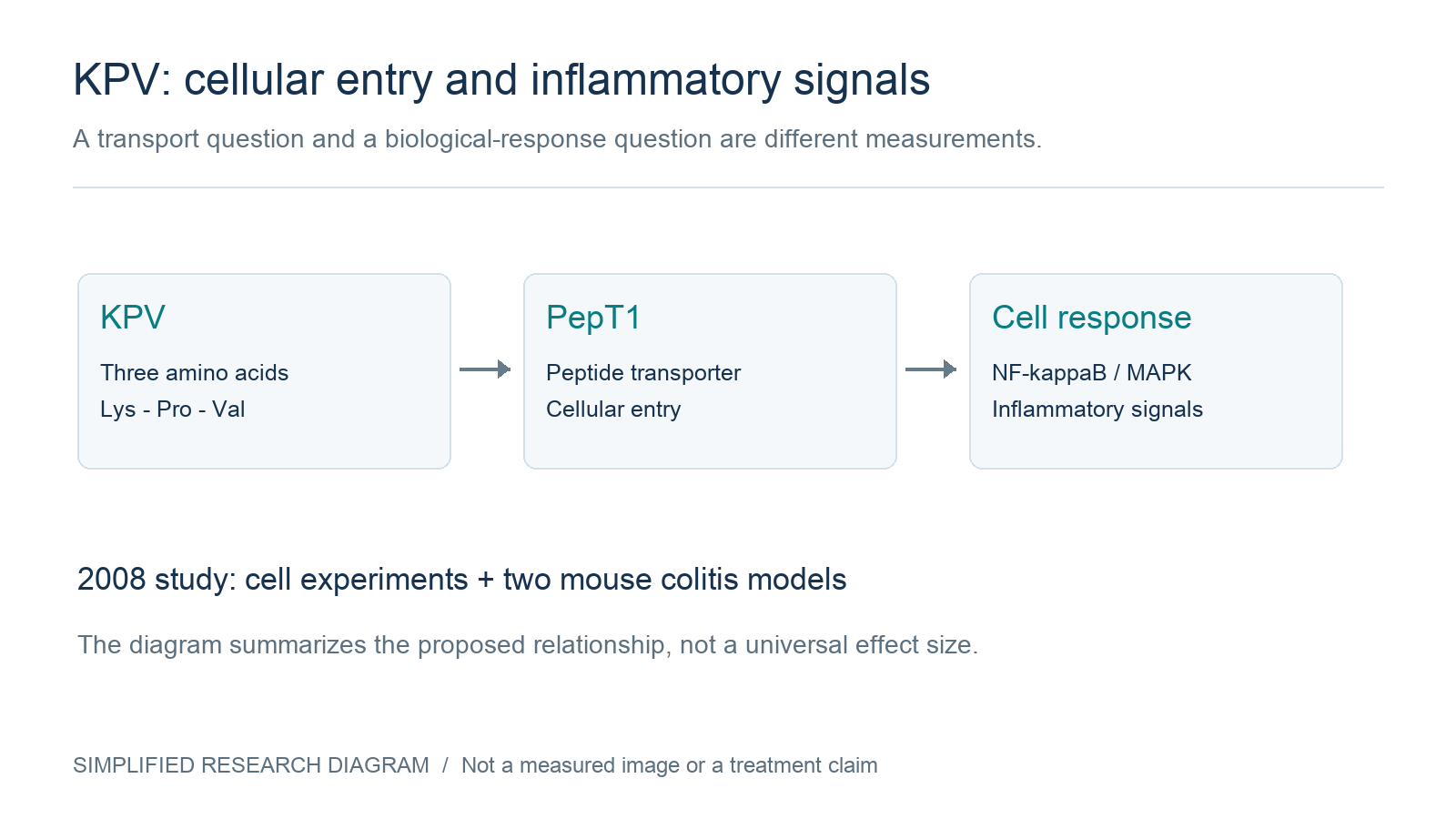
What the 2008 study actually measured
Dalmasso and colleagues tested intestinal epithelial and immune-cell models, then two mouse colitis models: DSS and TNBS. They reported that nanomolar KPV concentrations reduced activation of NF-kappaB and MAP kinase inflammatory pathways in their cell experiments. Their uptake work linked KPV entry to PepT1. In the mice, inflammatory cytokine expression decreased. These are cell and animal findings, not a controlled human treatment result. The accessible abstract does not give a universal percentage reduction to quote. Read the original study.
Why two models are useful
Two models can test whether an observation survives a change in the experimental setup. That is stronger than repeating one condition, but it does not turn a mouse result into a human result. When comparing KPV papers, look for the cell type, the measured inflammatory marker and the delivery method. Otherwise, two headlines that both say “less inflammation” may describe quite different experiments.
Transport and delivery are different layers
A later paper studied KPV carried in nanoparticles inside a hydrogel. That adds another question: can a formulation bring the peptide to the intended location? Our KPV delivery-study explanation covers that separate experiment. The transporter paper asks about cellular entry; the delivery paper asks about a designed carrier system. Neither establishes that any vial labeled KPV reproduces the complete experimental intervention.
What this means when choosing research material
Start with the molecule you need, then the question you want to study. For a transport or inflammation project, describe the required KPV form, quantity and analytical documentation. A catalogue name is a starting point for that conversation. It cannot replace a specific experimental design or confirm the properties of an allocated batch.
Entry into a cell and improvement in disease are different questions
| Check | What it tells you |
|---|---|
| Transport | Did the experiment show entry or dependence on a transport pathway? |
| Cell signaling | Did it measure the selected inflammatory signal? |
| Animal or human outcome | Was an outcome tested beyond the cell model? |
For laboratory procurement, review the related NHD catalog material and confirm the selected variant, amount basis and available records. Send a research enquiry with those requirements; the cited experiment is not a test of an NHD lot.
Explore the related NHD product
See the KPV product record for catalogue information. Send your quantity and document requirements for a quote. Availability and the scope of any lot documents need confirmation.
Original studies
- KPV cellular uptake and two mouse colitis models — original study
- Separate mouse study of KPV anti-inflammatory activity
Sources checked 5 October 2026. This explanation uses the accessible original abstracts and figure descriptions. The diagram is a simplified explanation, not an experimental image. NHD catalogue materials are for qualified laboratory research, development and manufacturing enquiries, not human or veterinary use.
Sources & editorial method
AI-assisted writing; deterministic explanatory diagram.
1 linked records are listed in the references below. Read the editorial and AI-assistance policy.
How to interpret this article
AI-assisted editorial review; not independent human peer review. Experimental endpoints and catalogue material are distinguished.
Research-use boundary: Catalog materials discussed on this website are for laboratory research, development and manufacturing use only, not for human or veterinary use. This content is not medical advice and does not provide administration instructions.
Primary records and authoritative sources
- Primary publication — PubMed 18061177Dalmasso G et al. PepT1-mediated tripeptide KPV uptake reduces intestinal inflammation. Gastroenterology. 2008;134(1):166–178. PMID 18061177.
Continue with structured records
Move from this editorial analysis to the product identity, filtered evidence and controlled terminology behind it.