For research, development and manufacturing use only. Not for human or veterinary use.
Healing & Tissue Repair · Source-reviewed dossier
KPV
Source-Reviewed Research Dossier
KPV is a short three-amino-acid peptide, named for lysine, proline and valine. Research has examined inflammatory signaling in cells and experimental intestinal inflammation in animals. Some studies deliver KPV using a carrier, such as nanoparticles or a hydrogel; that carrier is part of the experiment. This page explains the findings in plain language, separates free-peptide and delivery-system results, and lists the identity and variants relevant to a research quotation.
Research use only Lot documents on request
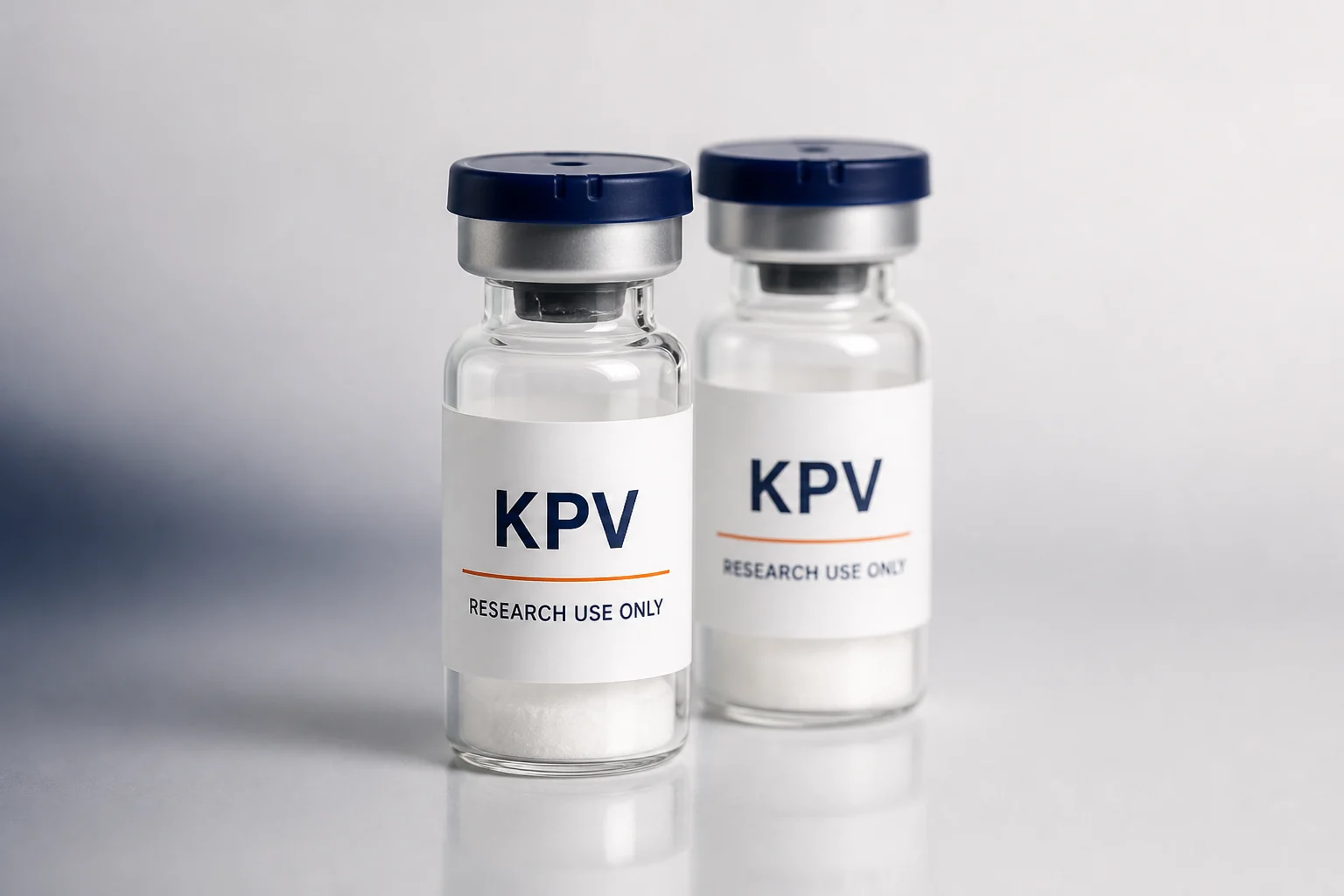
AI-generated packaging mockup for catalog navigation. It is not a photograph of an actual supplied lot; container, label and presentation may vary.
Product family
Compound overview
Shared values below are consolidated from the current catalog record. They are not independent verification or lot results; request the applicable product specification and ask which lot records are available before ordering.
Product identity
Product type
Peptide research compound
Catalog family
KPV
Research category
Healing & Tissue Repair
Catalog CAS RN
67727-97-3
Catalog molecular formula
C16H30N4O4
Catalog molecular weight
342.44 g/mol
Catalog sequence
Lys-Pro-Val
Evidence status
Cell and animal research; no established controlled human efficacy
Cell and animal research; no established controlled human efficacyDo not generalize beyond the cited model
Source review
Primary or authoritative records linked belowChecked 2026-09-01
Identity safeguard Reference identifiers above describe the literature compound record. Confirm the supplied form, formula, molecular weight, purity and storage conditions against the applicable product specification and any available lot records.
Mechanism of action
How KPV is studied
A target-to-pathway view grounded in the linked research records.
Calming inflammation in skin cells
In human skin cells exposed to fine dust, KPV reduced oxidative stress and lowered release of IL-1 beta, an inflammatory messenger. It also limited signs of programmed cell death. These are cell-dish findings. They do not show that KPV protects skin in living animals or people.
Gut inflammation in mice with special delivery
One mouse study gave KPV inside nanoparticles wrapped in a gel designed to release it in the colon. This system reduced gut inflammation in mice with experimental colitis. The benefit belongs to the nanoparticle-gel plus KPV, not to KPV alone. The result is from mice and does not apply to humans.
Evidence limits and material identity
The findings listed here come from cells or mice. The linked studies do not establish controlled human treatment benefits. Catalog KPV is for research use only. Its identity and purity are set by the product specification and lot documents, not by biological results. A vial is not a medicine and has no proven health benefit.
Reported research findings
What published studies report about KPV
Reported outcomes are paired with their experimental model and evidence boundary.
Cell study
Keratinocyte stress pathways were evaluated
A 2025 study reported reduced apoptosis and inflammatory signaling in a fine-dust-exposed keratinocyte model.
In-vitro exposure cannot establish topical or systemic human outcomes.
Translation boundary: findings are limited to the evidence level stated on each card. Experimental protocol quantities are research details, not usage instructions.
Single-component peptide · 5 mg/vial nominal · 10-vial pack · supplied form and release limits controlled by lot specification.
Lot documentation
Document availability and scope must be confirmed for this variant and lot in the written quotation. A catalog description is not a lot-specific test result.
Catalog no.KPV10
Pack size10 mg × 10 vials
Specification & documents for KPV10
Product specification
Single-component peptide · 10 mg/vial nominal · 10-vial pack · supplied form and release limits controlled by lot specification.
Lot documentation
Document availability and scope must be confirmed for this variant and lot in the written quotation. A catalog description is not a lot-specific test result.
Quality system
Quality documentation
A listed document is not proof of availability for this lot. Ask the team to confirm the current COA status and the scope of any other records before ordering.
Lot-specific Certificate of AnalysisAvailability and scope must be confirmed for the selected catalog variant and lot
Interpret the documents, not just the headline number.
Use the source-reviewed guide to separate chromatographic area purity, quantitative assay, LC-MS identity, composition and stability evidence before comparing variants or requesting a lot record.
Evidence boundary: each card states its evidence type. Human trials and regulatory records describe the studied or regulated intervention; preclinical records remain model-specific. None verifies the identity, quality, safety or efficacy of this catalog lot or provides usage instructions.
Literature basis
Curated references
Third-party publications selected for direct relevance.
Laroui H, et al. Gastroenterology. 2010. PMID 19909746.
Mouse colitis model
Research FAQ
KPV questions
Concise answers for researchers comparing identity, evidence and catalog variants.
What effects are studied for KPV?
In human skin cells exposed to fine dust, KPV reduced oxidative stress, lowered IL-1 beta, and limited cell-death signals. In a mouse colitis model, KPV delivered in nanoparticles and a gel reduced gut damage. These are lab and animal findings only. They do not prove KPV treats skin damage, colitis, or any condition in people.
How should the KPV research findings be understood?
The findings listed here come from cells or mice. The linked studies do not establish controlled human treatment benefits. Catalog KPV is for research use only. Its identity and purity are set by the product specification and lot documents, not by biological results. A vial is not a medicine and has no proven health benefit.
What evidence is available for KPV?
The available evidence includes cell work and targeted-delivery animal studies rather than controlled human trials.
Does the cited research validate this catalog material?
No. The cited records describe their own intervention, formulation, model and controls. They do not verify the identity, purity, sterility, safety or efficacy of a catalog lot.
Which quality documents can be requested?
Tell us which records your project requires. Availability and scope must be confirmed for the selected material. Published papers are not batch certificates, and this page does not confirm that a lot-specific COA is available.
How should KPV be stored?
Request the storage conditions for the exact supplied form and selected variant. A temperature stated for another supplier or a clinical drug preparation is not a verified storage specification for NHD catalog material.
Does a KPV-loaded carrier study also test free KPV?
Not necessarily. The study design must say which groups were compared. A carrier can affect where and how much material reaches the tested tissue, so the combination should not be treated as equivalent to an unformulated research vial.
What should I include in a research quotation request?
Send the exact product name, selected catalog variant, required quantity, destination and documents needed for the project. Specify whether the amount refers to powder mass or measured peptide content. Availability, price, lead time and document scope require confirmation.
Does a published study replace a lot-specific analytical report?
No. A paper describes the material and methods used in that study. It does not establish the identity, purity or content of a different supplied lot. Ask which records actually apply to the requested material; do not assume a COA is available.
Knowledge center
Related insights
Owned educational content connected to this family.
KPV research spans keratinocyte stress models and targeted colon-delivery systems. The published effects are preclinical, and FDA states that it has not identified human…
Updated October 1, 2026
ArticleTechnical references and clearly labeled examples
KPV is a three-amino-acid peptide. Researchers examined whether a transport pathway called PepT1 helped it enter cells and affect inflammatory signaling. This guide explains…
Claims were checked against the linked primary publication, regulatory label or authoritative compound record. Published findings stay attached to their study model, formulation and route. Catalog identity and lot quality remain controlled by the applicable specification and lot-specific documents.
Editorial status: NHD evidence editorial workflow · 2026-10-09 · Not independent medical review · Review policy