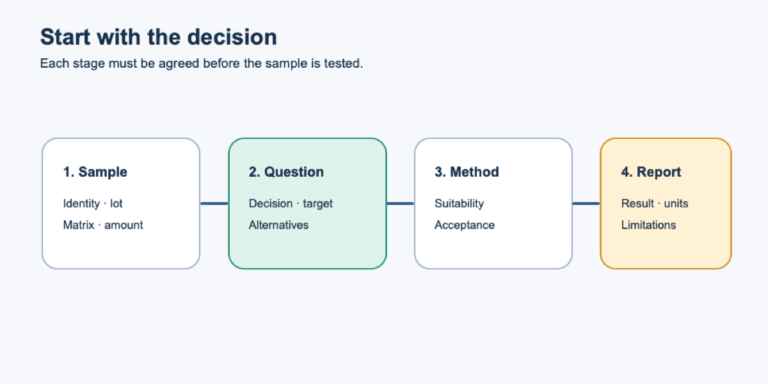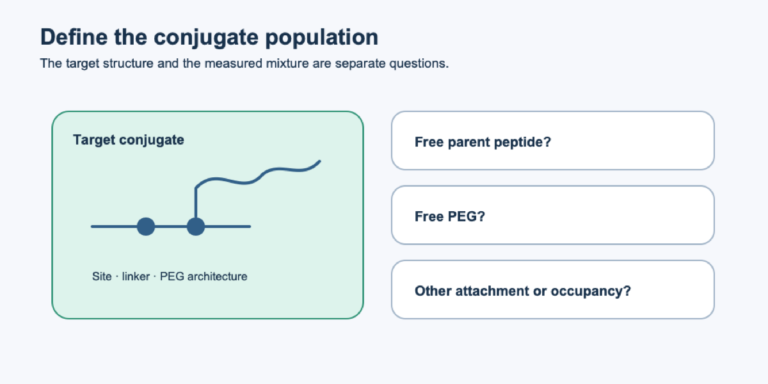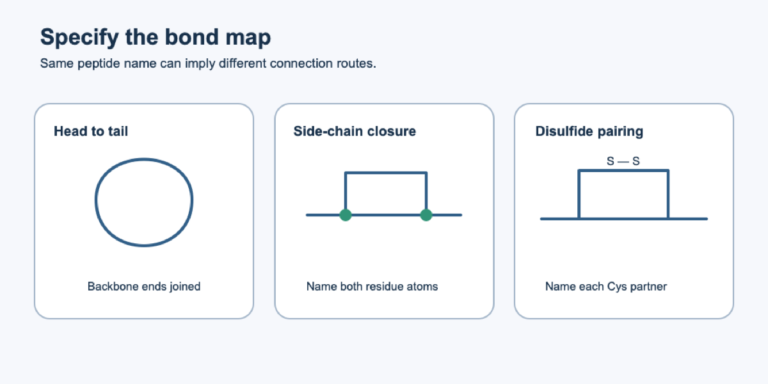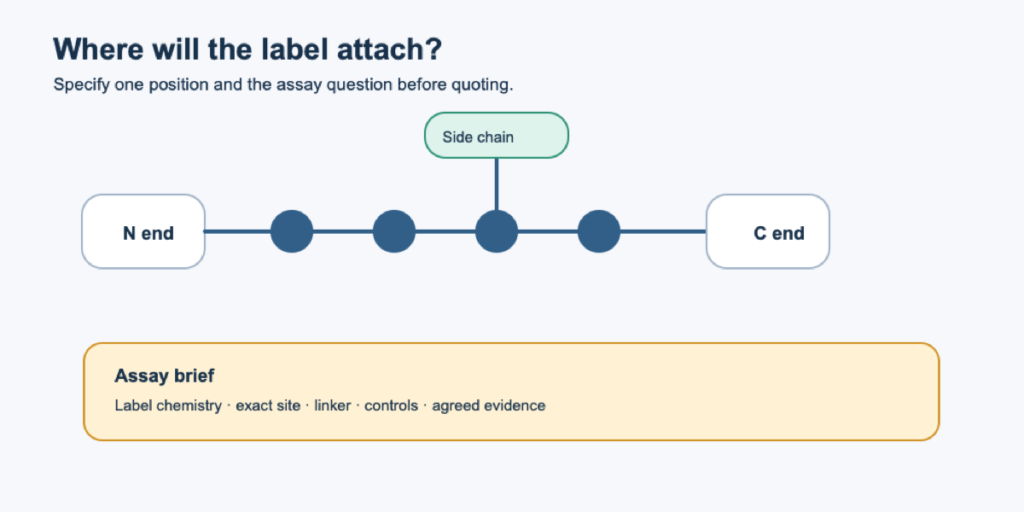
A sequence plus the words “biotinylated” or “fluorescent” does not define one product. The same peptide can be tagged at an available terminus or a selected side chain, with or without a spacer, using different chemical forms of a label. Each choice changes what must be synthesized, purified and characterized. It may also change how the reagent behaves in the intended assay. NHD therefore asks for sequence, attachment site, label, linker, scale, purification target and analytical scope before confirming a labeling project. Its modification service page treats each as a project review item, not a catalog-wide promise.
Start with the experiment. A capture reagent has a different question from a fluorescent binding tracer or an internally quenched substrate. For capture, identify what surface or binding partner sees the peptide and where a biotin handle can be placed without deliberately covering the region under study. For a fluorescence readout, specify the instrument channel, the intended measurement and whether free dye could confound it. For a donor–quencher substrate, state the proposed cleavage site and the intended reporter pair. These are design inputs, not proof that a chosen label preserves binding or signal. Supplier technical material describes multiple peptide labeling chemistries and reporters; it does not establish feasibility for a particular NHD order.
A concrete reason to keep position and linker in the brief comes from a study of yeast α-factor fluorescent analogues. The authors made 15 labeled analogues with an N-terminal or selected side-chain NBD label and measured receptor affinity and biological activity. In that growth-arrest assay, 11 of 15 retained 6–60% of the parent peptide’s biological activity; affinity also depended on label position and distance from the backbone. Those numbers describe that yeast receptor experiment only. They do not predict a buyer’s assay or an NHD product.
The label design brief
| Decision to record | What to send to the supplier | Why a buyer needs it in writing |
|---|---|---|
| Parent molecule | Exact N-to-C residue sequence, stereochemistry and terminal groups | The unmodified comparison must be unambiguous. |
| Assay job | Capture, imaging/tracing, binding readout or cleavage readout; assay matrix and detection setup | The assay sets the design question and usable signal. |
| Label | Chemical name, requested derivative or reactive form where known, and whether one or two labels are required | A color name alone does not fix the structure. |
| Attachment | N terminus, C terminus or named side-chain residue and position | Positional alternatives are different requested molecules. |
| Spacer | Identity and intended length, or ask for options to be quoted separately | A spacer is part of the molecular design, not merely packaging. |
| Quantity and form | Requested amount, aliquot format and any formulation restrictions | Material handling and analytical work can be scoped together. |
| Release evidence | Identity of conjugate, chromatographic assessment, free-label or unlabeled-peptide question, report format and agreed limits | A generic purity percentage may not answer the assay’s interference question. |
Use “proposed” when the chemistry remains open. For example: “Please evaluate N-terminal biotin with an Ahx spacer and quote any necessary alternative separately.” NHD lists biotin with or without Ahx as an option for review; the exact structure and feasibility require written confirmation on the modification service route. An internal side-chain label should name the residue and position explicitly, including whether other reactive residues must remain untouched.
Choose controls for the question, not by habit
An unlabeled parent can help separate effects of the label from the peptide’s baseline response. A label-only or blank-matrix control can help identify background from the detector or free reporter. For a capture assay, a blocked or irrelevant sequence control may be useful if the assay design calls for it. For a cleavage reporter, a no-enzyme or inhibitor condition may help distinguish spontaneous signal from the intended reaction. These are possible controls to discuss with the assay owner; none is universally required or supplied by NHD by default.
The quote should say which control compounds, if any, are separate deliverables. It should also say what evidence will distinguish conjugated product from unreacted peptide or free label. Identity evidence, chromatographic assessment and label-specific measurements answer different questions. Ask which are technically suitable for the requested chemistry and which appear in the deliverable report. The NHD page says QC methods and records are agreed in the quotation; do not infer a standard method from the label class alone.
A request that a supplier can review
Research assay: streptavidin-based capture of a synthetic peptide in buffer. Parent sequence and terminal groups: [insert exact N-to-C specification]. Proposed product: one N-terminal biotin attachment via [specified spacer or request design options]. The [named motif] must remain available for the assay. Please review attachment chemistry and offer any alternative site as a separately identified product. State the target quantity and aliquots; list the identity, chromatographic and free-label/unlabeled-peptide questions your proposed analytical package can answer; provide methods, report fields and acceptance criteria in the written quote. Quote an unlabeled parent as a separate control if feasible. Research use only.
Replace the bracketed information with the actual assay details. If the functional motif or label position is uncertain, ask for design review rather than presenting a guess as a specification. The accepted design should preserve the exact site and linker names through the quote, purchase order and final report. If an alternative is proposed, compare it as an alternative molecule, not as an interchangeable substitute.
Before approving the quote
Check that the structure described in the quote matches the assay brief, including residue numbering and terminal chemistry. Check that “purity” has a named method and an agreed criterion, and that any free label or unconjugated peptide concern is specifically addressed. Check whether the quote includes controls and whether the stated storage/handling advice is specific to the selected label. NHD notes that handling depends on peptide, label, light sensitivity and formulation; a universal rule should not be inserted into an order without project evidence.
For a concrete feasibility review, submit the completed brief through NHD’s quote form and link it to the peptide modification service. Research products and services are for research use, not human or veterinary use.
Sources and scope
- NHD peptide modification services establishes project-review fields and possible label classes; it does not guarantee a specific dye, design or QC package.
- Merck/Sigma peptide labeling note supports the existence of multiple labeling chemistries and reporters; it is not NHD capability evidence.
- Ding et al. studied 15 NBD-labeled yeast α-factor analogues; 11 retained 6–60% activity in that study’s growth-arrest assay. This case illustrates position and spacer sensitivity only in that system. The design brief and control questions are editorial procurement tools, with no performance prediction for other peptides.
Sources & editorial method
AI-assisted source-reviewed editorial; published after user confirmation. Human technical review not recorded.
3 linked records are listed in the references below. Read the editorial and AI-assistance policy.
How to interpret this article
This article summarizes third-party records and does not establish the identity, quality, safety or efficacy of any catalog lot.
Research-use boundary: Catalog materials discussed on this website are for laboratory research, development and manufacturing use only, not for human or veterinary use. This content is not medical advice and does not provide administration instructions.
Primary records and authoritative sources
- NHD peptide modification servicesSource 1. [NHD peptide modification services](https://nhdbio.com/services/peptide-modification-services/) establishes project-review fields and possible label classes; it does not guarantee a specific dye, design or QC package.
- Merck/Sigma peptide labeling noteSource 2. [Merck/Sigma peptide labeling note](https://www.sigmaaldrich.com/US/es/technical-documents/technical-article/chemistry-and-synthesis/peptide-synthesis/labeling-reagents) supports the existence of multiple labeling chemis
- Ding et al.Source 3. [Ding et al.](https://pubmed.ncbi.nlm.nih.gov/12081627/) studied 15 NBD-labeled yeast α-factor analogues; 11 retained 6–60% activity in that study's growth-arrest assay. This case illustrates position and spacer sensitiv