For research, development and manufacturing use only. Not for human or veterinary use.
Metabolic Research · NNMT
5-Amino-1MQ
Scientific Dossier
5-Amino-1MQ is a cell-permeable small-molecule inhibitor of nicotinamide N-methyltransferase (NNMT). Published preclinical work connects NNMT inhibition with lower 1-MNA, higher intracellular NAD+ and SAM, reduced lipid accumulation in adipocytes, lower adiposity in diet-induced obese mice and stronger muscle regeneration in aged mice. Human efficacy, safety and dosing have not been established.
Research use only Lot documents on request
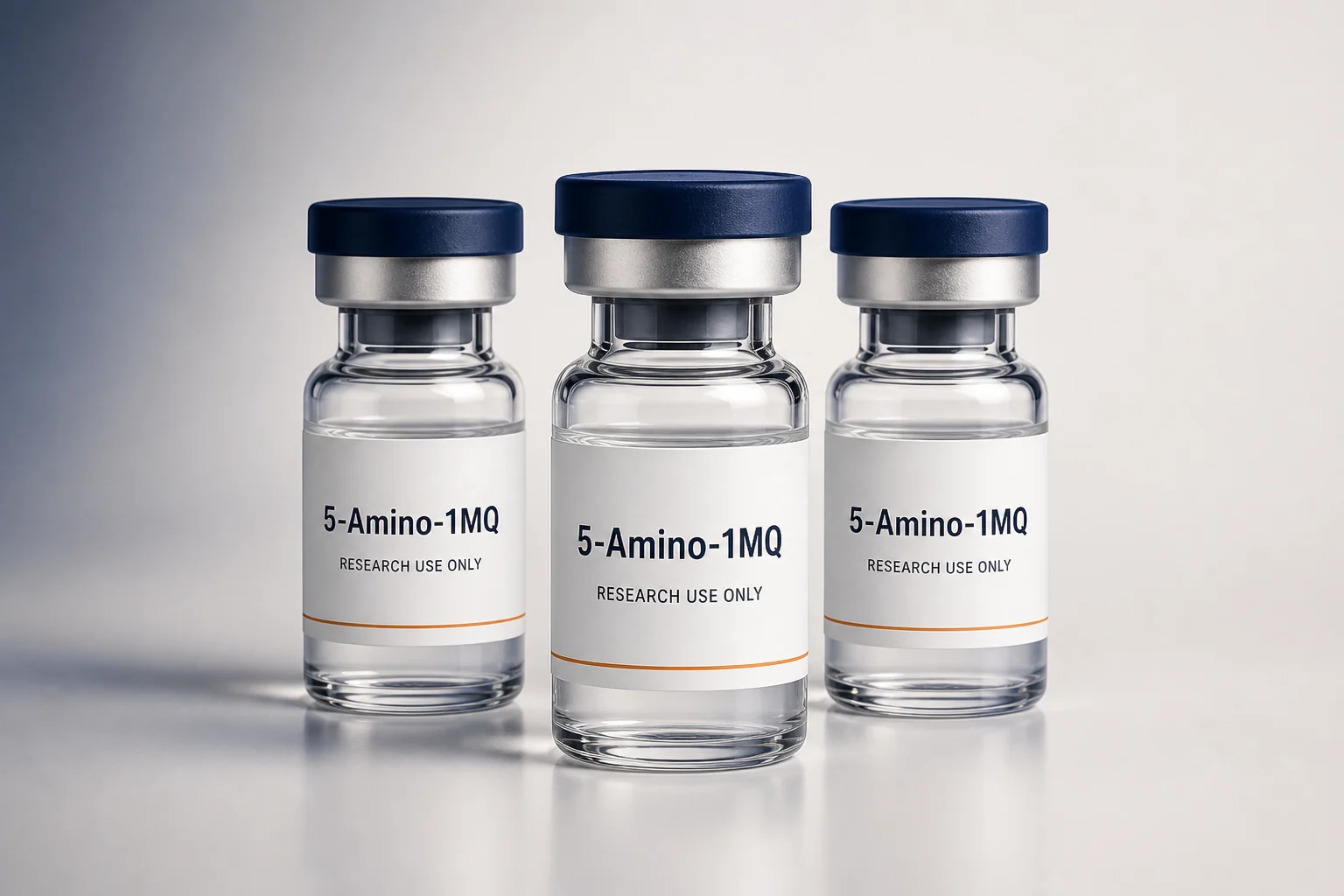
AI-generated packaging mockup for catalog navigation. It is not a photograph of an actual supplied lot; container, label and presentation may vary.
Product family
Compound overview
Shared values below are consolidated from the current catalog record. They are not independent verification or lot results; the current product specification and lot COA control.
Product identity
Product type
Small-molecule research compound
Reference chemical name
5-Amino-1-methylquinolinium
Common abbreviation
5-Amino-1MQ · NNMTi
Research target
Nicotinamide N-methyltransferase (NNMT)
Inhibitor class
Nicotinamide-site competitive inhibitor
Evidence scope
Biochemical, cell, rat PK and mouse studies
Human clinical evidence
No established human efficacy or dosing
Intended use
Research, development and manufacturing use only
Literature reference parameters
PubChem CID
9501075-amino-1-methylquinolinium cation
Reference CAS RN
685079-15-6Free cation record; supplied salt may differ
NNMT IC50 1.2 µMPublished biochemical assay; not a lot-release value
Reported permeability
High in PAMPA and Caco-2 assaysExperimental classification; no detectable efflux reported
Primary research systems
3T3-L1 adipocytes · DIO mice · aged-mouse muscle · rat PKPreclinical only
PubChem reference identity
CID 950107 · C10H11N2+ · 159.21 g/molThe record represents the free quinolinium cation. Counterions, water and the supplied salt are outside this formula.
Reference structure key
ZMJBCEIHNOWCMC-UHFFFAOYSA-OPubChem InChIKey for CID 950107; useful when comparing records with similar names.
Identity safeguard Reference identifiers above describe the literature compound record. The supplied form, formula, molecular weight, purity and storage conditions must be verified against the product-specific specification and lot COA.
Mechanism of action
How 5-Amino-1MQ is studied
A target-to-pathway view grounded in the linked research records.
Selective NNMT inhibition
Docking in the 2017 medicinal-chemistry study predicted occupancy of the nicotinamide substrate-binding region; biochemical assays reported low-micromolar NNMT inhibition. The binding mode was not established as a direct clinical mechanism.
1-MNA pathway modulation
In differentiated adipocytes, NNMT inhibition reduced intracellular 1-MNA, providing a direct pharmacodynamic readout of target engagement.
NAD+ and SAM availability
Published cell work reported increases in intracellular NAD+ and SAM, linking NNMT activity to energy and methyl-donor metabolism.
Cell-permeable research tool
The amino-substituted methylquinolinium scaffold was classified as highly permeable in PAMPA and Caco-2 transport experiments.
Reported research findings
What published studies report about 5-Amino-1MQ
Reported outcomes are paired with their experimental model and evidence boundary.
Cell model
Reduced lipid accumulation in adipocytes
5-Amino-1MQ suppressed lipid accumulation during 3T3-L1 adipocyte differentiation and altered NNMT-linked metabolites.
Reported at laboratory concentrations in cultured cells; not evidence of fat loss in humans.
In an 11-day diet-induced-obesity mouse experiment, treated animals showed about 5.1% weight loss, about 35% lower epididymal fat-pad mass and more than 30% smaller adipocytes versus controls.
The reported protocol was a controlled mouse study and must not be interpreted as human dosing guidance.
The study measured membrane permeability, enzyme selectivity, adipocyte metabolites and lipogenesis, then assessed body weight, white adipose tissue and cholesterol in diet-induced obese mice.
These endpoints support preclinical investigation of NNMT inhibition. The paper did not test weight-loss efficacy in people.
Translation boundary: findings are limited to the evidence level stated on each card. Experimental protocol quantities are research details, not usage instructions.
Interpret the documents, not just the headline number.
Use the source-reviewed guide to separate chromatographic area purity, quantitative assay, LC-MS identity, composition and stability evidence before comparing variants or requesting a lot record.
HPLC area ≠ assayA dominant peak does not establish target mass fraction.
Intact mass ≠ full sequenceIdentity strength depends on resolution and orthogonal evidence.
Counterions affect contentWater, salt form and solvents change the as-is composition.
Storage needs a data basisShipping practice is not the same as stability evidence.
Evidence map
Research context
Published studies and regulatory records, not customer testimonials or usage guidance.
In vitro
Cultured adipocyte models
Published work evaluated NNMT-related metabolites and lipogenesis in cultured adipocytes. This is mechanistic laboratory evidence, not a human outcome.
Evidence boundary: each card states its evidence type. Human trials and regulatory records describe the studied or regulated intervention; preclinical records remain model-specific. None verifies the identity, quality, safety or efficacy of this catalog lot or provides usage instructions.
Literature basis
Curated references
Third-party publications selected for direct relevance.
J. Med. Chem. 2017. PMID 28548833 · DOI 10.1021/acs.jmedchem.7b00389.
Medicinal chemistry
Research FAQ
5-Amino-1MQ questions
Concise answers for researchers comparing identity, evidence and catalog variants.
What is 5-Amino-1MQ?
5-Amino-1MQ is a small-molecule inhibitor of nicotinamide N-methyltransferase (NNMT), an enzyme involved in nicotinamide methylation, 1-MNA formation and the balance of NAD+ and methyl-donor metabolism.
Is 5-Amino-1MQ a peptide?
No. Despite often appearing in peptide research catalogs, 5-Amino-1MQ is a methylquinolinium small molecule and contains no peptide chain.
What effects have been reported in research?
Published preclinical studies reported NNMT inhibition, lower intracellular 1-MNA, higher NAD+ and SAM, reduced adipocyte lipid accumulation, lower adiposity measurements in diet-induced-obese mice and improved muscle regeneration after injury in aged mice.
Has 5-Amino-1MQ been proven effective in humans?
No established human clinical efficacy, safety profile or dosing regimen is available. Results on this page are limited to biochemical, cell and animal research.
Why can CAS number and molecular weight vary between listings?
Some references describe the free 5-amino-1-methylquinolinium cation, while supplied research material may be a specific counter-ion salt. The lot-specific specification and COA must control the identity, formula and molecular weight used for procurement.
How do the 5AM, 10AM and 50AM variants differ?
They are catalog pack-size variants within the same product family. Select the required nominal amount and request the corresponding lot-specific COA before ordering.
Knowledge center
Related insights
Owned educational content connected to this family.
A source-led review of 5-Amino-1MQ as an NNMT inhibitor, separating enzyme, cell and mouse findings from claims that have not been demonstrated in humans.
A practical laboratory guide to checking 5-Amino-1MQ identity, purity language, analytical methods and lot-specific documentation without confusing a catalog listing with a published study…
Published-study results are tied to the linked records and kept separate from catalog-lot claims. Imported purity, storage and document-availability templates have been removed pending product- and lot-specific confirmation.
Editorial status: Source review complete · 2026-08-28 · Not independent medical review · Review policy