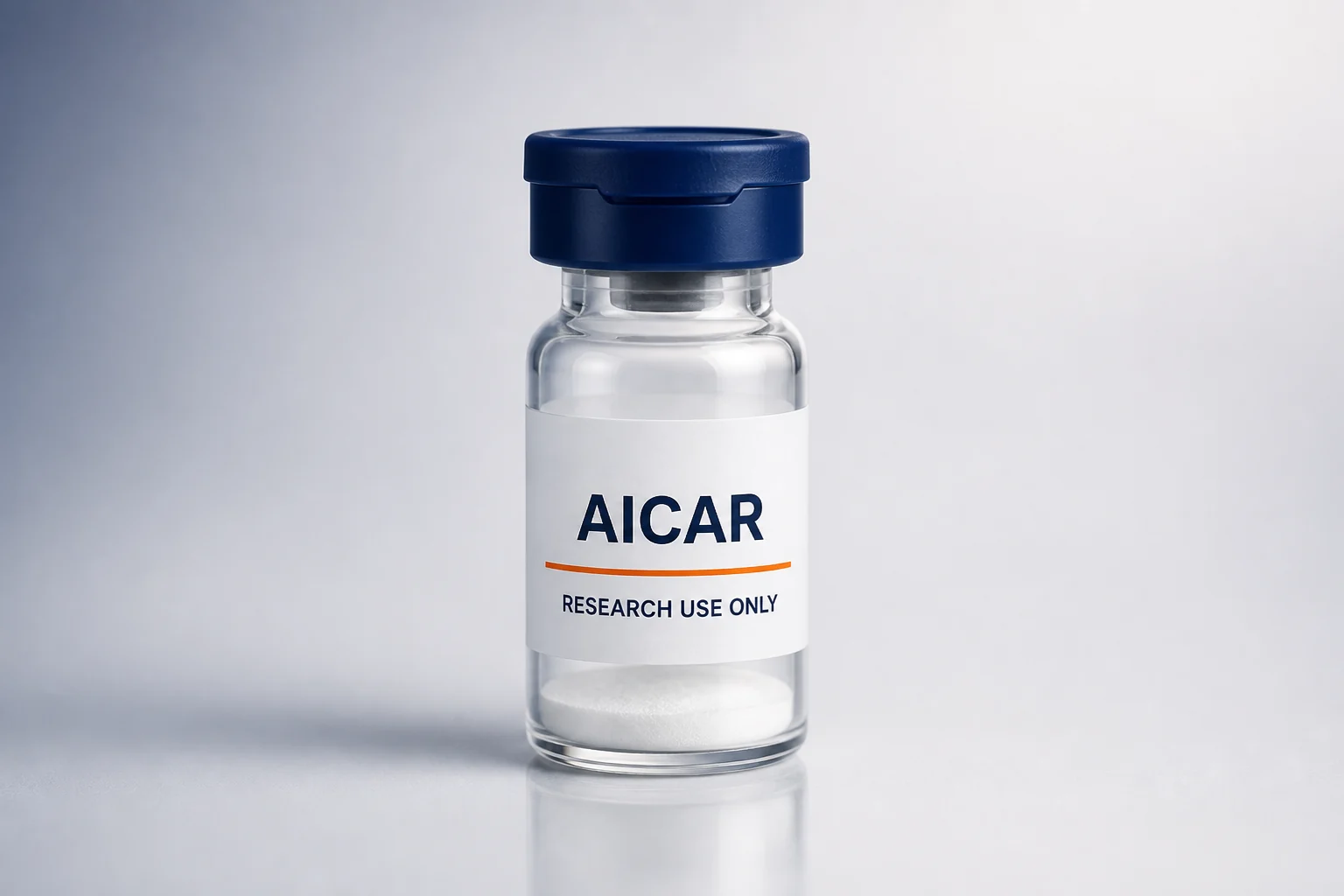
AICAR in Diabetic Polyneuropathy: What the 2024 Mouse Study Found
A 2024 study reported prevention and reversal of neuropathy measures after experimental AICAR exposure in mouse models of type 1 and type 2 diabetes.…
Updated October 1, 2026Metabolic & Weight Loss · Source-reviewed dossier

Source-Reviewed Research Dossier
AICAR is a laboratory compound used mainly to study AMPK, a cell's energy sensor. Cells convert it into a molecule that looks like AMP, which can switch on AMPK. But it also affects other processes, so researchers do not treat it as a clean, AMPK-only tool. A systematic review found important effects that occur without AMPK. A mouse study of diabetic nerve damage reported that treatment prevented or reversed nerve problems and changed how damaged mitochondria were cleared, alongside effects on insulin, glucose and lipids. These are cell and animal findings. Human outcomes are not established.
Shared values below are consolidated from the current catalog record. They are not independent verification or lot results; request the applicable product specification and ask which lot records are available before ordering.
Product identity
Literature reference parameters
Identity safeguard Reference identifiers above describe the literature compound record. Confirm the supplied form, formula, molecular weight, purity and storage conditions against the applicable product specification and any available lot records.
A target-to-pathway view grounded in the linked research records.
Reported research findings
Reported outcomes are paired with their experimental model and evidence boundary.
A systematic review catalogued widely reported AMPK activation together with important AMPK-independent effects.
Experimental conclusions require controls that separate AMPK dependence from other AICAR/ZMP actions.
Read the primary studyA 2024 animal study reported prevention and reversal of diabetic-polyneuropathy measures alongside mitophagy-related changes.
Rodent disease-model findings do not establish clinical outcomes or catalog-lot performance.
Read the primary studyCatalog options
Pack-level catalog data; lot-level controls remain document-specific.
Small-molecule research compound · 50 mg/vial nominal · 10-vial pack · chemical form, identity and assay controlled by lot specification.
Document availability and scope must be confirmed for this variant and lot in the written quotation. A catalog description is not a lot-specific test result.
A listed document is not proof of availability for this lot. Ask the team to confirm the current COA status and the scope of any other records before ordering.
Analytical interpretation
Use the source-reviewed guide to separate chromatographic area purity, quantitative assay, LC-MS identity, composition and stability evidence before comparing variants or requesting a lot record.
Open the Quality & Documentation HubHPLC area ≠ assayA dominant peak does not establish target mass fraction.
Intact mass ≠ full sequenceIdentity strength depends on resolution and orthogonal evidence.
Counterions affect contentWater, salt form and solvents change the as-is composition.
Storage needs a data basisShipping practice is not the same as stability evidence.
Evidence map
Published studies and regulatory records, not customer testimonials or usage guidance.
Experimental conclusions require controls that separate AMPK dependence from other AICAR/ZMP actions.
View primary recordRodent disease-model findings do not establish clinical outcomes or catalog-lot performance.
View primary recordThird-party publications selected for direct relevance.
Višnjić D, et al. Cells. 2021. PMID 34064363.
Experimental study. 2024. PMID 39795939.
Concise answers for researchers comparing identity, evidence and catalog variants.
AICAR is mainly used to study AMPK signaling and cellular energy sensing, and it has been tested in models of metabolism and diabetes complications. A systematic review found it is not selective for AMPK because important effects occur without it. A mouse study reported prevention or reversal of diabetic neuropathy measures alongside changes in clearing damaged mitochondria, while also affecting insulin, glucose and lipid handling. These are laboratory and animal findings, not human benefit.
AICAR supplied for laboratory work is a defined small molecule, not a finished medicine, and it has not been shown to be safe or effective for human use. Identity, purity and lot handling are separate questions addressed by specifications and analytical documents. Cell or animal findings should not be transferred to other compounds, salt forms, blends or routes without direct evidence. Reviews summarize past experiments, not new results.
The evidence base is predominantly mechanistic and preclinical, with a systematic review documenting both AMPK-linked and independent actions.
No. The cited records describe their own intervention, formulation, model and controls. They do not verify the identity, purity, sterility, safety or efficacy of a catalog lot.
A lot-specific COA, product specification sheet and analytical method summary can be requested where applicable.
Store at -20 °C, protected from light and moisture. After reconstitution, aliquot and avoid repeated freeze-thaw cycles. Confirm the applicable storage statement on the product-specific specification and lot documentation.
Knowledge center
Owned educational content connected to this family.
A 2024 study reported prevention and reversal of neuropathy measures after experimental AICAR exposure in mouse models of type 1 and type 2 diabetes.…
Updated October 1, 2026
AICAR naming often collapses acadesine, its intracellular phosphorylated metabolite ZMP and an entire AMPK pathway into one label. Reproducible research needs those three concepts…
Updated October 1, 2026Knowledge tools
Move from this dossier into canonical evidence maps, verified status records, analytical interpretation and laboratory calculations.
Claims were checked against the linked primary publication, regulatory label or authoritative compound record. Published findings stay attached to their study model, formulation and route. Catalog identity and lot quality remain controlled by the applicable specification and lot-specific documents.
Technical procurement
Selected: AR50 · 50 mg × 10 vials
Tell us what you need. Your enquiry will be routed to the appropriate contact for catalog numbers, availability and quotation details.