For research, development and manufacturing use only. Not for human or veterinary use.
Mitochondrial-derived peptide research · MOTS-c
MOTS-c (Human)
Product specifications & quotation
MOTS-c is a short peptide associated with mitochondria, the structures that help cells manage energy. Researchers study its links to metabolic signaling, cellular stress and exercise. Intervention findings largely come from laboratory and animal work. Measuring natural MOTS-c levels after exercise in people is a different experiment from administering the peptide. Here you can read those findings, check catalog identity and choose a research variant without confusing published studies with batch-specific evidence.
Research use only Lot documents on request
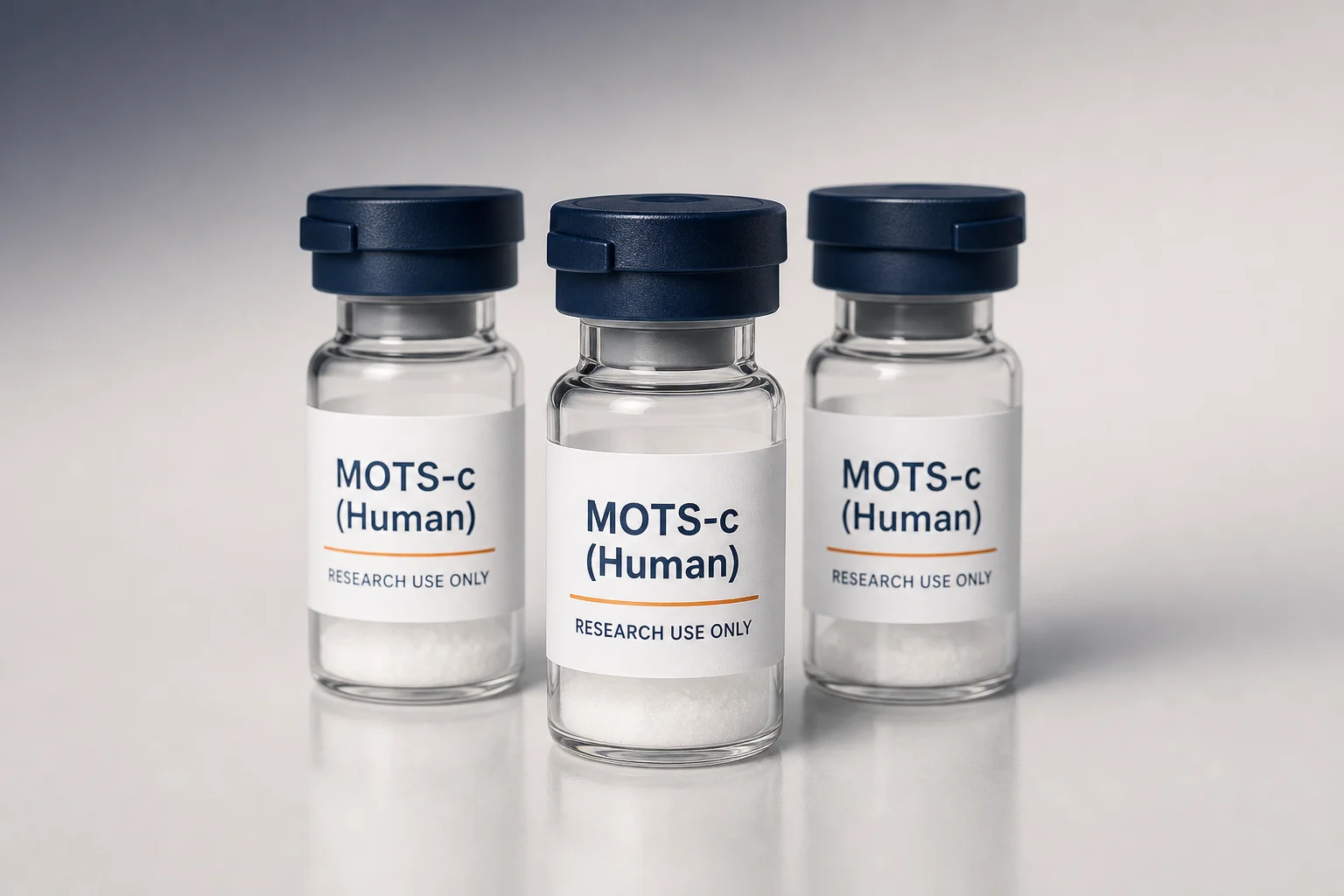
AI-generated packaging mockup for catalog navigation. It is not a photograph of an actual supplied lot; container, label and presentation may vary.
Product family
Compound overview
Shared values below are consolidated from the current catalog record. They are not independent verification or lot results; request the applicable product specification and ask which lot records are available before ordering.
Product identity
Product type
Peptide research compound
Catalog family
MOTS-c (Human)
Research category
Metabolic & Weight Loss
Evidence status
Source-reviewed literature module available below
Intended use
Research, development and manufacturing use only
Literature reference parameters
Compound class
Mitochondrial-derived 16-amino-acid peptideCompound-level research classification
Evidence status
Cell and animal evidence; no identified human drug exposure dataSource-reviewed through 2026-08-28
Primary evidence anchor
2015 discovery paper · PMID 25738459See linked references and study articles
Original discovery publication
16-amino-acid mitochondrial-derived peptideThe original Lee et al. Cell Metabolism paper is PMID 25738459. PMID 25738453 is a separate commentary.
Identity safeguard Reference identifiers above describe the literature compound record. Confirm the supplied form, formula, molecular weight, purity and storage conditions against the applicable product specification and any available lot records.
Mechanism of action
How MOTS-c (Human) is studied
A target-to-pathway view grounded in the linked research records.
Glucose use and insulin sensitivity
Insulin sensitivity means the liver and muscle cells respond well to insulin, helping clear glucose from the blood. The 2015 discovery study in mice found MOTS-c acts mainly on skeletal muscle, where it indirectly activates AMPK, a cellular energy sensor. In mice, this protected against insulin resistance from ageing and high-fat feeding. These are animal experiments. They do not show that using this catalog peptide improves insulin sensitivity in people. PMID 25738459.
Body-weight and metabolic research
The same mouse experiments reported protection against diet-induced obesity. This is a key reason MOTS-c draws metabolic research interest. The proposed route involves muscle energy sensing through AMPK, not a direct fat-burning drug action. Because the evidence comes from animals, it supports further laboratory study of metabolism, not a proven weight-loss effect from this catalog product in humans. PMID 25738459.
Exercise performance: mice and human observations
A 2021 study reported that MOTS-c improved physical performance in young, middle-aged and old mice, and late-life intermittent treatment increased capacity and healthspan. Separately, exercise raised natural MOTS-c in human muscle and circulation. The human part measured the body's own peptide response during exercise. It did not give MOTS-c to people to test a performance benefit. PMID 33473109.
Reported research findings
What published studies report about MOTS-c (Human)
Reported outcomes are paired with their experimental model and evidence boundary.
Mouse experiments
Glucose use and insulin sensitivity
Mouse experiments reported protection against diet- and age-associated insulin resistance. These experiments did not test treatment benefits in people.
Experimental metabolic findings; human treatment benefit has not been established by these studies.
A 2021 study reported improved physical performance in mice given MOTS-c. A separate part of the study measured natural MOTS-c levels around exercise in 10 young men. The human participants were studied during exercise, rather than given MOTS-c to test a treatment benefit. PMID 33473109.
Human observation and administration experiments answer different questions.
Translation boundary: findings are limited to the evidence level stated on each card. Experimental protocol quantities are research details, not usage instructions.
10 mg nominal per vial · 10 vials per pack. Confirm supplied form, mass basis and lot release specifications before ordering.
Lot documentation
Document availability and scope must be confirmed for this variant and lot in the written quotation. A catalog description is not a lot-specific test result.
Catalog no.MS20
Pack size20 mg × 10 vials
Specification & documents for MS20
Product specification
20 mg nominal per vial · 10 vials per pack. Confirm supplied form, mass basis and lot release specifications before ordering.
Lot documentation
Document availability and scope must be confirmed for this variant and lot in the written quotation. A catalog description is not a lot-specific test result.
Catalog no.MS40
Pack size40 mg × 10 vials
Specification & documents for MS40
Product specification
40 mg nominal per vial · 10 vials per pack. Confirm supplied form, mass basis and lot release specifications before ordering.
Lot documentation
Document availability and scope must be confirmed for this variant and lot in the written quotation. A catalog description is not a lot-specific test result.
Quality system
Quality documentation
A listed document is not proof of availability for this lot. Ask the team to confirm the current COA status and the scope of any other records before ordering.
Lot-specific Certificate of AnalysisAvailability and scope must be confirmed for the selected catalog variant and lot
Interpret the documents, not just the headline number.
Use the source-reviewed guide to separate chromatographic area purity, quantitative assay, LC-MS identity, composition and stability evidence before comparing variants or requesting a lot record.
Evidence boundary: each card states its evidence type. Human trials and regulatory records describe the studied or regulated intervention; preclinical records remain model-specific. None verifies the identity, quality, safety or efficacy of this catalog lot or provides usage instructions.
Literature basis
Curated references
Third-party publications selected for direct relevance.
U.S. FDA. Current compounding safety-information page.
Research FAQ
MOTS-c (Human) questions
Concise answers for researchers comparing identity, evidence and catalog variants.
What effects are studied for MOTS-c (Human)?
The clearest effects come from mouse studies: protection against diet- and age-related insulin resistance, reduced diet-induced obesity, and better physical capacity, including when treatment started late in life. In humans, only natural MOTS-c changes after exercise have been measured, in a small observational setting. That is different from giving the peptide as a treatment, so human benefit from this research compound is not established. PMIDs 25738459, 33473109.
How should the MOTS-c (Human) research findings be understood?
A 2021 study reported that MOTS-c improved physical performance in young, middle-aged and old mice, and late-life intermittent treatment increased capacity and healthspan. Separately, exercise raised natural MOTS-c in human muscle and circulation. The human part measured the body's own peptide response during exercise. It did not give MOTS-c to people to test a performance benefit. PMID 33473109.
What does “Human” mean in the MOTS-c name?
It identifies the reference sequence. It does not mean the material is donor-derived, tested in people or intended for human use.
Which MOTS-c sizes can I enquire about?
MS10 lists 10 mg per vial, MS20 lists 20 mg and MS40 lists 40 mg. Each pack contains 10 vials. Confirm availability, supplied form and lot specifications with your quote.
Are these products in stock?
A catalogue listing is not a stock confirmation. Tell us the vial size, number of packs and destination so we can confirm availability and quotation details.
Can I request a COA before ordering?
Ask which documents are available for the selected variant and lot. A COA, specification sheet or method summary is not guaranteed by this listing; availability and scope must be confirmed before ordering.
What should I include in a quote request?
Include the product name, catalogue code, vial size, number of packs, research purpose, destination and required documents. Mention any requirements for supplied form, purity or peptide content so they can be assessed separately.
Does the labelled vial mass mean peptide content?
The listed mg per vial is a nominal catalogue size. It does not establish measured peptide content or purity. Confirm what the mass refers to and which measurements are available for the selected lot.
How should the material be stored?
Request the storage conditions for the exact supplied form and selected variant. A temperature stated for another supplier or a clinical drug preparation is not a verified storage specification for NHD catalog material.
Are the original metabolic results human clinical evidence?
No. The foundational intervention results came from cell and mouse experiments. They do not establish treatment benefits in people.
Does “Human” in the catalog name mean it can be used in people?
No. The qualifier identifies the sequence reference. It does not describe approval or suitability for human administration. Confirm the sequence and supplied form needed for the laboratory project.
What should I include in a research quotation request?
Send the exact product name, selected catalog variant, required quantity, destination and documents needed for the project. Specify whether the amount refers to powder mass or measured peptide content. Availability, price, lead time and document scope require confirmation.
Does a published study replace a lot-specific analytical report?
No. A paper describes the material and methods used in that study. It does not establish the identity, purity or content of a different supplied lot. Ask which records actually apply to the requested material; do not assume a COA is available.
Knowledge center
Related insights
Owned educational content connected to this family.
The paper that introduced MOTS-c combined cell experiments with mouse metabolic models. It is an important discovery record, but the intervention findings were preclinical.
Updated October 1, 2026
ArticleSequence terminology, preclinical evidence and FDA…
“Human” in a MOTS-c catalog title ordinarily describes the referenced peptide sequence; it does not mean the material was isolated from a human donor,…
Updated October 1, 2026
ArticleTechnical references and labeled calculations
Researchers studying MOTS-c asked whether it changes location inside stressed cells and affects gene regulation. That is a mechanism experiment. This guide explains what…
Published-study results are tied to the linked records and kept separate from catalog-lot claims. Imported purity, storage and document-availability templates have been removed pending product- and lot-specific confirmation.
Editorial status: Source review complete · 2026-10-09 · Not independent medical review · Review policy