Lot-document scope confirmed before quotation · Research use only
  • Specification Review
  • Lot Documents on Request
  • Business Support · Xi’an
  • Destination Eligibility Confirmed
西安诺和达生物科技有限公司
For research, development and manufacturing use only. Not for human or veterinary use.

Reproductive & Hormone · Source-reviewed dossier

Oxytocin Acetate

Source-Reviewed Research Dossier

Oxytocin is a short natural peptide with two well-known roles: it causes uterine contractions during labor and milk release during breastfeeding. In the brain, it also acts as a signal, and scientists study possible links to social behavior, stress and maternal care. Those brain-related ideas are still developing; study results depend heavily on the model, how it is given and who is studied. Regulated oxytocin medicines exist, but their approved uses are narrow and tied to specific formulations and routes, such as intravenous or intramuscular obstetric use. A research research material is not that finished medicine. This page separates these categories so readers can see which effects are well established, which remain experimental, and why oxytocin attracts research interest.

Research use only Lot documents on request
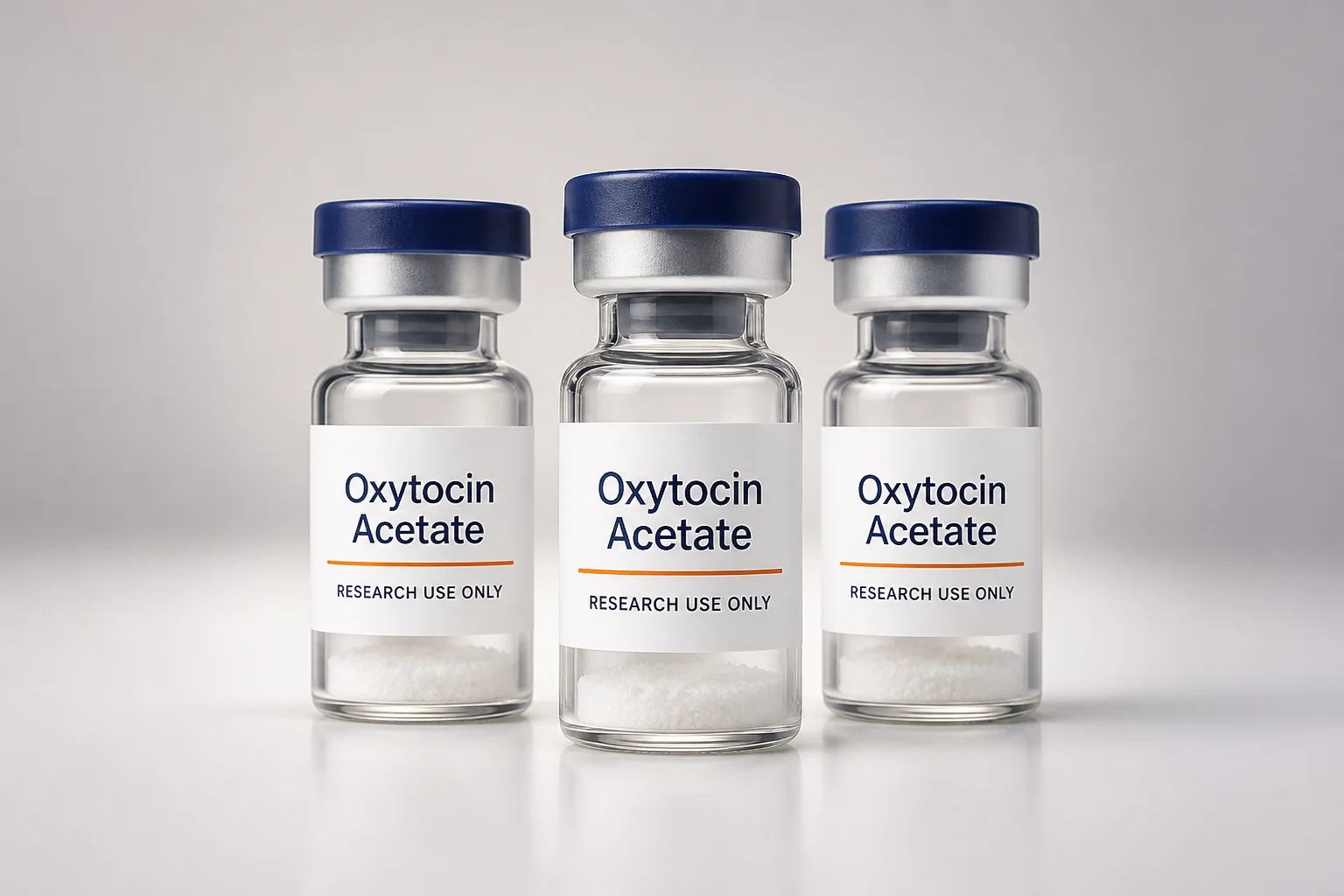
Oxytocin Acetate research product family with 3 catalog variants
AI-generated packaging mockup for catalog navigation. It is not a photograph of an actual supplied lot; container, label and presentation may vary.

Product family

Compound overview

Shared values below are consolidated from the current catalog record. They are not independent verification or lot results; request the applicable product specification and ask which lot records are available before ordering.

Product identity

Product type
Peptide research compound
Catalog family
Oxytocin Acetate
Research category
Reproductive & Hormone
Catalog CAS RN
50-56-6
Catalog molecular formula
C43H66N12O12S2
Catalog molecular weight
1007.19 g/mol
Catalog sequence
Cys-Tyr-Ile-Gln-Asn-Cys-Pro-Leu-Gly-NH2 (disulfide bridge Cys1-Cys6)
Evidence status
Established physiology and regulated obstetric use; behavioral claims remain context-specific
Intended use
Research, development and manufacturing use only

Literature reference parameters

Compound or material class
Nonapeptide oxytocin-receptor agonistCatalog-family identity
Evidence scope
Established physiology and regulated obstetric use; behavioral claims remain context-specificDo not generalize beyond the cited model
Source review
Primary or authoritative records linked belowChecked 2026-09-01

Identity safeguard Reference identifiers above describe the literature compound record. Confirm the supplied form, formula, molecular weight, purity and storage conditions against the applicable product specification and any available lot records.

Mechanism of action

How Oxytocin Acetate is studied

A target-to-pathway view grounded in the linked research records.

How oxytocin signals at its receptor

Oxytocin binds the oxytocin receptor, a docking site found in reproductive tissues and in many central and peripheral systems. In the uterus, receptor activation drives muscle contractions, and high estrogen levels near term make those receptors more responsive. Oxytocin also encourages prostaglandin production in fetal membranes and the decidua, adding to cervical ripening and contractility. In the brain, the same receptor family participates in circuits linked to fear, pain, stress and social processing, which is why behavioral research exists. These peripheral and central roles are related but experimentally separate.

Labor physiology and the Ferguson reflex

During labor, oxytocin is released in pulses of increasing frequency and amplitude from the posterior pituitary. Pressure from the fetus on the cervix activates a feedforward loop, the Ferguson reflex, that triggers more oxytocin release and stronger contractions. Sympathetic activation during contractions can dampen that release. The same biology explains why synthetic oxytocin infusions are used in obstetric care to induce or augment labor under close clinical monitoring. This is a regulated medical context with defined products and routes, not a general wellness mechanism.

Oxytocin Acetate: What the research can establish

Endogenous oxytocin physiology, intranasal behavioral experiments, and injectable obstetric medicines represent different evidence categories that should not be pooled. A review article summarizes existing work but does not constitute a new experiment. Regulated labels describe specific finished products, not research catalog material. Catalog identity and lot quality are governed by specifications and lot documents rather than by published clinical studies. Keeping these boundaries clear prevents overreading findings from one route, model or formulation as if they applied to all oxytocin materials.

Reported research findings

What published studies report about Oxytocin Acetate

Reported outcomes are paired with their experimental model and evidence boundary.

Physiology review

Peripheral and central oxytocin biology are distinct but connected

A 2024 review summarizes oxytocin synthesis, receptor signaling, pharmacology and clinical research.

A broad review does not validate a specific route or catalog preparation.

Read the primary study
Authoritative drug labels

Finished oxytocin medicines have product-specific labeling

DailyMed lists regulated oxytocin products with defined strengths, routes, warnings and indications.

A regulated label is not evidence that a catalog research material is the same finished drug.

Read the primary study
Translation boundary: findings are limited to the evidence level stated on each card. Experimental protocol quantities are research details, not usage instructions.

Catalog options

Variant specifications

Pack-level catalog data; lot-level controls remain document-specific.

Catalog no.OT2
Pack size2 mg × 10 vials
Specification & documents for OT2

Product specification

Single-component peptide · 2 mg/vial nominal · 10-vial pack · supplied form and release limits controlled by lot specification.

Lot documentation

Document availability and scope must be confirmed for this variant and lot in the written quotation. A catalog description is not a lot-specific test result.

Catalog no.OT5
Pack size5 mg × 10 vials
Specification & documents for OT5

Product specification

Single-component peptide · 5 mg/vial nominal · 10-vial pack · supplied form and release limits controlled by lot specification.

Lot documentation

Document availability and scope must be confirmed for this variant and lot in the written quotation. A catalog description is not a lot-specific test result.

Catalog no.OT10
Pack size10 mg × 10 vials
Specification & documents for OT10

Product specification

Single-component peptide · 10 mg/vial nominal · 10-vial pack · supplied form and release limits controlled by lot specification.

Lot documentation

Document availability and scope must be confirmed for this variant and lot in the written quotation. A catalog description is not a lot-specific test result.

Quality system

Quality documentation

A listed document is not proof of availability for this lot. Ask the team to confirm the current COA status and the scope of any other records before ordering.

Lot-specific Certificate of AnalysisAvailability and scope must be confirmed for the selected catalog variant and lot
COA availability unconfirmed Ask about availability
Product Specification SheetAvailability and scope must be confirmed for the selected catalog variant and lot
Confirm before ordering Request
Analytical Method SummaryAvailability and scope must be confirmed for the selected catalog variant and lot
Confirm before ordering Request

Analytical interpretation

Interpret the documents, not just the headline number.

Use the source-reviewed guide to separate chromatographic area purity, quantitative assay, LC-MS identity, composition and stability evidence before comparing variants or requesting a lot record.

Open the Quality & Documentation Hub

HPLC area ≠ assayA dominant peak does not establish target mass fraction.

Intact mass ≠ full sequenceIdentity strength depends on resolution and orthogonal evidence.

Counterions affect contentWater, salt form and solvents change the as-is composition.

Storage needs a data basisShipping practice is not the same as stability evidence.

Evidence map

Research context

Published studies and regulatory records, not customer testimonials or usage guidance.

Physiology review

Peripheral and central oxytocin biology are distinct but connected

A broad review does not validate a specific route or catalog preparation.

View primary record
Authoritative drug labels

Finished oxytocin medicines have product-specific labeling

A regulated label is not evidence that a catalog research material is the same finished drug.

View primary record
Evidence boundary: each card states its evidence type. Human trials and regulatory records describe the studied or regulated intervention; preclinical records remain model-specific. None verifies the identity, quality, safety or efficacy of this catalog lot or provides usage instructions.

Literature basis

Curated references

Third-party publications selected for direct relevance.

  1. 01

    Oxytocin physiology and pharmacology

    Review. 2024. PMID 38462255.

    Physiology review
  2. 02

    Oxytocin product labels

    U.S. National Library of Medicine, DailyMed.

    Authoritative drug labels

Research FAQ

Oxytocin Acetate questions

Concise answers for researchers comparing identity, evidence and catalog variants.

What effects are studied for Oxytocin Acetate?

The strongest evidence covers reproductive physiology. Oxytocin drives uterine contractions during labor and milk ejection during breastfeeding, and synthetic oxytocin is used in regulated obstetric care to induce or augment labor and to help prevent postpartum hemorrhage after delivery. Brain-related roles in fear, pain, stress and maternal behavior are plausible and actively studied, but the review notes some long-term behavioral and physiological adaptation ideas remain unproven. Those central effects should be treated as a developing research area rather than settled outcomes of any particular preparation.

How should the Oxytocin Acetate research findings be understood?

Endogenous oxytocin physiology, intranasal behavioral experiments, and injectable obstetric medicines represent different evidence categories that should not be pooled. A review article summarizes existing work but does not constitute a new experiment. Regulated labels describe specific finished products, not research catalog material. Catalog identity and lot quality are governed by specifications and lot documents rather than by published clinical studies. Keeping these boundaries clear prevents overreading findings from one route, model or formulation as if they applied to all oxytocin materials.

What evidence is available for Oxytocin Acetate?

Physiology and obstetric pharmacology are established, while behavioral effects show major context and study-design dependence.

Does the cited research validate this catalog material?

No. The cited records describe their own intervention, formulation, model and controls. They do not verify the identity, purity, sterility, safety or efficacy of a catalog lot.

Which quality documents can be requested?

A lot-specific COA, product specification sheet and analytical method summary can be requested where applicable.

How should Oxytocin Acetate be stored?

Store at -20 °C, protected from light and moisture. After reconstitution, aliquot and avoid repeated freeze-thaw cycles. Confirm the applicable storage statement on the product-specific specification and lot documentation.

Knowledge center

Related insights

Owned educational content connected to this family.

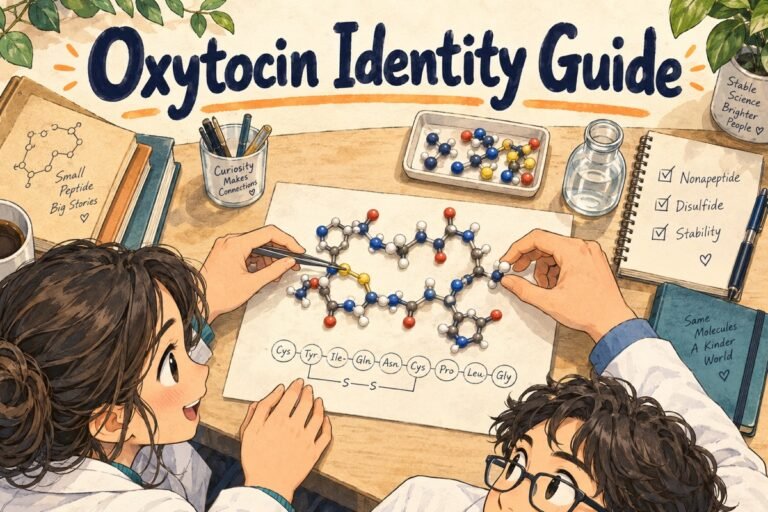
Editorial comic illustration: Oxytocin Identity Guide. Conceptual cover, not experimental imagery.

Oxytocin Identity Guide: Nonapeptide, Disulfide and Stability

Oxytocin is a cyclic nonapeptide with a Cys1–Cys6 disulfide bridge and a C-terminal amide. Sequence, disulfide state, counterion, aggregation and potency are distinct quality…

Updated October 1, 2026

Knowledge tools

Continue with structured evidence

Move from this dossier into canonical evidence maps, verified status records, analytical interpretation and laboratory calculations.

Internal technical source review

Claims were checked against the linked primary publication, regulatory label or authoritative compound record. Published findings stay attached to their study model, formulation and route. Catalog identity and lot quality remain controlled by the applicable specification and lot-specific documents.

Editorial status: NHD evidence editorial workflow · 2026-09-01 · Not independent medical review · Review policy

Technical procurement

Ready to request a quote?

Selected: OT2 · 2 mg × 10 vials