A weight-loss headline leaves an obvious question: did anything else improve? TRIUMPH-1 looked at knee pain and breathing interruptions during sleep, as well as body weight.
Who took part?
The phase 3 trial randomized 2,339 adults with obesity without diabetes and followed them for 80 weeks. Its knee-osteoarthritis subgroup included 574 people; the obstructive-sleep-apnea subgroup included 243.
What changed besides weight?
| Reported ITT comparison with placebo at week 80 | 9 mg trial group | 12 mg trial group |
|---|---|---|
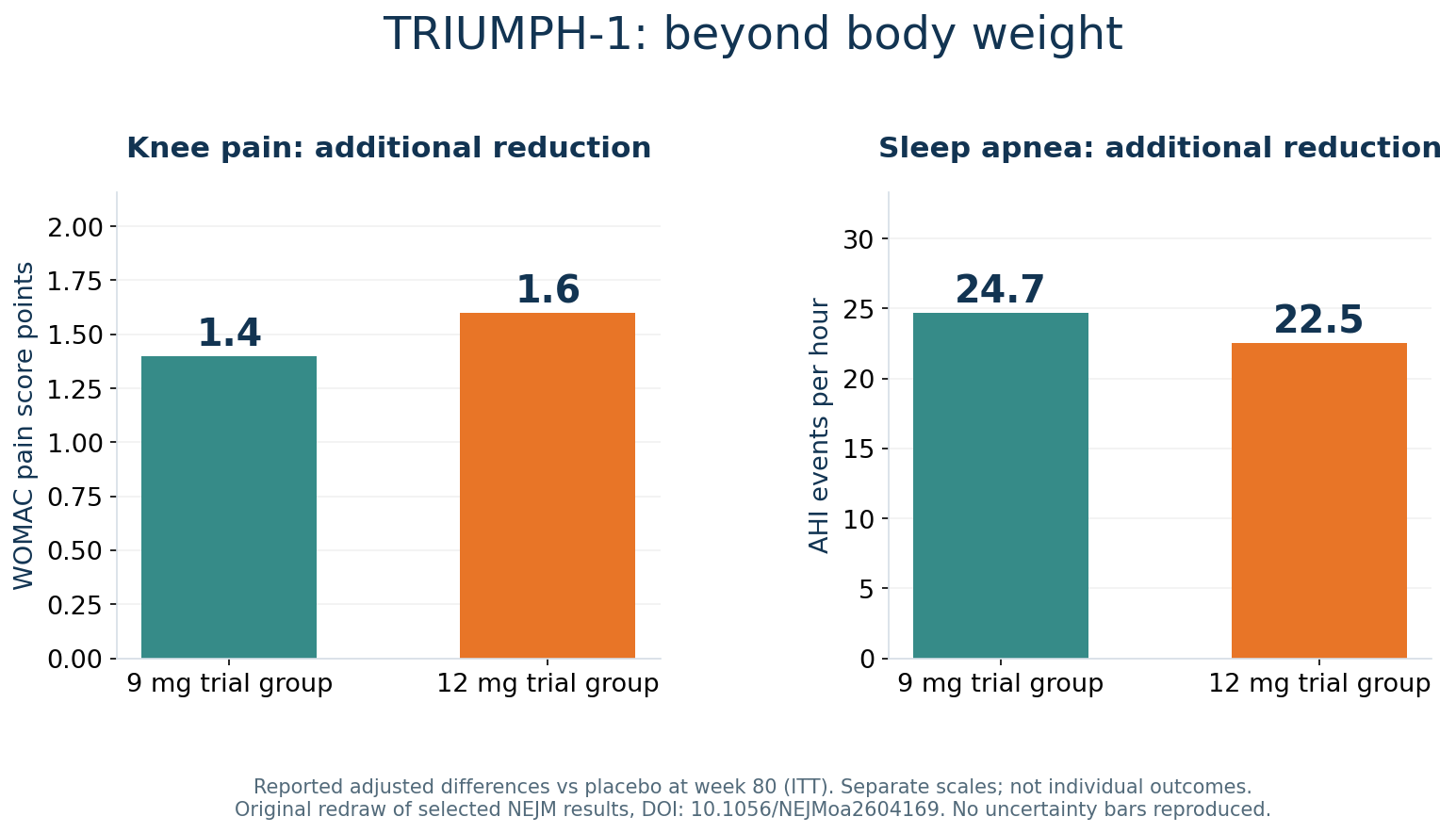
| Additional reduction in WOMAC knee-pain score | 1.4 points | 1.6 points |
| Additional reduction in apnea–hypopnea index (AHI) | 24.7 events/hour | 22.5 events/hour |
These are adjusted between-group differences, not total changes from baseline. All four comparisons had p<0.001. The pain scale runs from 1 to 10, with higher scores meaning worse pain. AHI counts breathing interruptions or reductions per hour of sleep. The paper’s primary subgroup analysis used a hybrid estimand; the table consistently uses its separately reported intention-to-treat (ITT) analysis.
How to read the numbers
Think of the placebo group as the comparison line. “Additional reduction” asks how much more the trial group changed than that line. It does not tell you where an individual finished.
For example, a difference in events per hour cannot, on its own, tell you that someone’s breathing became normal. Likewise, a lower pain score is not an image showing repaired cartilage. The measurement tells us which question the study answered.
Keep benefit and tolerability together
Gastrointestinal events were the most common adverse events. Lilly funded the trial. The subgroup findings should stay attached to this population, duration and analysis rather than becoming a promise for everyone.
Why this differs from TRIUMPH-2
Our TRIUMPH-2 article covers a different study in people with type 2 diabetes. When comparing the two, begin with who took part. A shared molecule name does not make the study populations interchangeable.
For research planning, useful questions include which endpoint matters, which comparator is needed, and whether the experiment can distinguish a direct effect from an effect that accompanies weight change.
Related NHD research material
The NHD Retatrutide product page identifies related laboratory catalog options. Check the intended material and available records for your experiment. This clinical trial does not demonstrate effects of NHD material.
For a laboratory enquiry, tell us the material, quantity, planned test and required documents. Ask NHD about material options and available documentation.
Continue reading
TRIUMPH-2: weight and glucose results and Tirzepatide: understanding an AHI endpoint.
Original source
Jastreboff et al., NEJM, 29 September 2026; DOI 10.1056/NEJMoa2604169. Checked 10 October 2026. AI-assisted editorial review checked the figures, study context and plain-language wording; this is not independent peer review.
NHD catalog materials are for laboratory research, development and manufacturing, not human or veterinary use. Published studies do not certify NHD batches. Catalog material is not interchangeable with a clinical trial medicine or a tested cosmetic formulation.
Sources & editorial method
AI-assisted writing
0 linked records are listed in the references below. Read the editorial and AI-assistance policy.
How to interpret this article
AI-assisted source and readability checks, not independent peer review.
Research-use boundary: Catalog materials discussed on this website are for laboratory research, development and manufacturing use only, not for human or veterinary use. This content is not medical advice and does not provide administration instructions.
Continue with structured records
Move from this editorial analysis to the product identity, filtered evidence and controlled terminology behind it.