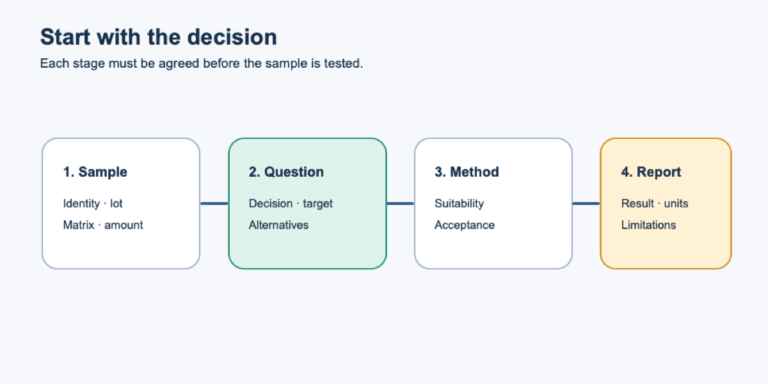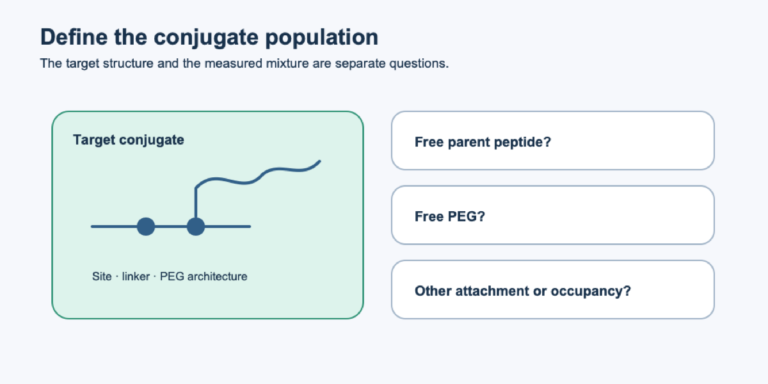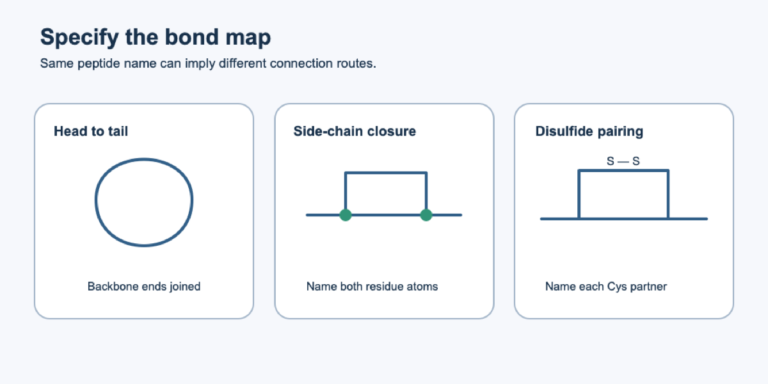
A vial’s labeled mass, chromatographic area purity and assigned peptide content are different quantities. To calibrate an assay, a laboratory needs a reference material with an assigned value and a documented measurement chain. A published oxytocin comparison shows why methods may produce similar means but different between-laboratory variation, even when all are scientifically legitimate.
Three analytical approaches in one collaborative study
The study compared HPLC assay, quantitative proton NMR (qNMR) and amino-acid analysis (AAA) for an oxytocin reference-standard candidate. After the paper’s stated exclusions for invalid standard preparation or other issues, the reported mean content was 1.807 mg/vial by HPLC, 1.798 mg/vial by qNMR, and 1.73 mg/vial by AAA. The corresponding between-laboratory relative standard deviations were 2.3%, 4.73% and 5.44%. These values are not three tests of an NHD batch; they belong to the particular candidate material, participating laboratories, methods and analysis rules of that study. [1, Results, Tables 4, 6 and 8]
| Method in the oxytocin collaboration | Reported mean mg/vial | Between-lab RSD | What the comparison does not establish |
|---|---|---|---|
| HPLC assay against characterized standard | 1.807 | 2.3% | The paper notes that standard-purity assignment uncertainty was not included in this CV. |
| qNMR | 1.798 | 4.73% | Performance depends on an appropriate internal standard and sample handling. |
| AAA | 1.73 | 5.44% | Hydrolysis and amino-acid calibration still require controls. |
The authors did not conclude that the lowest RSD makes HPLC universally most accurate. Their abstract notes that the HPLC CV did not include uncertainty in the standard’s purity assignment. The study also excluded one AAA laboratory because of an amino-acid standard solution problem and one HPLC laboratory because it could not obtain stable water-content data; an outlying HPLC observation was excluded in the statistical analysis. These decisions matter when interpreting apparent method precision. [1, §§3.1–3.2]
Questions for a procurement or QC record
Ask how the value was assigned: whether it is total powder mass, salt/hydrate-inclusive content, or amount of active peptide on a stated basis. Ask which method and calibrator were used, what uncertainty components were considered, how water/counterions/residual solvents were treated, and whether the reference value remains stable under its specified storage and use. The HPLC area-purity versus assay guide explains why one dominant chromatographic peak does not equal peptide mass fraction. The counterion and net-content guide covers components that a balance reading alone includes.
For a local method, choose a reference appropriate to the sequence and form being analyzed. Check identity by orthogonal methods and keep preparation records for working standards. A well-characterized published oxytocin reference does not automatically establish a value for another oxytocin formulation, salt form or supplier lot.
A separate USP-led original research article lays out a two-step value-assignment chain: characterize bulk peptide with mass balance, then use that characterized bulk as the standard to assign the vialed material. It also describes identity and content-uniformity checks and the need to consider counterions and residual solvents. This explains what the oxytocin collaboration’s HPLC precision number alone cannot capture: the uncertainty and traceability of the reference used to calibrate the assay. [2]
Five fields to request with a peptide standard
Record (1) chemical identity and form, (2) whether the assigned quantity is net peptide or total salt/hydrate-inclusive mass, (3) the assignment method and reference chain, (4) lot and vial uniformity evidence, and (5) storage/retest basis. If any field is unavailable, state the limit of comparability before using the standard for a product or research decision. None of these questions implies that NHD has supplied a particular document or passed a particular test.
Evidence limit
This is analytical metrology evidence. It supports a transparent value-assignment workflow, not a claim about treatment, manufacturing certification, or NHD lot-specific content.
Primary source and claim trail
- Survey of Peptide Quantification Methods and Comparison of Their Reproducibility: A Case Study Using Oxytocin. Journal of Pharmaceutical and Biomedical Analysis. 2019. DOI 10.1016/j.jpba.2018.12.028, PMID 30640042. Locations: Abstract (scope and HPLC uncertainty limitation); Results §§3.1.1–3.1.3 and Tables 4, 6, 8 (mean and between-lab RSD); §3.2 (method comparison and exclusions). Primary full text checked.
- McCarthy D, et al. Reference Standards to Support Quality of Synthetic Peptide Therapeutics. Pharmaceutical Research. 2023;40:1317–1328. DOI 10.1007/s11095-023-03493-1, PMID 36949371. Locations: Abstract and value-assignment methods (bulk mass balance followed by vial assignment), analytical testing and discussion of identity, impurities and stability. Independent USP-led primary research; no oxytocin values imported from this source.
Sources & editorial method
AI-assisted editorial draft; independent Codex source, image and seven-language review; human professional review not claimed
2 linked records are listed in the references below. Read the editorial and AI-assistance policy.
How to interpret this article
This article summarizes third-party records and does not establish the identity, quality, safety or efficacy of any catalog lot.
Research-use boundary: Catalog materials discussed on this website are for laboratory research, development and manufacturing use only, not for human or veterinary use. This content is not medical advice and does not provide administration instructions.
Primary records and authoritative sources
- Survey of Peptide Quantification Methods and Comparison of Their Reproducibility: A Case Study Using OxytocinSource 1. Abstract (scope and HPLC uncertainty limitation); Results §§3.1.1–3.1.3 and Tables 4, 6, 8 (mean and between-lab RSD); §3.2 (method comparison and exclusions). Primary full text checked.
- McCarthy D, et al. Reference Standards to Support Quality of Synthetic Peptide Therapeutics. Pharmaceutical Research. 2023;40:1317–1328.Source 2. Abstract and value-assignment methods (bulk mass balance followed by vial assignment), analytical testing and discussion of identity, impurities and stability. Independent USP-led primary research; no oxytocin values imp