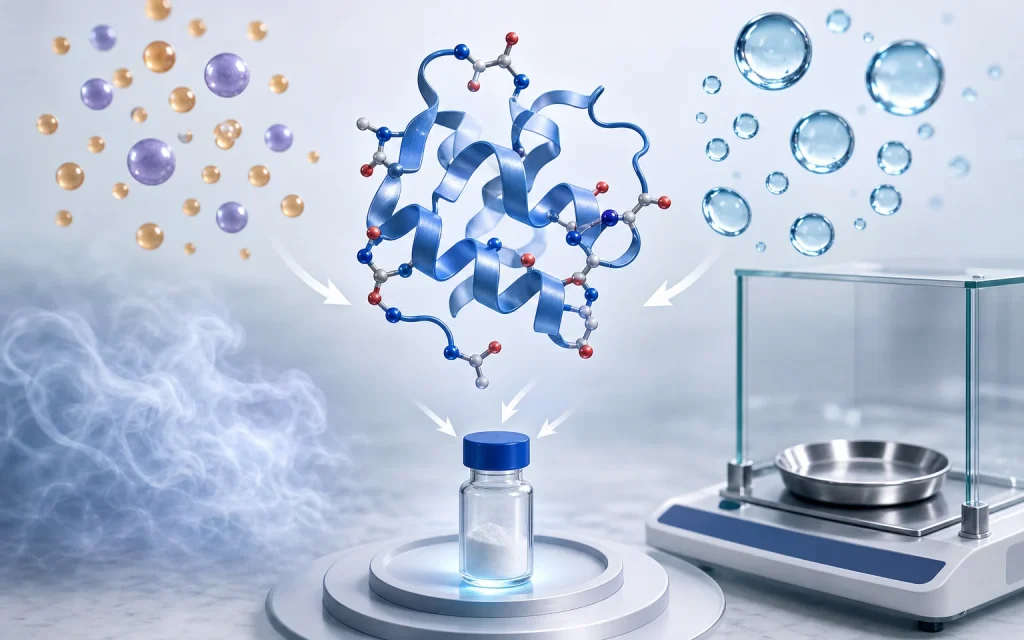
A vial can contain the intended peptide and still weigh more than the peptide alone. Counterions balance charge; water can be bound or adsorbed; residual solvents may remain from synthesis or purification; inorganic or other residues can contribute further mass. None of those components is revealed by an HPLC main-peak area percentage.
The right interpretation starts by defining the reporting basis. “As is” describes the material in its current composition. “Anhydrous” mathematically removes measured water. “Counterion-corrected” or “free-peptide equivalent” applies another stated correction. Without that basis, content numbers from different records may not be comparable.
Counterions are part of the analytical identity story
Peptides contain ionizable groups and are commonly isolated as salts. Trifluoroacetate can arise from purification conditions; acetate may result from a salt-exchange step. The counterion is not a peptide sequence impurity, yet it contributes to composition and can affect molecular-weight calculations, solubility and experimental design.
It should be measured by an appropriate quantitative method rather than inferred from the process name. Published methods include ion chromatography approaches for acetate and trifluoroacetate. A label such as “acetate form” identifies an intended form; it is not itself a quantitative counterion result.
Water requires its own measurement
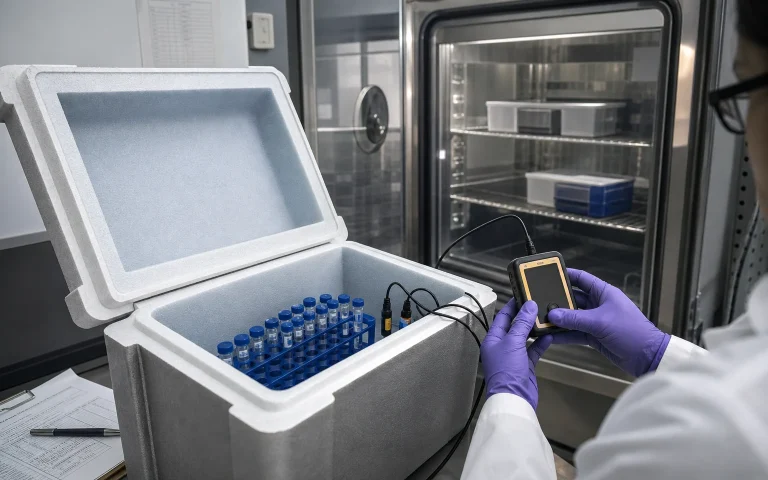
Lyophilized appearance does not mean zero water. Water can be associated with an amorphous cake, crystal lattice, excipients or ambient exposure. Karl Fischer titration is commonly used when water specificity matters; loss on drying can include other volatile material and therefore answers a somewhat different question.
The result should state the method and sample handling, because hygroscopic material can change during transfer. If assay is corrected to an anhydrous basis, the raw water result and formula should remain traceable.
Residual solvents are not one undifferentiated number
ICH Q3C(R8) groups solvents by toxicological risk and provides a framework for acceptable levels in drug substances and products. A research reagent is not automatically within that regulatory scope, but the document explains why solvent identity matters. “Residual solvents: pass” is less informative than the named solvent, method, limit and result.
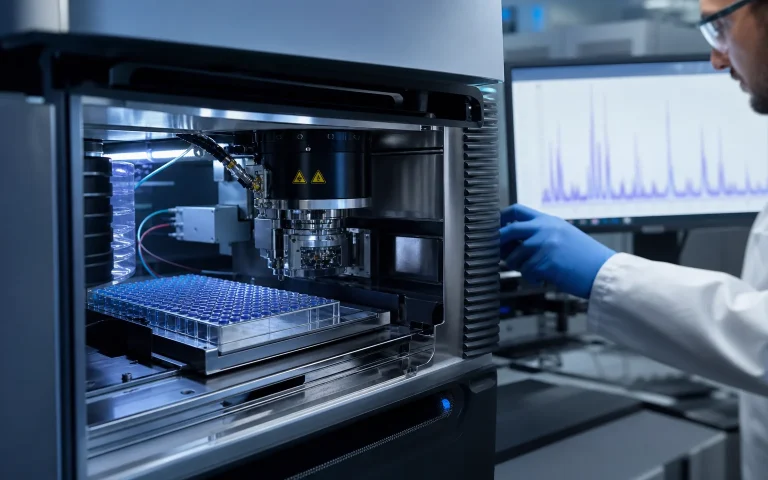
Headspace gas chromatography is often appropriate for volatile solvents. TFA and acetate generally need other approaches. A single GC panel should not be assumed to quantify every volatile, counterion or water contribution.
| Component | Typical analytical question | Possible method class |
|---|---|---|
| Target peptide | What amount is present on the stated basis? | Calibrated quantitative assay |
| Water | How much water is present? | Karl Fischer or justified alternative |
| Acetate / TFA | Which counterion and how much? | Ion chromatography or validated specific method |
| Volatile process solvents | Are named solvents below defined limits? | Headspace GC or suitable specific method |
| Nonvolatile inorganic residue | Is additional inorganic mass present? | Method chosen for the relevant element or residue |
A hypothetical mass-balance example
Imagine 100 mg of powder with separately measured 7 mg water and 9 mg counterion. Those two values do not prove that the remaining 84 mg is target peptide: peptide-related impurities, other residues and measurement uncertainty remain. Likewise, multiplying 100 mg by a 99% HPLC area result would be analytically unjustified.
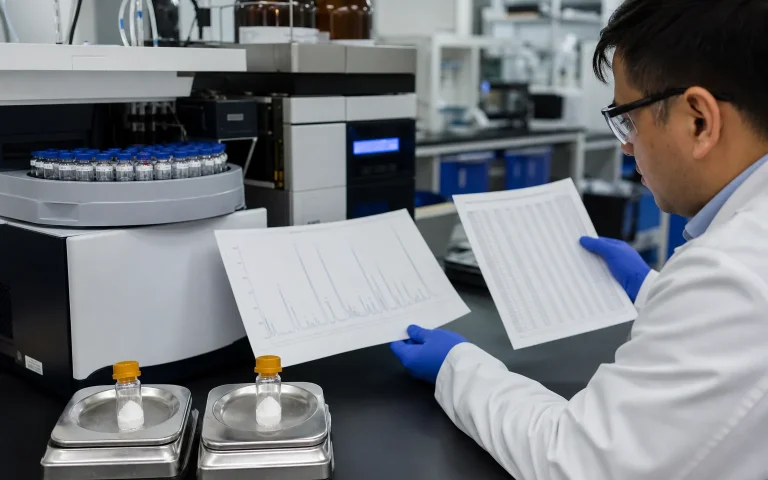
A defensible net-content calculation uses a quantitative peptide assay and clearly states whether corrections were applied. It also reports enough composition data to explain the basis. Values should not be forced to total exactly 100% when methods have separate uncertainty and coverage.
Procurement questions that prevent confusion
- What exact salt or counterion form is specified?
- Is counterion identity only declared, or quantitatively measured?
- Is the peptide assay reported as-is, anhydrous or counterion-corrected?
- Which method measured water, and how was the sample protected during handling?
- Which named residual solvents are in the panel, and what are their limits and results?
- Can the lot record support a transparent net peptide amount rather than only total powder weight?
Composition is best treated as a set of linked measurements. The goal is not to turn every component into a marketing claim; it is to ensure that an experimental concentration or molar amount is based on the quantity actually present.
Sources & editorial method
The editorial workflow starts with linked regulatory guidance and peer-reviewed analytical-method records; extracts scope, definitions, required fields and limitations; and separates general method principles from product- and lot-specific claims. AI-assisted drafting was used to structure the first version. Claims, examples and boundaries were checked against the linked records in the site editorial workflow. This is not independent peer review or evidence that any catalog lot has passed the tests described.
4 linked records are listed in the references below. Read the editorial and AI-assistance policy.
How to interpret this article
This composition guide does not report a counterion, water, solvent or assay value for any catalog lot. Exact composition requires batch-specific validated measurements.
Research-use boundary: Catalog materials discussed on this website are for laboratory research, development and manufacturing use only, not for human or veterinary use. This content is not medical advice and does not provide administration instructions.
Primary records and authoritative sources
- ICH Q3C(R8): Impurities—Guideline for Residual SolventsOfficial framework for classification and control of residual solvents.
- Determination of trifluoroacetic acid in synthetic peptides by ion chromatographyPeer-reviewed quantitative counterion method; PMID 22252914.
- Quantification of peptide counterions by validated ion chromatographyRecent peer-reviewed analytical-method record; PMID 40872554.
- Determination of acetate and trifluoroacetate in synthetic peptidesPeer-reviewed method record; PMID 9764489.
Continue the documentation review
Each guide answers a different analytical question. Use the complete set before treating one number as a complete quality record.
Open the complete Quality & Documentation Hub