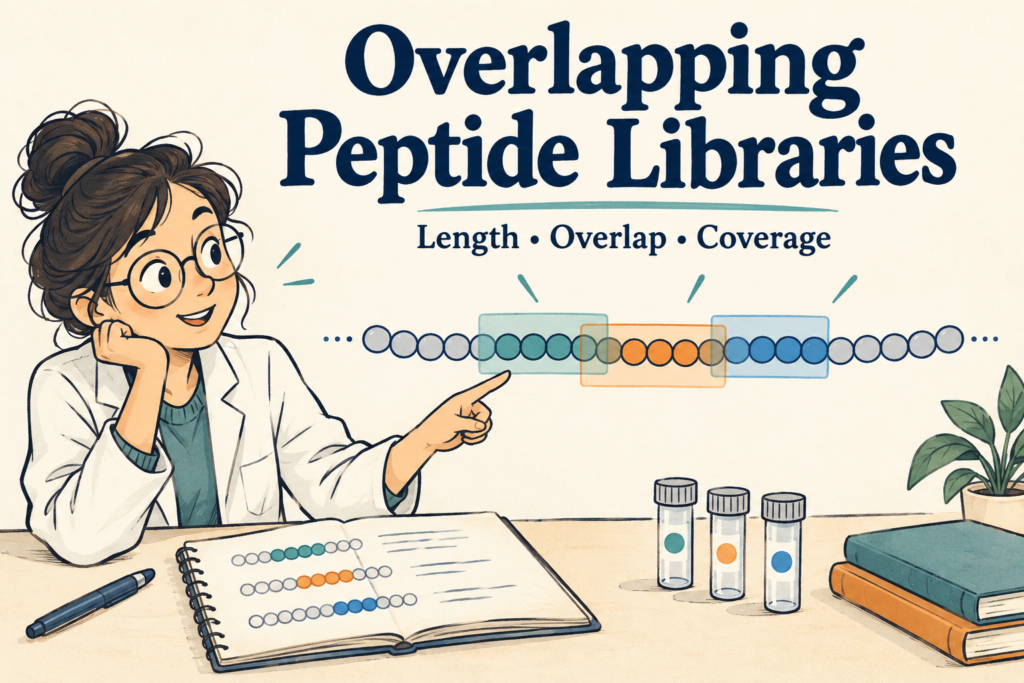
An overlapping peptide library is a set of short peptides taken from a longer sequence. Each piece shares part of its sequence with the next. Think of photographs taken along a road: neighboring photographs overlap so you can follow the route.
If you are ordering one for the first time, start with three questions: how long should each piece be, how much should neighboring pieces overlap, and must the very last position be included?
1. Length and overlap describe different things
A 15-residue peptide contains 15 amino acids. If two neighboring peptides overlap by 11 residues, the next piece starts four positions later: 15 minus 11 equals 4. This distance is the step.
The first piece covers positions 1–15, the second 5–19, and the third 9–23. Positions are counted from 1, and both ends are included.
JPT lists a 15-residue length with an 11-residue overlap as one option in its request form. It is an example of an available design format, not a rule that suits every experiment.
Source: JPT custom peptide-pool request form
2. A 300-position example: why 72 and 73 can both be correct
Here is an original calculation, not an NHD experiment or completed order. Take a sequence of 300 amino acids. Use 15-amino-acid pieces and move the start by four positions each time.
The last full piece on that regular pattern starts at 285 and ends at 299. There are 72 pieces, but position 300 is left out.
To include the last position while keeping every piece 15 residues long, you can add a piece covering 286–300. The total becomes 73. That final piece overlaps the preceding one by 14 residues, so it is an exception to the regular pattern.
The count for full pieces on the regular pattern is: round down ((300 − 15) ÷ 4), then add 1 = 72. The extra terminal piece is a design choice, not a counting error.
3. More overlap means more pieces
For the same 300-position sequence and 15-residue length, an overlap of 10 gives a step of 5 and 58 pieces, ending exactly at position 300. An overlap of 14 gives a step of 1 and 286 pieces. These are calculated counts, not predictions of performance or price.
Do not choose the largest overlap simply because it covers more positions. Agree the design with the team running the experiment, then check the complete sequence list before ordering.
4. What to include in the request
Send the exact long sequence, the selected region, peptide length, overlap and the final-position rule. A protein name alone may not identify the exact sequence version.
Give each short peptide an ID. Specify whether you need separate vials or mixed pools, how much of each peptide is required, and which purity and identity records are essential. Agree how missing or difficult entries will be reported.
For example, 73 entries at 1 mg per entry adds up to 73 mg across the order. It does not mean one vial contains 73 mg, and it does not specify the peptide-content basis. This is a packing calculation only.
Check a peptide sequence with the NHD sequence analyzer
5. Start with the material you actually need
If you only need a named material such as GHK-Cu or LL-37, start with its product page. An overlapping library is a different request: it needs the full sequence list and project-specific feasibility review.
View the GHK-Cu product family
Explore custom peptide synthesis
Send NHD the sequence list and the requirements you already know. Available scope, individual entries, documents, price and delivery require confirmation; this guide does not establish that every library can be supplied.
Ask NHD to review your peptide request
Sources & editorial method
AI-assisted writing checked against the listed sources.
1 linked records are listed in the references below. Read the editorial and AI-assistance policy.
How to interpret this article
Examples explain the topic; they are not NHD batch results or supply commitments.
Research-use boundary: Catalog materials discussed on this website are for laboratory research, development and manufacturing use only, not for human or veterinary use. This content is not medical advice and does not provide administration instructions.
Primary records and authoritative sources
- JPT custom PepMix request formDesign and request fields; not NHD capabilities.
Continue with structured records
Move from this editorial analysis to the product identity, filtered evidence and controlled terminology behind it.