


Understand the study
Afamelanotide: What Does “Pain-Free Sunlight Time” Mean?
Separate a rare-disease trial from ordinary tanning or sun-protection claims.

Why was sunlight a medical problem?
The trials studied people with erythropoietic protoporphyria, or EPP, a rare condition associated with painful reactions to light. The question was whether a defined afamelanotide implant increased direct sunlight exposure without pain. It was not a cosmetic tanning trial or a test of sunscreen for the general public. [1]
Why were there two trials?
The European study included 74 patients over nine months; the US study included 94 over six months. Both compared clinical implants with placebo, but their periods and sunlight assessments should be read separately. Two trials about the same compound do not automatically produce one interchangeable measurement. [1]
- 01EPP patients
- 02Defined clinical implant
- 03Accumulated pain-free sunlight hours
What did the sunlight hours represent?
No. In the US study, median accumulated pain-free direct-sunlight time was 69.4 hours versus 40.8 hours over six months. It was not a daily allowance. The European study reported 6.0 versus 0.8 hours under its own nine-month assessment. The protocol matters before comparing these figures. [1]
Why use the median?
The median is the middle result after observations are placed in order. For an invented set of 1, 2, 3, 4 and 100 hours, the median is 3, while the average is 22. This explains why the label matters. It is a teaching example, not the trial’s patient data.
What conclusion fits the study?
The trials reported longer pain-free sunlight time in the studied EPP populations. That is a disease-specific outcome. It does not establish unlimited safe sun exposure, prevention of all light damage, or a benefit from a catalog powder. A clinical implant’s result belongs to its formulation and testing conditions.
How is the catalog link useful?
The related Melanotan I/Afamelanotide catalog page helps readers check names and material identity for laboratory work. Confirm the exact form rather than assuming a research material is the clinical implant. Tell the team the experiment, quantity and records needed; the publication does not verify an NHD lot.
Explore the research topic
Related research products
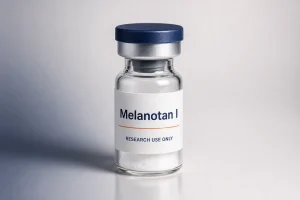
Melanotan I
Skin-related research
View product
GHK-Cu
Skin-related research
View product
LL-37
Skin-related research
View productImages illustrate the catalog. Related products are further reading, not claims of equal effects or interchangeability.
Original research and reading notes
Study amounts and preparations identify experimental conditions, not recommended use. AI-assisted research explanation; sources checked 11 October 2026. NHD catalog materials are for research, development and manufacturing, not human or veterinary use.