


ArticleRandomized human implant trials in EPP;…
Afamelanotide: What Does “Pain-Free Sunlight Time” Mean?
Separate a rare-disease trial from ordinary tanning or sun-protection claims.
Updated October 11, 2026
NHD Global
Cosmetic & Skin · Source-reviewed dossier
Source-Reviewed Research Dossier
Melanotan I is a research peptide often linked to afamelanotide, a synthetic version of the natural hormone α-MSH. In a small human study, repeated injections of such a peptide caused measurable skin darkening that lasted weeks, with subcutaneous delivery fully bioavailable versus intravenous, while oral dosing produced no detectable drug. That early work helped justify a controlled-release implant approved only for adults with erythropoietic protoporphyria, a condition causing painful sunlight reactions. Catalog Melanotan I powder is a research material, not that implant, and no published evidence supports treating it as interchangeable or as a safe tanning product.
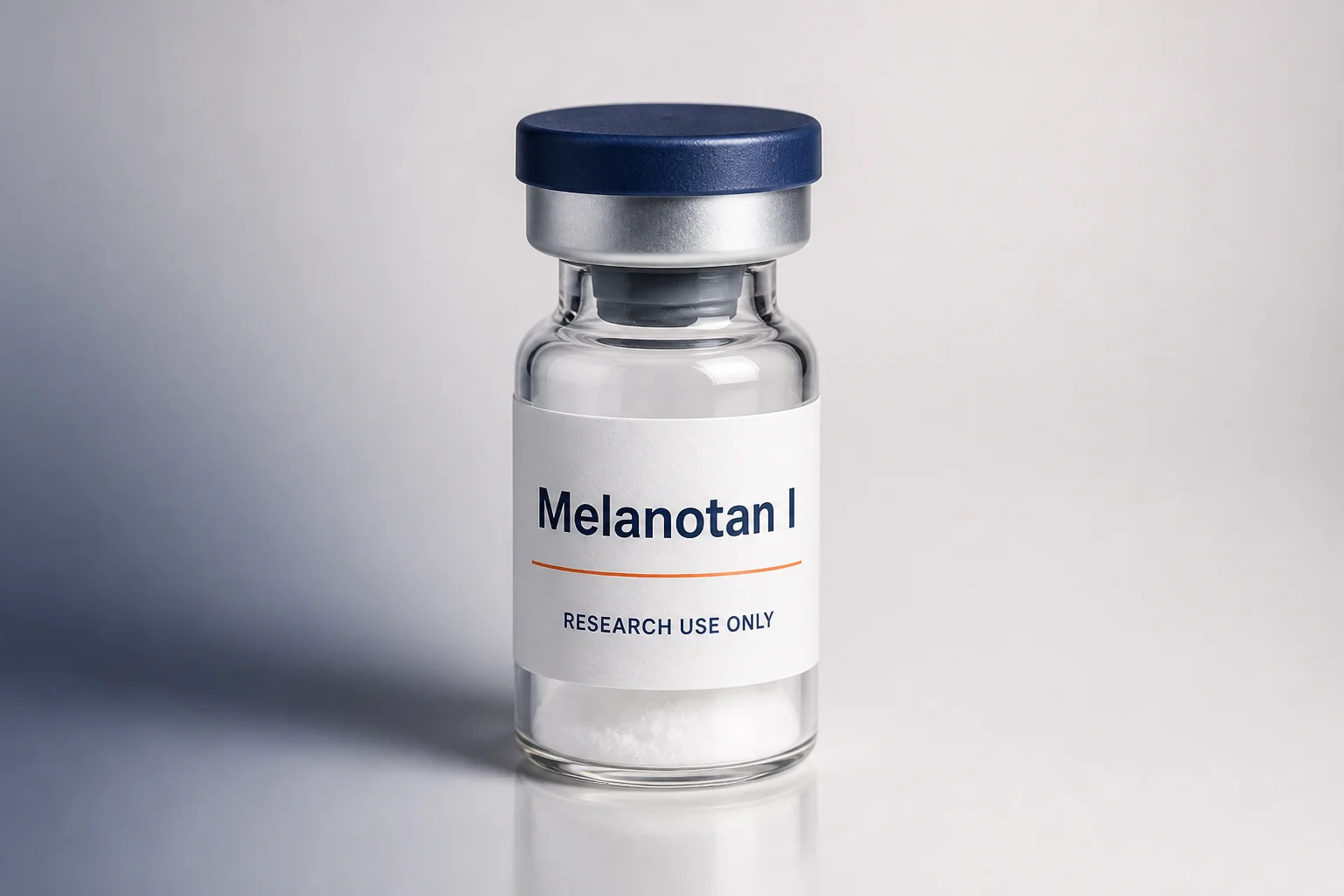
Shared values below are consolidated from the current catalog record. They are not independent verification or lot results; request the applicable product specification and ask which lot records are available before ordering.
Product identity
Literature reference parameters
Identity safeguard Reference identifiers above describe the literature compound record. Confirm the supplied form, formula, molecular weight, purity and storage conditions against the applicable product specification and any available lot records.
A target-to-pathway view grounded in the linked research records.
Reported research findings
Reported outcomes are paired with their experimental model and evidence boundary.
An early human study evaluated the synthetic melanotropin analogue now associated with afamelanotide.
Early experimental exposure does not establish safety for unapproved tanning formulations.
Read the primary studyThe label covers a 16 mg controlled-release implant for adults with erythropoietic protoporphyria.
It does not approve catalog Melanotan I, self-injection or cosmetic tanning.
Read the primary studyCatalog options
Pack-level catalog data; lot-level controls remain document-specific.
Single-component peptide · 10 mg/vial nominal · 10-vial pack · supplied form and release limits controlled by lot specification.
Document availability and scope must be confirmed for this variant and lot in the written quotation. A catalog description is not a lot-specific test result.
A listed document is not proof of availability for this lot. Ask the team to confirm the current COA status and the scope of any other records before ordering.
Analytical interpretation
Use the source-reviewed guide to separate chromatographic area purity, quantitative assay, LC-MS identity, composition and stability evidence before comparing variants or requesting a lot record.
Open the Quality & Documentation HubHPLC area ≠ assayA dominant peak does not establish target mass fraction.
Intact mass ≠ full sequenceIdentity strength depends on resolution and orthogonal evidence.
Counterions affect contentWater, salt form and solvents change the as-is composition.
Storage needs a data basisShipping practice is not the same as stability evidence.
Evidence map
Published studies and regulatory records, not customer testimonials or usage guidance.
Early experimental exposure does not establish safety for unapproved tanning formulations.
View primary recordIt does not approve catalog Melanotan I, self-injection or cosmetic tanning.
View primary recordThird-party publications selected for direct relevance.
Human study. 1997. PMID 9113347.
U.S. FDA label, revised 2024.
Concise answers for researchers comparing identity, evidence and catalog variants.
In a small pharmacokinetic trial, repeated subcutaneous or intravenous dosing produced measurable tanning of the forehead, arms and neck. The effect peaked about one week after dosing and was still detectable three weeks later. Subcutaneous dosing was fully bioavailable compared with intravenous, while oral dosing yielded no detectable drug. Side effects were minimal, but the small number of volunteers and short follow-up do not establish safety or effectiveness for unapproved tanning products.
The approved product is a 16 mg controlled-release implant for adults with erythropoietic protoporphyria. Its formulation, release profile, indication and risk controls belong to that specific product, not to research powder sold as Melanotan I. A research material and a licensed implant share a related peptide sequence but are not the same material. Published implant outcomes cannot be assigned to unapproved formulations, self-injection or cosmetic tanning.
Human pigmentation studies and a narrow product approval exist, but no general tanning approval follows.
No. The cited records describe their own intervention, formulation, model and controls. They do not verify the identity, purity, sterility, safety or efficacy of a catalog lot.
A lot-specific COA, product specification sheet and analytical method summary can be requested where applicable.
Store at -20 °C, protected from light and moisture. After reconstitution, aliquot and avoid repeated freeze-thaw cycles. Confirm the applicable storage statement on the product-specific specification and lot documentation.
Knowledge center
Owned educational content connected to this family.

Separate a rare-disease trial from ordinary tanning or sun-protection claims.
Updated October 11, 2026Knowledge tools
Move from this dossier into canonical evidence maps, verified status records, analytical interpretation and laboratory calculations.
Claims were checked against the linked primary publication, regulatory label or authoritative compound record. Published findings stay attached to their study model, formulation and route. Catalog identity and lot quality remain controlled by the applicable specification and lot-specific documents.
Technical procurement
Selected: MT1 · 10 mg × 10 vials
Tell us what you need. Your enquiry will be routed to the appropriate contact for catalog numbers, availability and quotation details.