


ANALYTICAL METHODS · PRACTICAL GUIDE
Peptide Acetylation and Amidation: What Changes at Each End?
Understand the two ends of a peptide before calculating terminal modifications.
Two labels show the same peptide sequence, but one also says “Ac” or “amide.” Are the products identical? Those small additions describe changes to the ends of the chain. They belong in both the specification and the expected mass.
A peptide has a beginning and an end
A peptide sequence is usually written from its amino end, called the N-terminus, to its carboxyl end, called the C-terminus. Changing a group at either end can change the molecule without changing the sequence letters.
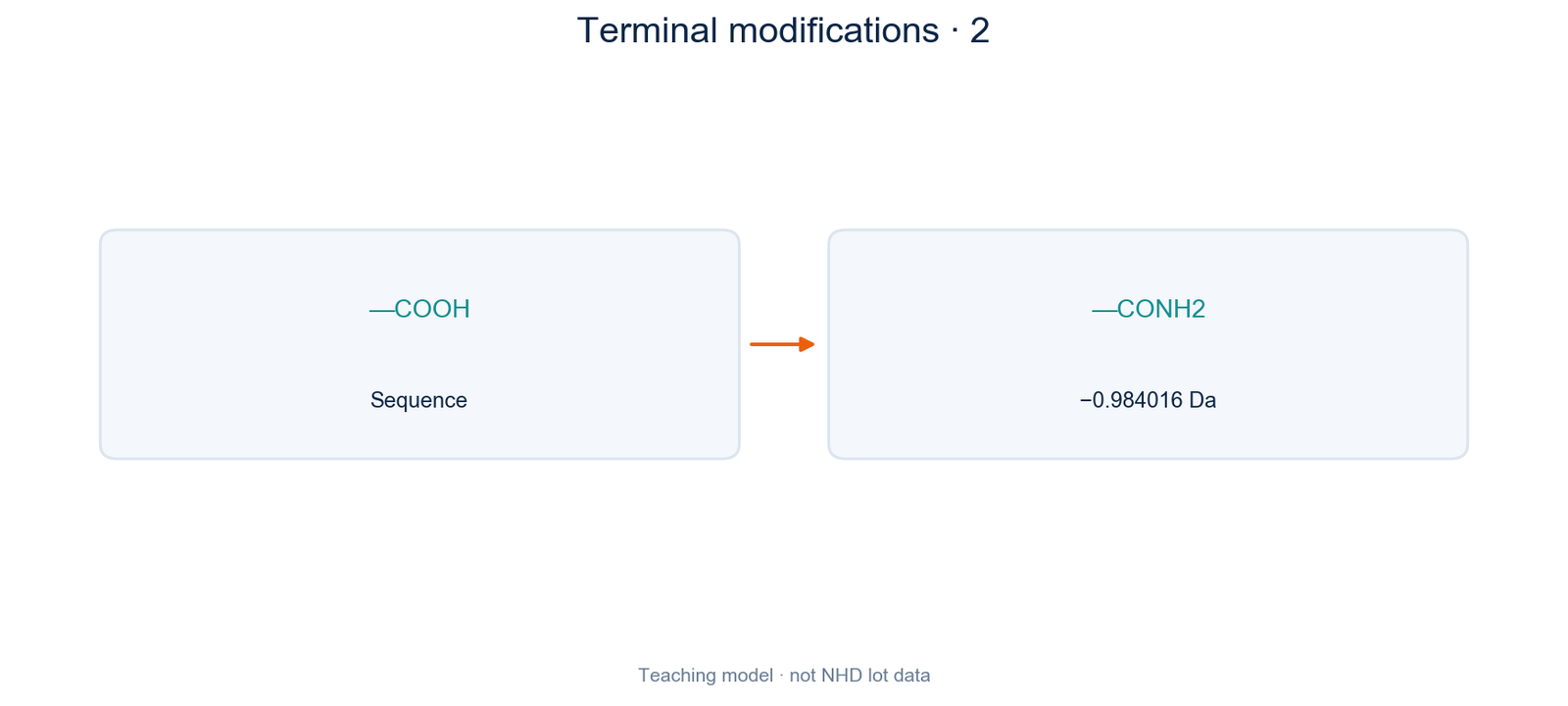
The diagram shows a simplified end-group change, rather than a three-dimensional structure.

What does N-terminal acetylation add?
Compared with the corresponding free end, the net added composition is C2H2O. Its monoisotopic mass contribution is +42.010565 Da.
State the location as well as the modification. A +42 shift alone does not tell you whether the acetyl group is at the N-terminus or another suitable position.
Why C-terminal amidation makes the mass slightly lower
In a simplified picture, the C-terminal COOH group becomes CONH2. That replacement changes the atoms; it is not simply adding an extra group on top. The monoisotopic mass change is −0.984016 Da.
Keep the minus sign. If your reference uses average molecular mass, use the matching average-mass calculation instead.
What happens when both ends change?
Start with an example unmodified monoisotopic mass of 1,000.000000 Da. Add 42.010565 for N-terminal acetylation and subtract 0.984016 for C-terminal amidation. The result is 1,041.026549 Da, with the rest of the molecule unchanged.
This calculation predicts a mass difference. It does not predict the biological effect or stability of those changes.
See the answer
1,000.000000 − 0.984016 = 999.015984 Da.
Acetylation is different from acetate
Acetylation means an acetyl group is covalently attached to the molecule. Acetate describes a salt component, or counterion, associated with the material. A label saying acetate does not by itself mean the peptide was N-terminally acetylated.
Write the sequence, N- and C-terminal groups, other modifications and salt form as separate details.

Checking Thymosin α1 or KPV forms
For Thymosin α1 or KPV, check the actual end groups of the selected variant. Keep them with the sequence when requesting or comparing materials.
Discuss material and document requirements with NHD · Continue with the analytical guide