


ANALYTICAL METHODS · PRACTICAL GUIDE
How to Read a Peptide COA: A Worked Example for Buyers
Check the lot, distinguish requirements from results and recognize what was not tested.
A certificate of analysis, usually shortened to COA, summarizes reported testing for an identified sample or lot. It is tempting to jump to the word “Pass.” A more useful approach is to check which material was tested and what each result actually says.
1. Read the identity block first
Find the product name, form or variant, lot number, sample identification and report date. Compare them with the vial label and order. A report for another lot does not become yours simply because it names the same peptide.

A material may have several names, but an alias should not conceal a different sequence, terminal group or molecular form. If the identifiers disagree, ask for clarification before relying on the document.
2. Requirement and result are different columns
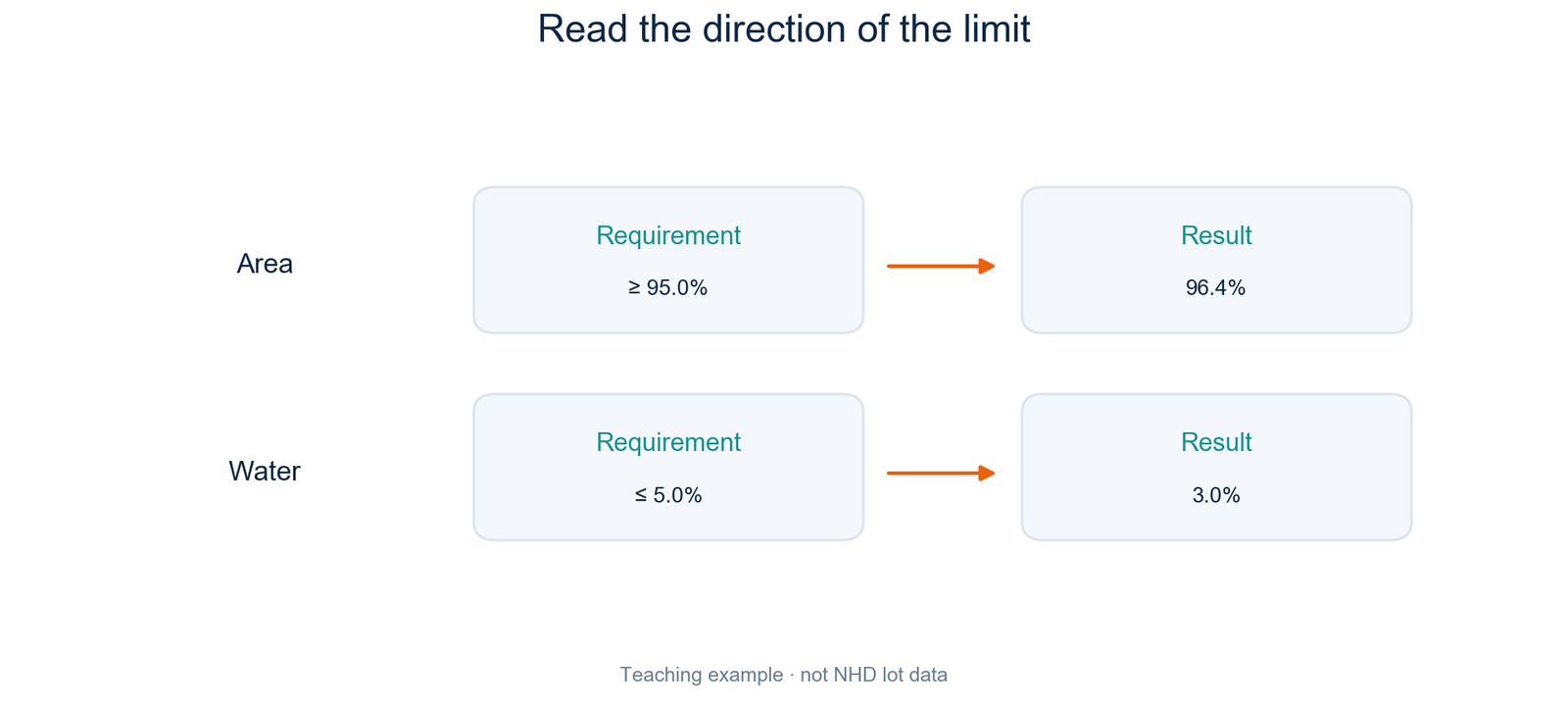
A requirement describes the agreed acceptance criterion. A result describes the measurement or observation. Here is an invented three-row report to practice reading both.
| Test | Requirement | Reported result |
|---|---|---|
| Identity | Match declared form by stated method | Consistent with expected mass |
| HPLC area purity | At least 95.0% | 96.4% |
| Water | At most 5.0% w/w | 3.0% w/w |
For the purity row, 96.4 is greater than 95.0, so it meets that fictional criterion. For water, 3.0 is less than 5.0. Passing those rows does not establish an unlisted test. The identity wording also needs its method and scope; “consistent” is not a claim that every possible structure was excluded.
3. Decode the reporting words
“Not tested” means no result is supplied for that item. “Below quantitation limit” means the method cannot reliably quantify at that level; it does not mean zero. “Not detected” needs its detection limit and method. “Conforms” requires knowing what requirement it refers to.
| Wording | A useful follow-up |
|---|---|
| Not tested | Is the test needed and can it be arranged? |
| Below a reporting limit | What is the limit, method and unit? |
| Conforms | Against which criterion and method version? |
| Typical value | Is this a batch result or general information? |

4. Read units and reporting basis
A percentage may describe chromatographic area, mass fraction or another basis. A mg/g result is not automatically the same kind of percentage. Write the full definition beside the number before doing arithmetic.
For a hypothetical mass result, 20 mg/g equals 2% by mass because one gram is 1,000 mg. This conversion says nothing about HPLC area purity. It also does not turn a limit result into an exact amount.
5. Decide when to ask for supporting records
A COA is a summary. If a result affects your experiment, ask what supporting records can be supplied: complete chromatogram and integration table, mass spectrum, method reference or result basis. Confirm availability rather than assuming every supplier provides every item.
Check report revisions too. A corrected report should be identifiable so the lab does not use an older version accidentally. ICH Q6A treats a specification as tests, procedures and acceptance criteria; it is a drug-substance guideline here used for general reading context, not a claim of NHD compliance.
6. Practice: what can you conclude?
Check your answer
No. The reported purity does not establish endotoxin. Ask whether it was tested and what result and method are available.
Keep a short note with the agreed requirement, actual result, units, lot and unresolved questions. You can then explain exactly why a document is sufficient for a particular decision—or which information is still missing.
Use this guide in a product enquiry
For materials such as LL-37、GHK-Cu, identify the exact form, quantity and research question first. Then ask what records are available for the relevant lot. Matching product names do not make different specifications interchangeable.
Discuss products and document requirements with NHD. Continue learning: Reading a chromatogram / Lot documents.