


ANALYTICAL METHODS · PRACTICAL GUIDE
mg/mL vs µM: Two Ways to Describe the Same Peptide Solution
See what each concentration unit counts, then convert between mg/mL and µM.
Is 1 mg/mL stronger than 500 µM? You cannot tell from those two numbers alone. They describe concentration in different ways. With the peptide’s molecular weight, you can put both values into the same unit.
Read mg/mL as weight per volume
A concentration of 1 mg/mL means one millilitre of solution contains 1 mg of the material being counted. At that concentration, 2 mL contains 2 mg and 10 mL contains 10 mg.
Be specific about the material: is this weighed powder, or a measured amount of the target peptide?
Read µM as molecular amount per volume
µM means micromolar: micromoles per litre. It is useful when comparing amounts of molecules. At the same mg/mL, smaller molecules give more molecules per volume than larger ones.
Think of two bags of beads with equal weight. A bag of smaller beads can contain more individual beads.

Convert 1 mg/mL into µM
Take an example peptide with a molecular weight of 2,000 g/mol. First, 1 mg/mL is the same as 1 g/L. Divide by 2,000 to get 0.0005 mol/L, then convert to micromolar: 500 µM.
µM = mg/mL × 1,000,000 ÷ molecular weight (g/mol)
Nothing in the bottle changed. You have described the same concentration using a different unit.
Try a second molecular weight
At 1,000 g/mol, the same 1 mg/mL becomes 1,000 µM. At 2,000 g/mol, it was 500 µM. The first solution has twice as many molecules per volume, even though the weight concentrations match.

See the answer
0.2 × 1,000,000 ÷ 4,000 = 50 µM.
Keep concentration separate from total amount
Two tubes at 250 µM can have different total amounts if one holds 1 mL and the other holds 10 mL. Concentration says how much is present per volume; total amount also needs the volume.
The conversion also cannot tell you whether the peptide fully dissolved or stayed intact. Those are separate checks.
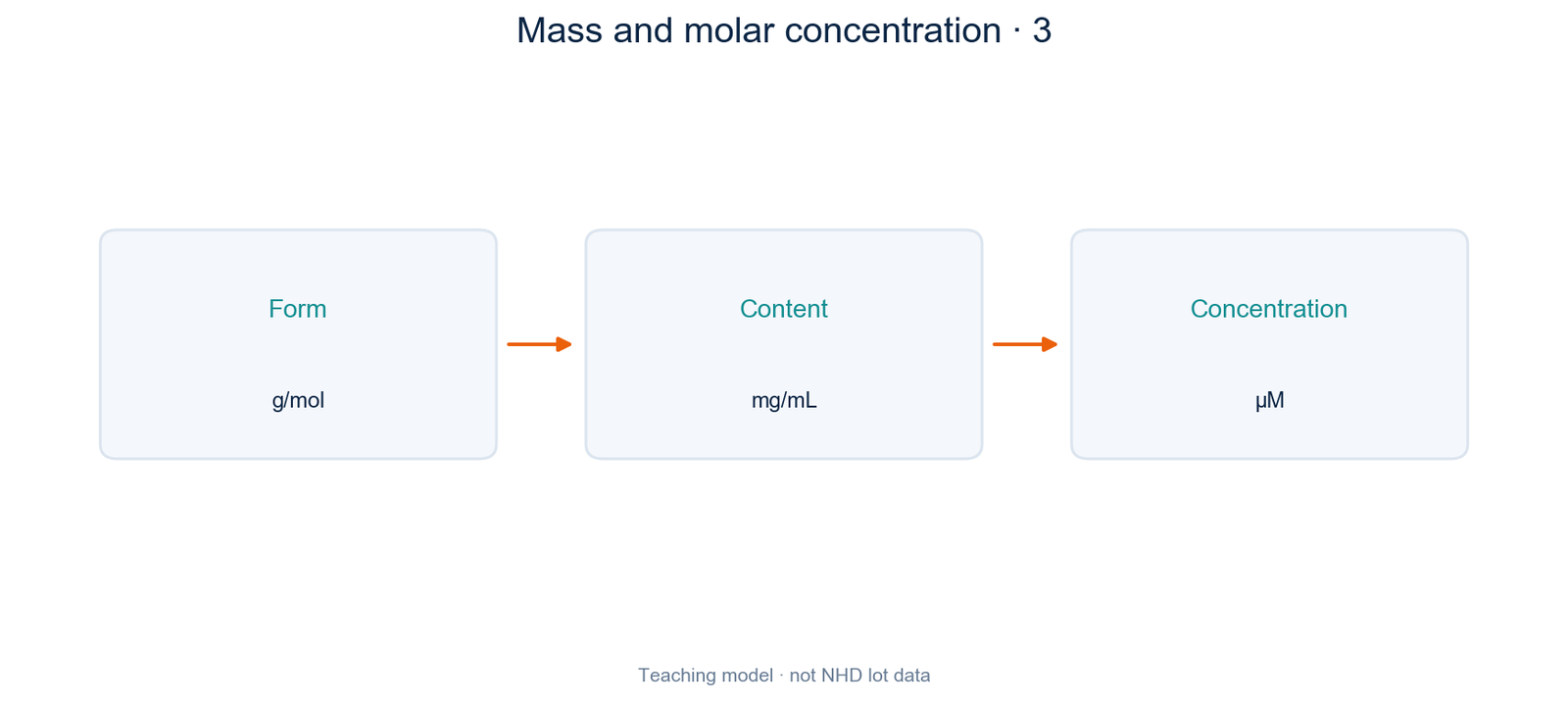
Comparing KPV or LL-37 concentrations
For KPV or LL-37, record the concentration unit and exact product form together. If you are comparing a research paper with a product record, first convert both to the same unit using the correct molecular weight.
Discuss material and document requirements with NHD · Continue with the analytical guide

 KPV
 LL-37