A peptide can reduce biofilm formation without stopping bacterial growth at the same concentration. The LL-37 study illustrates that distinction. Understanding what each test measures makes the results much easier to compare.
What is a biofilm?
A biofilm is a community of microbes attached to a surface within a surrounding matrix. An ordinary growth assay asks whether bacteria multiply under the test conditions. A biofilm assay can ask whether they attach and build that community. A substance can affect one behavior without stopping all bacterial growth.
Two concentrations from one laboratory study
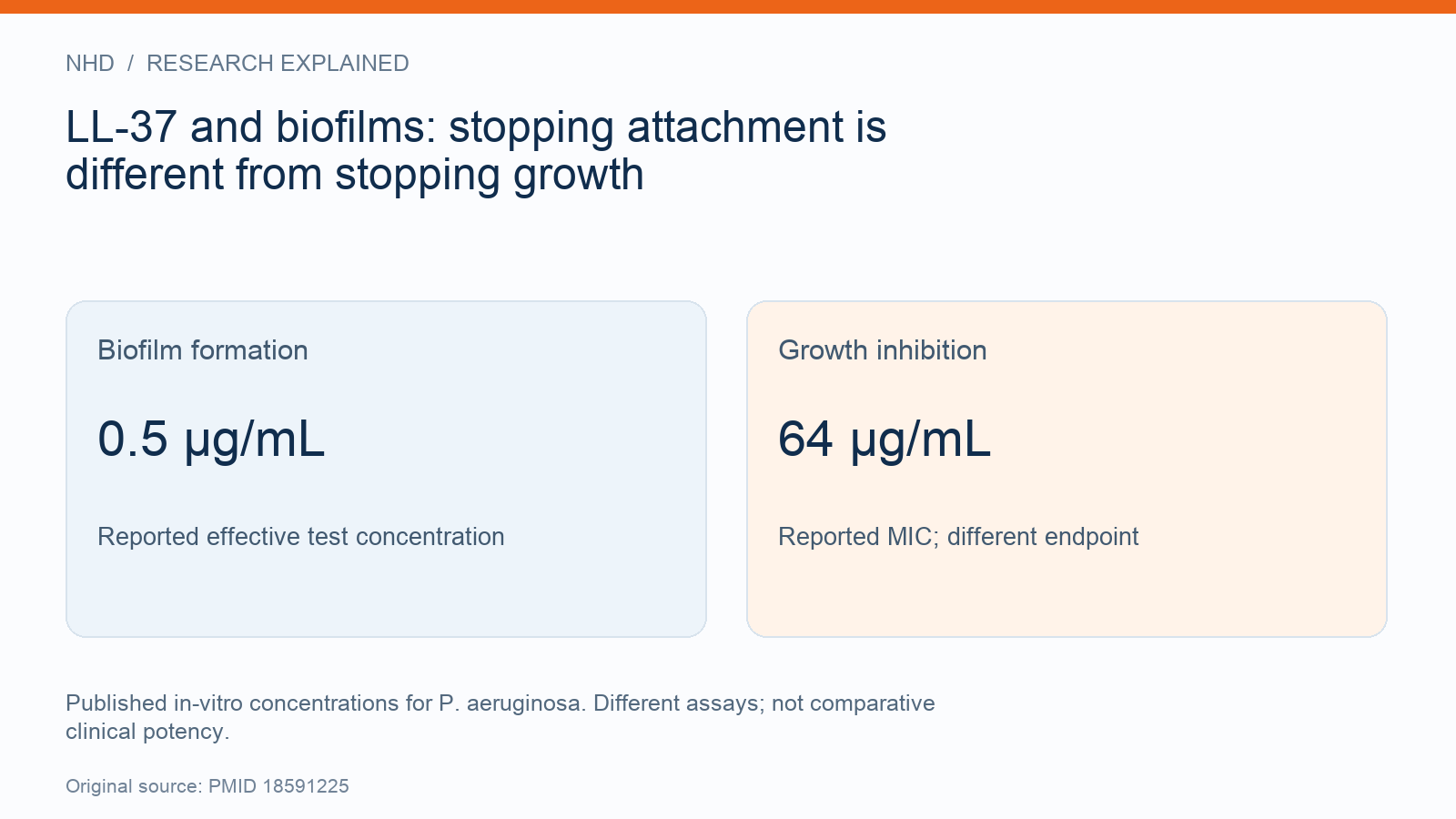
A 2008 LL-37 study reported inhibition of Pseudomonas aeruginosa biofilm formation at 0.5 micrograms per millilitre. Its reported minimum inhibitory concentration, or MIC, was 64 micrograms per millilitre. MIC describes the growth-inhibition threshold under the specified test conditions. The lower biofilm concentration refers to a different endpoint.
Why “128 times stronger” would be misleading
Dividing 64 by 0.5 gives 128. That arithmetic is correct, but the interpretation “128 times stronger” is not. The calculation compares two different assays, not two measures of the same potency. A more accurate summary is that the biofilm-formation response occurred below the growth-inhibition threshold in that experimental setup.
The mechanism involved bacterial behavior
The authors examined attachment, twitching motility and signaling associated with biofilm behavior. This helps explain why the endpoint could change without broad growth inhibition at the same concentration. It suggests a research question about how bacteria organize on a surface. It does not establish that LL-37 removes every mature biofilm or treats an infection in a person.
Read the medium and the stage
For comparisons, ask which strain, medium, surface and biofilm stage were tested. Preventing formation and disrupting an established community are different tasks. Our LL-37 medium and MIC guide explains why salt and culture conditions also matter. A number without its conditions is difficult to reuse meaningfully.
Product connection for laboratory enquiries
The LL-37 product page is the related catalogue entry. For a biofilm project, identify whether you plan to measure attachment, biofilm biomass or bacterial growth. Describe the molecular form and document requirements along with the quantity. This makes the enquiry more useful than asking only for an “antibacterial peptide.”
Less biofilm and fewer living bacteria are different findings
| Check | What it tells you |
|---|---|
| Biofilm measurement | Measures the attached community or its material, depending on the assay. |
| Growth measurement | Tracks growth under the selected culture conditions. |
| Viability measurement | Asks whether organisms remain alive using the stated method. |
For laboratory procurement, review the related NHD catalog material and confirm the selected variant, amount basis and available records. Send a research enquiry with those requirements; the cited experiment is not a test of an NHD lot.
Related products and enquiries
Ask NHD about the required material, quantity and analytical documents. Stock, price and available batch records need confirmation.
Original research
Sources checked 6 October 2026. AI-assisted editorial review covered source attribution, numerical accuracy and readability; this is not independent peer review. NHD catalogue materials are for qualified laboratory research, development and manufacturing, not human or veterinary use.
Sources & editorial method
AI-assisted writing and deterministic explanatory figure
0 linked records are listed in the references below. Read the editorial and AI-assistance policy.
How to interpret this article
AI-assisted editorial review, not independent peer review.
Research-use boundary: Catalog materials discussed on this website are for laboratory research, development and manufacturing use only, not for human or veterinary use. This content is not medical advice and does not provide administration instructions.
Continue with structured records
Move from this editorial analysis to the product identity, filtered evidence and controlled terminology behind it.