
LL-37 research includes both antibacterial activity and cell signaling. A skin-cell migration study explains why these are separate questions, and a later trial shows why that distinction matters.
Killing bacteria and moving skin cells are different effects
An antibacterial experiment asks whether a peptide limits bacteria under defined test conditions. A cell-migration experiment asks whether cells move. Those are different outcomes, even if both can be relevant to wound research. For LL-37, reading the study type first prevents a common misunderstanding: an antibacterial result does not automatically show faster repair of skin.
What are keratinocytes?
Keratinocytes are cells that form much of the outer layer of skin. Migration means movement, rather than simply making more cells. In a cell assay, researchers can measure whether an experimental condition changes that movement. A complete wound also involves other cells, blood supply, mechanical conditions and many signaling processes, so a migration assay examines only one part of the larger question.
The two clear numbers in the 2005 experiment
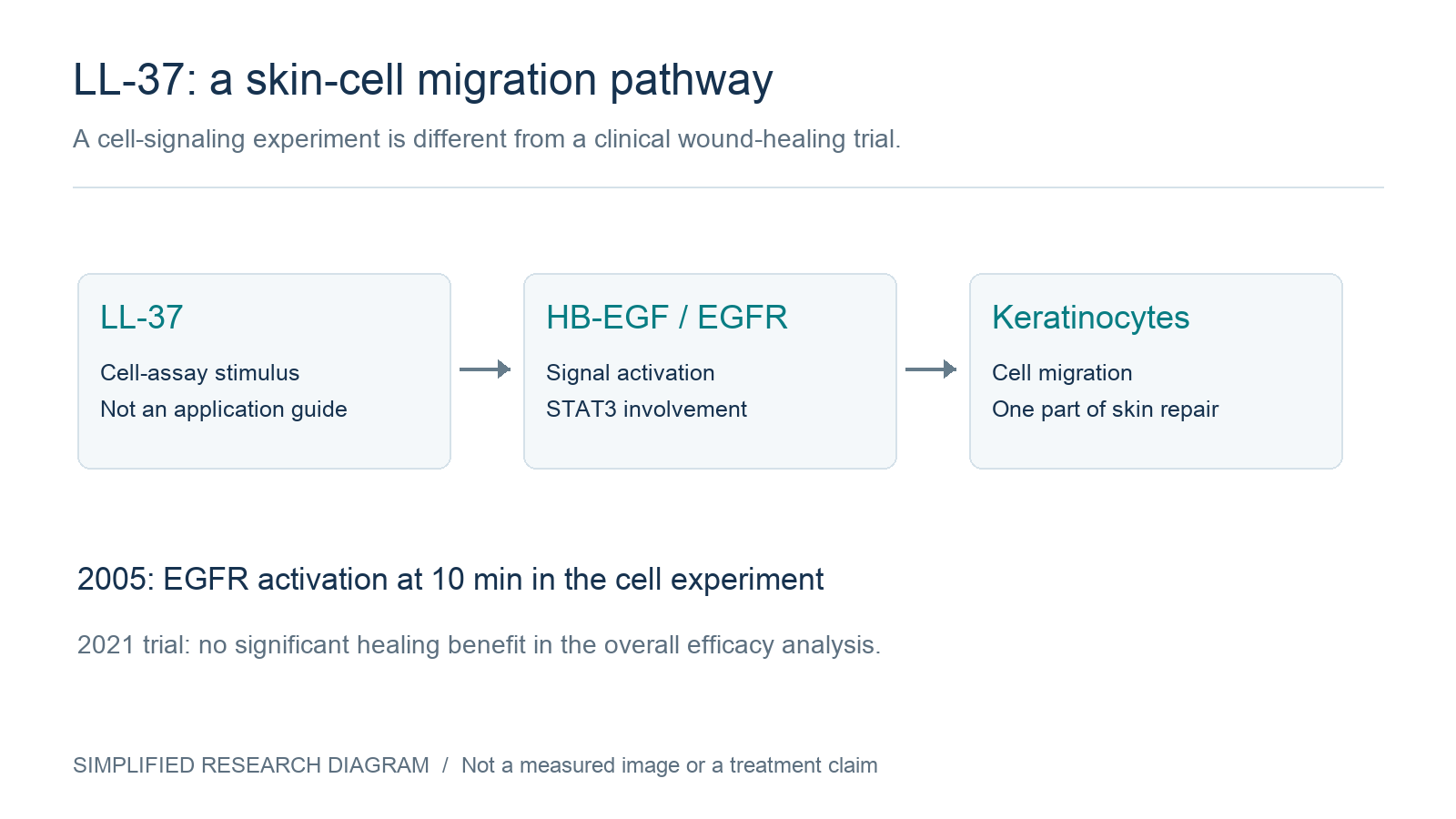
Tokumaru and colleagues reported maximum keratinocyte migration at 1 microgram/mL LL-37 in their Boyden chamber assay. They also observed EGFR phosphorylation after 10 minutes. EGFR is a receptor involved in cell signaling; phosphorylation is a biochemical sign of activation. These numbers describe that cell experiment. They are not wound-healing rates, human treatment amounts or instructions for applying a research material. Read the original study.
Why blocking a pathway helps explain the result
The researchers tested inhibitors of steps in the proposed pathway. Blocking those steps prevented the LL-37-induced migration response. That is more informative than observing movement alone: it helps connect the response to a signaling mechanism involving HB-EGF, EGFR and STAT3. A simplified pathway diagram shows the proposed relationship, rather than the molecular structure or the full complexity of living skin.
What happened when a formulated product was tested in people?
The 2021 HEAL LL-37 trial studied topical LL-37 with compression therapy in 148 treated patients with hard-to-heal venous leg ulcers. The overall efficacy analysis did not find a significant healing improvement compared with placebo. A post hoc subgroup with larger ulcers showed a signal that required further study. This does not cancel the cell finding: the studies ask different questions. It does show why a promising mechanism should not be presented as a proven clinical benefit. Read this study.
Choose the material for the question
A project measuring bacterial growth is different from a project measuring cell movement or receptor activation. State which question your material needs to support. For the antibacterial side, our LL-37 test-medium guide explains another factor that can change a result. When enquiring about LL-37, include the required molecular form, quantity and analytical documentation. Published biology cannot substitute for the identity records of the material used in your own work.
Explore the related NHD product
See the LL-37 product record for catalogue information. Send your quantity and document requirements for a quote. Availability and the scope of any lot documents need confirmation.
Original studies
- Keratinocyte migration and EGFR signaling — 2005 original study
- HEAL LL-37 phase IIb trial — 2021 original study
Sources checked 5 October 2026. This explanation uses the accessible original abstracts and figure descriptions. The diagram is a simplified explanation, not an experimental image. NHD catalogue materials are for qualified laboratory research, development and manufacturing enquiries, not human or veterinary use.
Sources & editorial method
AI-assisted writing; deterministic explanatory diagram.
2 linked records are listed in the references below. Read the editorial and AI-assistance policy.
How to interpret this article
AI-assisted editorial review; not independent human peer review. Experimental endpoints and catalogue material are distinguished.
Research-use boundary: Catalog materials discussed on this website are for laboratory research, development and manufacturing use only, not for human or veterinary use. This content is not medical advice and does not provide administration instructions.
Primary records and authoritative sources
- Keratinocyte migration and EGFR signaling — 2005 original studyOriginal study; checked 2026-10-05.
- HEAL LL-37 phase IIb trial — 2021 original studyOriginal study; checked 2026-10-05.
Continue with structured records
Move from this editorial analysis to the product identity, filtered evidence and controlled terminology behind it.