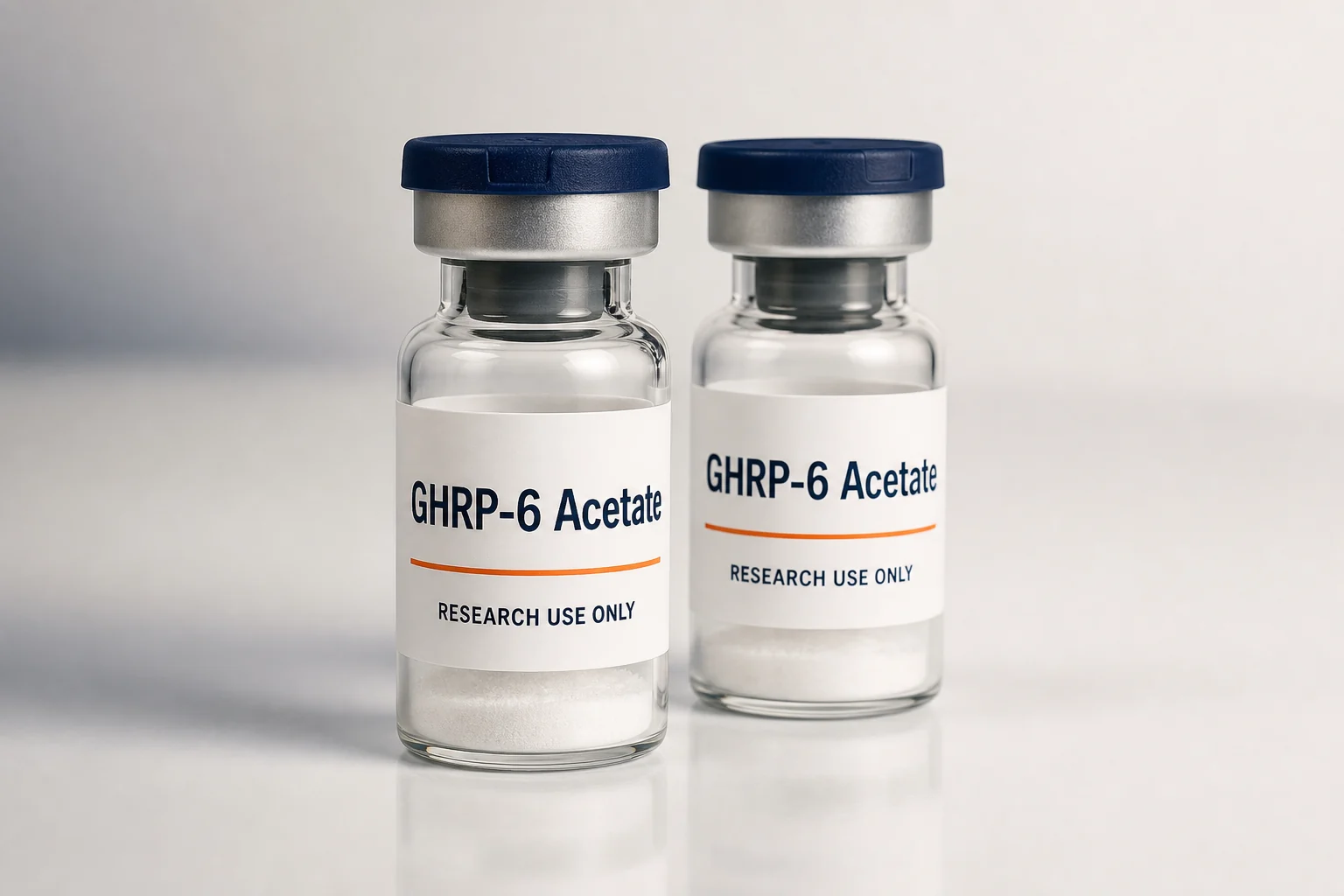
GHRP-6 Human Evidence: GH Pulses and GHRH Dependence
GHRP-6 can provoke growth-hormone release in controlled human experiments, but the response depends heavily on intact hypothalamic GHRH signaling and does not establish a…
Updated October 1, 2026Growth Hormone & IGF · Source-reviewed dossier

Source-Reviewed Research Dossier
GHRP-6 is a short lab-made peptide studied for its ability to trigger growth hormone release. Researchers use it because the hormone rise it causes is easy to measure in blood. A key human finding: when given with the body's natural growth-hormone-releasing hormone, the combined surge was far larger than either alone. When the link between the brain's control centre and the pituitary gland was cut, GHRP-6 stopped working. Later rat work reported less heart and organ damage from a toxic cancer drug. Those are early animal findings only. This material is for research, not human use, and its identity and quality are set by lot documentation.
Shared values below are consolidated from the current catalog record. They are not independent verification or lot results; request the applicable product specification and ask which lot records are available before ordering.
Product identity
Literature reference parameters
Identity safeguard Reference identifiers above describe the literature compound record. Confirm the supplied form, formula, molecular weight, purity and storage conditions against the applicable product specification and any available lot records.
A target-to-pathway view grounded in the linked research records.
Reported research findings
Reported outcomes are paired with their experimental model and evidence boundary.
A study in patients with hypothalamic-pituitary disconnection reported blocked GHRP-6-induced GH secretion and loss of synergy with GHRH.
The study examines diagnostic physiology, not general treatment effectiveness.
Read the primary studyA 2024 study evaluated GHRP-6 in a doxorubicin-injury animal model and reported prosurvival-pathway findings.
Animal injury-model results cannot establish human outcomes.
Read the primary studyCatalog options
Pack-level catalog data; lot-level controls remain document-specific.
Single-component peptide · 5 mg/vial nominal · 10-vial pack · supplied form and release limits controlled by lot specification.
Document availability and scope must be confirmed for this variant and lot in the written quotation. A catalog description is not a lot-specific test result.
Single-component peptide · 10 mg/vial nominal · 10-vial pack · supplied form and release limits controlled by lot specification.
Document availability and scope must be confirmed for this variant and lot in the written quotation. A catalog description is not a lot-specific test result.
A listed document is not proof of availability for this lot. Ask the team to confirm the current COA status and the scope of any other records before ordering.
Analytical interpretation
Use the source-reviewed guide to separate chromatographic area purity, quantitative assay, LC-MS identity, composition and stability evidence before comparing variants or requesting a lot record.
Open the Quality & Documentation HubHPLC area ≠ assayA dominant peak does not establish target mass fraction.
Intact mass ≠ full sequenceIdentity strength depends on resolution and orthogonal evidence.
Counterions affect contentWater, salt form and solvents change the as-is composition.
Storage needs a data basisShipping practice is not the same as stability evidence.
Evidence map
Published studies and regulatory records, not customer testimonials or usage guidance.
The study examines diagnostic physiology, not general treatment effectiveness.
View primary recordAnimal injury-model results cannot establish human outcomes.
View primary recordThird-party publications selected for direct relevance.
Human endocrine study. 1995. PMID 7883854.
Preclinical study. 2024. PMID 38873418.
Concise answers for researchers comparing identity, evidence and catalog variants.
The clearest effect is a prompt, dose-related rise in blood growth hormone. Human studies measured this directly and found it was larger than the body's own releasing hormone. Giving both together produced a combined rise exceeding the sum of their separate effects, pointing to cooperation between two control systems. These are measurements of normal hormone physiology under controlled conditions, not evidence of performance, recovery, body-composition or anti-ageing benefits.
The consistent measurable effect of GHRP-6 is a rise in blood growth hormone under controlled conditions, plus a larger rise when combined with natural releasing hormone. The organ-protection results come from one animal model and are exploratory. Neither shows improvements in body composition, athletic performance, recovery, ageing or any disease outcome in people. The human studies were physiology experiments, not treatment trials. Material identity and quality are separate issues, set by product specifications rather than by any biological finding.
Published evidence includes human GH-provocation studies and animal disease models.
No. The cited records describe their own intervention, formulation, model and controls. They do not verify the identity, purity, sterility, safety or efficacy of a catalog lot.
A lot-specific COA, product specification sheet and analytical method summary can be requested where applicable.
Store at -20 °C, protected from light and moisture. After reconstitution, aliquot and avoid repeated freeze-thaw cycles. Confirm the applicable storage statement on the product-specific specification and lot documentation.
Knowledge center
Owned educational content connected to this family.
GHRP-6 can provoke growth-hormone release in controlled human experiments, but the response depends heavily on intact hypothalamic GHRH signaling and does not establish a…
Updated October 1, 2026
GHRP-6 is the amidated hexapeptide His-D-Trp-Ala-Trp-D-Phe-Lys-NH2. Its D residues, terminal amide, counterion and content basis are identity-critical.
Updated October 1, 2026Knowledge tools
Move from this dossier into canonical evidence maps, verified status records, analytical interpretation and laboratory calculations.
Claims were checked against the linked primary publication, regulatory label or authoritative compound record. Published findings stay attached to their study model, formulation and route. Catalog identity and lot quality remain controlled by the applicable specification and lot-specific documents.
Technical procurement
Selected: G65 · 5 mg × 10 vials
Tell us what you need. Your enquiry will be routed to the appropriate contact for catalog numbers, availability and quotation details.