For research, development and manufacturing use only. Not for human or veterinary use.
Growth Hormone & IGF · GHRF analogue research
Tesamorelin
Scientific Product Dossier
Tesamorelin is a peptide modeled on a natural signal that prompts the pituitary gland to release growth hormone. Researchers study its downstream effects on IGF-1 and body-fat distribution. Trials of a pharmaceutical preparation in adults with HIV and lipodystrophy focused on deep abdominal fat, which is different from total body weight. NHD catalog material is for research, not the approved finished medicine. The sections below explain these distinctions and the information to check before requesting a quote.
Research use only Lot documents on request
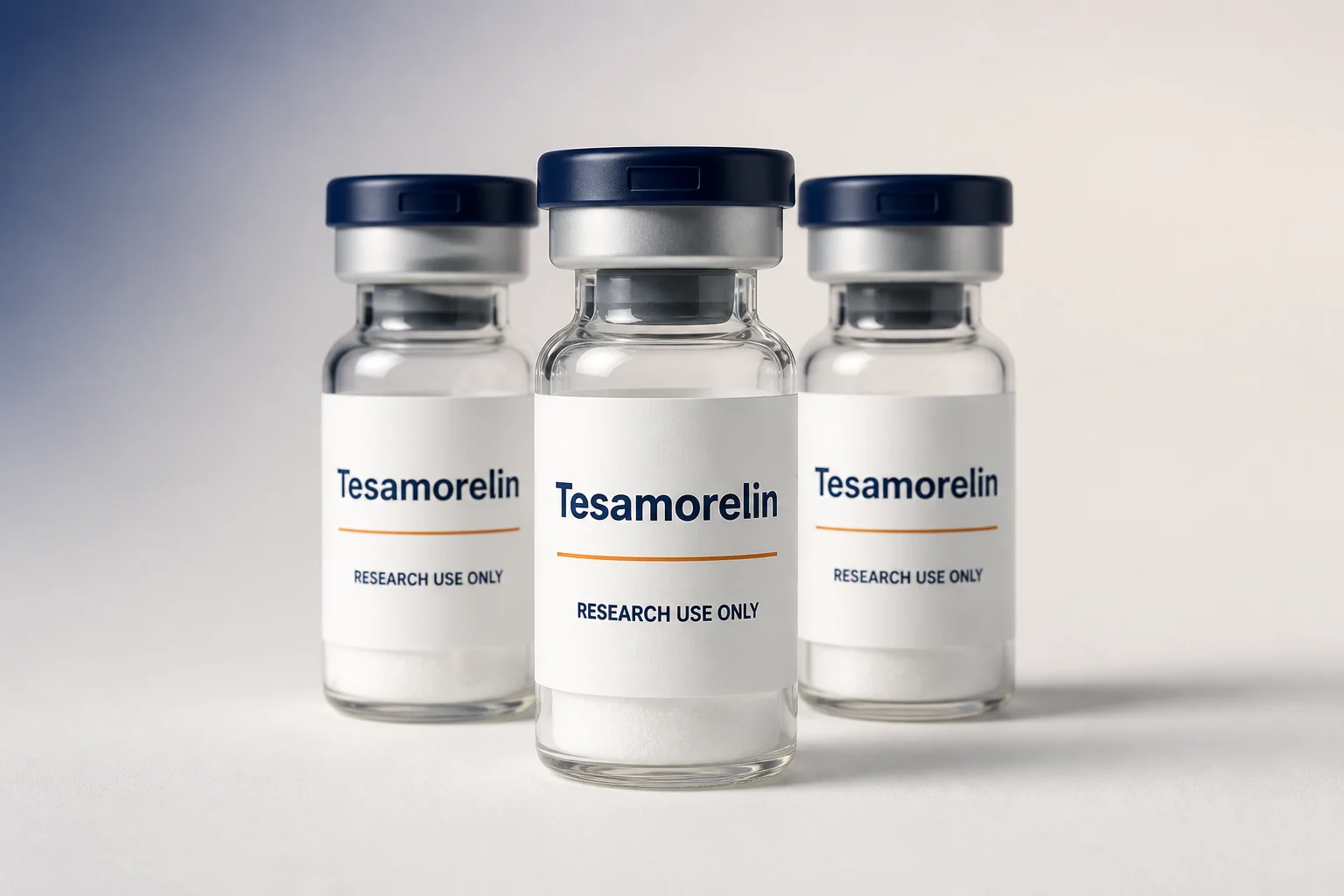
AI-generated packaging mockup for catalog navigation. It is not a photograph of an actual supplied lot; container, label and presentation may vary.
Product family
Compound overview
Shared values below are consolidated from the current catalog record. They are not independent verification or lot results; request the applicable product specification and ask which lot records are available before ordering.
Adults with HIV and lipodystrophyDo not generalize to weight loss or anti-aging
U.S. regulatory boundary
Approved branded medicine; not indicated for weight-loss managementResearch material remains unapproved
Identity safeguard Reference identifiers above describe the literature compound record. Confirm the supplied form, formula, molecular weight, purity and storage conditions against the applicable product specification and any available lot records.
Mechanism of action
How Tesamorelin is studied
A target-to-pathway view grounded in the linked research records.
How it acts on the pituitary
Tesamorelin is built to look like growth hormone–releasing factor, the pituitary's natural trigger. When it docks onto pituitary cells, the gland releases its own growth hormone in pulses instead of receiving hormone from outside. This lets researchers study the body's own feedback loop: brain signal, pituitary response, and the hormone levels that feed back on both. The pulse pattern is part of why it is used as a laboratory tool.
Tesamorelin: IGF-1 as a downstream signal
Growth hormone from the pituitary tells the liver and other tissues to make IGF-1, a hormone involved in growth and metabolism. The approved medicine's labeling and human study records report IGF-1 rising after treatment, so researchers use it as a sign the pathway was switched on. The same labeling warns that this pathway can affect glucose handling, which is why it is monitored.
Fat loss that is selective
In controlled human research, tesamorelin reduced deep abdominal visceral fat while limb fat and fat just under the skin stayed the same. Visceral fat is the metabolically active fat linked to inflammation and heart-metabolic risk, so researchers care about it specifically, not total body weight. This selective pattern is why the approved medicine's indication is written around abdominal fat in one defined group, not weight management.
What the approval covers, and what it does not
An FDA-approved branded tesamorelin medicine exists, but its authorization is narrow: reducing excess abdominal fat in adults with HIV and lipodystrophy, with explicit labeling that it is not for weight-loss management. That covers one specific drug product studied in a defined patient group. Catalog tesamorelin is a different research chemical. Its identity, purity, and behavior must be established per lot. Approval, clinical evidence, and research-vial status are three separate things.
Reported research findings
What published studies report about Tesamorelin
Reported outcomes are paired with their experimental model and evidence boundary.
Human RCT
Visceral-adipose-tissue endpoint studied in HIV lipodystrophy
Randomized controlled research reported significant reductions in visceral adipose tissue and improvements in selected body-composition measures in the defined HIV-lipodystrophy population.
Population- and indication-specific evidence; it cannot support general weight-loss, bodybuilding or anti-aging claims.
Approved branded-drug indication is narrowly defined
FDA labeling authorizes a specific tesamorelin drug product for reducing excess abdominal fat in adults with HIV and lipodystrophy and states it is not indicated for weight-loss management.
Approval does not apply to third-party catalog research material.
Translation boundary: findings are limited to the evidence level stated on each card. Experimental protocol quantities are research details, not usage instructions.
Single-component peptide · 2 mg/vial nominal · 10-vial pack · supplied form and release limits controlled by lot specification.
Lot documentation
Document availability and scope must be confirmed for this variant and lot in the written quotation. A catalog description is not a lot-specific test result.
Catalog no.TSM5
Pack size5 mg × 10 vials
Specification & documents for TSM5
Product specification
Single-component peptide · 5 mg/vial nominal · 10-vial pack · supplied form and release limits controlled by lot specification.
Lot documentation
Document availability and scope must be confirmed for this variant and lot in the written quotation. A catalog description is not a lot-specific test result.
Catalog no.TSM10
Pack size10 mg × 10 vials
Specification & documents for TSM10
Product specification
Single-component peptide · 10 mg/vial nominal · 10-vial pack · supplied form and release limits controlled by lot specification.
Lot documentation
Document availability and scope must be confirmed for this variant and lot in the written quotation. A catalog description is not a lot-specific test result.
Catalog no.TSM20
Pack size20 mg × 10 vials
Specification & documents for TSM20
Product specification
Single-component peptide · 20 mg/vial nominal · 10-vial pack · supplied form and release limits controlled by lot specification.
Lot documentation
Document availability and scope must be confirmed for this variant and lot in the written quotation. A catalog description is not a lot-specific test result.
Quality system
Quality documentation
A listed document is not proof of availability for this lot. Ask the team to confirm the current COA status and the scope of any other records before ordering.
Lot-specific Certificate of AnalysisAvailability and scope must be confirmed for the selected catalog variant and lot
Interpret the documents, not just the headline number.
Use the source-reviewed guide to separate chromatographic area purity, quantitative assay, LC-MS identity, composition and stability evidence before comparing variants or requesting a lot record.
Evidence boundary: each card states its evidence type. Human trials and regulatory records describe the studied or regulated intervention; preclinical records remain model-specific. None verifies the identity, quality, safety or efficacy of this catalog lot or provides usage instructions.
Literature basis
Curated references
Third-party publications selected for direct relevance.
U.S. Food and Drug Administration. 2025 labeling record for BLA 022505.
FDA record
Research FAQ
Tesamorelin questions
Concise answers for researchers comparing identity, evidence and catalog variants.
What effects are studied for Tesamorelin?
The main human evidence comes from randomized controlled research in adults with HIV and lipodystrophy. A pharmaceutical tesamorelin product reduced visceral abdominal fat and improved belly-image distress. IGF-1 rose as expected. Limb fat and under-skin abdominal fat were unchanged, and glucose measures were not disturbed in that trial. These results belong to that specific population and product. They do not extend to general weight loss, athletic performance, or anti-aging, and say nothing about catalog material.
How should the Tesamorelin research findings be understood?
An FDA-approved branded tesamorelin medicine exists, but its authorization is narrow: reducing excess abdominal fat in adults with HIV and lipodystrophy, with explicit labeling that it is not for weight-loss management. That covers one specific drug product studied in a defined patient group. Catalog tesamorelin is a different research chemical. Its identity, purity, and behavior must be established per lot. Approval, clinical evidence, and research-vial status are three separate things.
What is tesamorelin?
Tesamorelin is a growth hormone-releasing factor analogue that stimulates pituitary growth hormone secretion and downstream IGF-1.
Is tesamorelin approved for general weight loss?
No. The FDA-approved branded medicine has a narrow indication for reducing excess abdominal fat in adults with HIV and lipodystrophy and is not indicated for weight-loss management.
Is this catalog material the FDA-approved tesamorelin medicine?
No. This is research, development and manufacturing material and must not be represented as the regulated branded drug.
Which quality documents can be requested?
Tell us which records your project requires. Availability and scope must be confirmed for the selected material. Published papers are not batch certificates, and this page does not confirm that a lot-specific COA is available.
How should Tesamorelin be stored?
Request the storage conditions for the exact supplied form and selected variant. A temperature stated for another supplier or a clinical drug preparation is not a verified storage specification for NHD catalog material.
Is visceral fat the same as body weight?
No. Visceral fat is fat around organs inside the abdomen. Body weight includes fat, muscle, bone, water and other tissues. A change in visceral-fat measurements cannot be substituted for the same change in total body weight.
What should I include in a research quotation request?
Send the exact product name, selected catalog variant, required quantity, destination and documents needed for the project. Specify whether the amount refers to powder mass or measured peptide content. Availability, price, lead time and document scope require confirmation.
Does a published study replace a lot-specific analytical report?
No. A paper describes the material and methods used in that study. It does not establish the identity, purity or content of a different supplied lot. Ask which records actually apply to the requested material; do not assume a COA is available.
Knowledge center
Related insights
Owned educational content connected to this family.
ArticleRandomized controlled human trials and FDA…
An evidence-led review of tesamorelin trials in adults with HIV-associated abdominal fat accumulation, including endpoints, limits and FDA-labeled context.
Updated October 1, 2026
ArticleFDA labeling and analytical quality principles
A clear comparison between a tesamorelin research material and the FDA-approved EGRIFTA WR finished drug, focusing on formulation, documentation and evidence transfer.
A CT scan can tell researchers about the amount of abdominal fat and a separate property called attenuation. Those measurements are different. This guide…
A small trial looked at the relationship between tesamorelin and cognition and brain connectivity. The main measures found no clear improvement, but machine learning…
Published-study results are tied to the linked records and kept separate from catalog-lot claims. Imported purity, storage and document-availability templates have been removed pending product- and lot-specific confirmation.
Editorial status: Source review complete · 2026-10-09 · Not independent medical review · Review policy