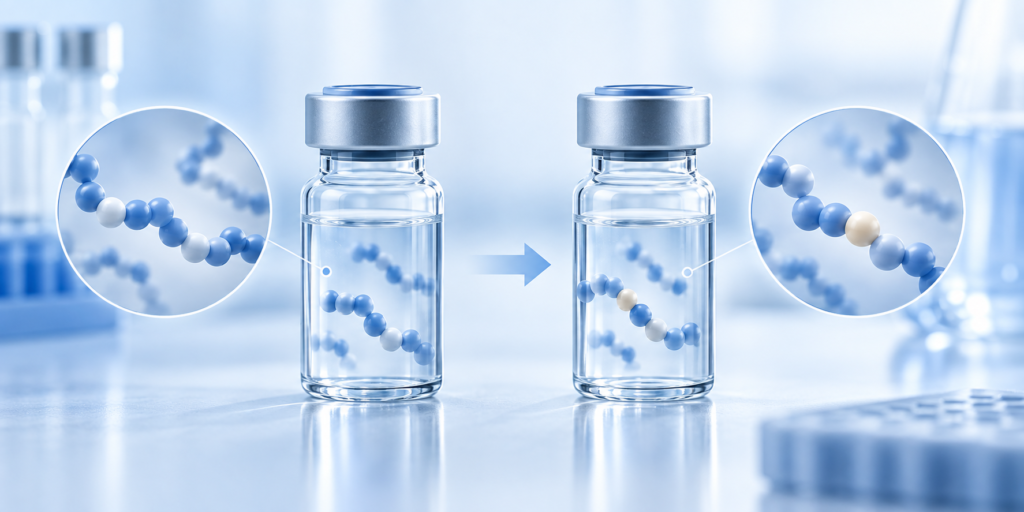
Asparagine deamidation can produce aspartate or isoaspartate forms that complicate peptide-map interpretation. When a modified peak appears after proteolysis, it is tempting to assign it to the starting material. That assignment is unsafe unless the preparation’s own contribution has been measured. Digestion pH, duration and peptide sequence can influence the result.
A controlled pH comparison
Liu and colleagues compared endoprotease Glu-C digestion at pH 4.5 in ammonium acetate with digestion at pH 8.0 in ammonium bicarbonate. Their study included exenatide and an ACTH-derived peptide alongside protein examples. In the exenatide Glu-C fragment examined by LC–MS, after 48 hours at pH 8.0 the paper reports complete conversion of the measured asparaginyl peptide to deamidated material; at pH 4.5 it reports about 1% deamidation after the same prolonged incubation. Isotope-labeling experiments supported formation during sample preparation. [1, Results, Figure 4]
| Exenatide Glu-C fragment in study | 48-hour observation | Boundary |
|---|---|---|
| pH 8.0 digestion | No asparaginyl peptide observed; reported complete deamidation | Extreme prolonged condition for this peptide, not a rate for all peptides. |
| pH 4.5 digestion | About 1% measured deamidation | Same study’s mildly acidic condition; method-specific. |
These data do not mean every peptide should be digested at pH 4.5. Protease activity, cleavage specificity, completeness, buffer compatibility and sequence coverage must be established for the intended assay. The authors observed useful Glu-C activity under their mildly acidic condition, but an unrelated enzyme may not perform similarly. A 48-hour challenge is informative for artifact potential; it is not a recommended routine incubation time. [1]
How to test whether a modification was present before digestion
Analyze a short and long digestion time course from the same starting material. Where feasible, compare a method with a different pH or cleavage route and check whether the same modified fraction is present when the sample is processed promptly. Use an appropriate standard or isotope-tracing control if the modification origin is central to a quality decision. Resolve the unmodified, Asp and isoAsp forms sufficiently to support the proposed assignment; a single mass shift alone may not distinguish structural isomers.
Report digestion conditions next to the modified fraction. A result such as “1% deamidation” without its peptide sequence, digest time, pH and quantification method cannot be transferred to a different assay. For product quality, the LC–MS identity guide explains why identity needs more than one matching mass, while the storage evidence guide explains why a degradation rate requires a defined stability design.
An independent isotope-labeling study used ¹⁸O-containing water to distinguish deamidation created during sample processing from deamidation already present before that processing. Its specific mass-shift logic depends on the labeling chemistry and fragmentation method; it is a confirmation option, not a shortcut around a time-course control. [2]
A reportable deamidation result needs
- The exact Asn-containing sequence, digest enzyme, pH, temperature, duration and quench time.
- Evidence that the target modified and unmodified forms are separated or correctly deconvolved, with Asp/isoAsp assignment only when supported.
- A short-versus-long preparation control from the same starting material; if the fraction rises during processing, label it as possible assay artifact.
- A numerical denominator: modified peak area, isotope-normalized response or mole fraction are not interchangeable without validation.
Evidence limit
This is a method experiment, not proof of the stability, purity or release status of any NHD peptide. Its practical contribution is a controlled way to challenge the assumption that a post-digestion modification was present in the original sample.
Primary source and claim trail
- Liu S, et al. Mildly Acidic Conditions Eliminate Deamidation Artifact during Proteolysis: Digestion with Endoprotease Glu-C at pH 4.5. Amino Acids. 2016;48:1059–1067. DOI 10.1007/s00726-015-2166-z, PMID 26748652. Locations: Abstract (method), Materials and Methods (exenatide/ACTH, buffers and enzyme), Results and Figure 4 (48-hour pH 8.0 versus 4.5 observations), supplementary Figure S3 as cited in paper (isotope evidence). Primary full text checked.
- Use of ¹⁸O labels to monitor deamidation during protein and peptide sample processing. Journal of the American Society for Mass Spectrometry. DOI 10.1016/j.jasms.2008.02.011, PMID 18394920. Location: Abstract and method/results on ¹⁸O-label distinction between pre-existing and processing-induced deamidation. Independent primary analytical study; no numeric rate was transferred to the exenatide comparison.
Sources & editorial method
AI-assisted editorial draft; independent Codex source, image and seven-language review; human professional review not claimed
2 linked records are listed in the references below. Read the editorial and AI-assistance policy.
How to interpret this article
This article summarizes third-party records and does not establish the identity, quality, safety or efficacy of any catalog lot.
Research-use boundary: Catalog materials discussed on this website are for laboratory research, development and manufacturing use only, not for human or veterinary use. This content is not medical advice and does not provide administration instructions.
Primary records and authoritative sources
- Liu S, et al. Mildly Acidic Conditions Eliminate Deamidation Artifact during Proteolysis: Digestion with Endoprotease Glu-C at pH 4.5. Amino Acids. 2016;48:1059–1067.Source 1. Abstract (method), Materials and Methods (exenatide/ACTH, buffers and enzyme), Results and Figure 4 (48-hour pH 8.0 versus 4.5 observations), supplementary Figure S3 as cited in paper (isotope evidence). Primary full tex
- Use of ¹⁸O labels to monitor deamidation during protein and peptide sample processingSource 2. Abstract and method/results on ¹⁸O-label distinction between pre-existing and processing-induced deamidation. Independent primary analytical study; no numeric rate was transferred to the exenatide comparison.