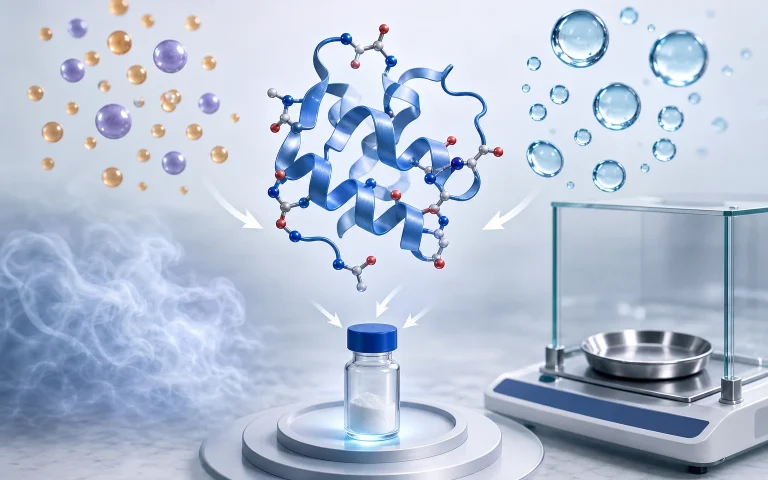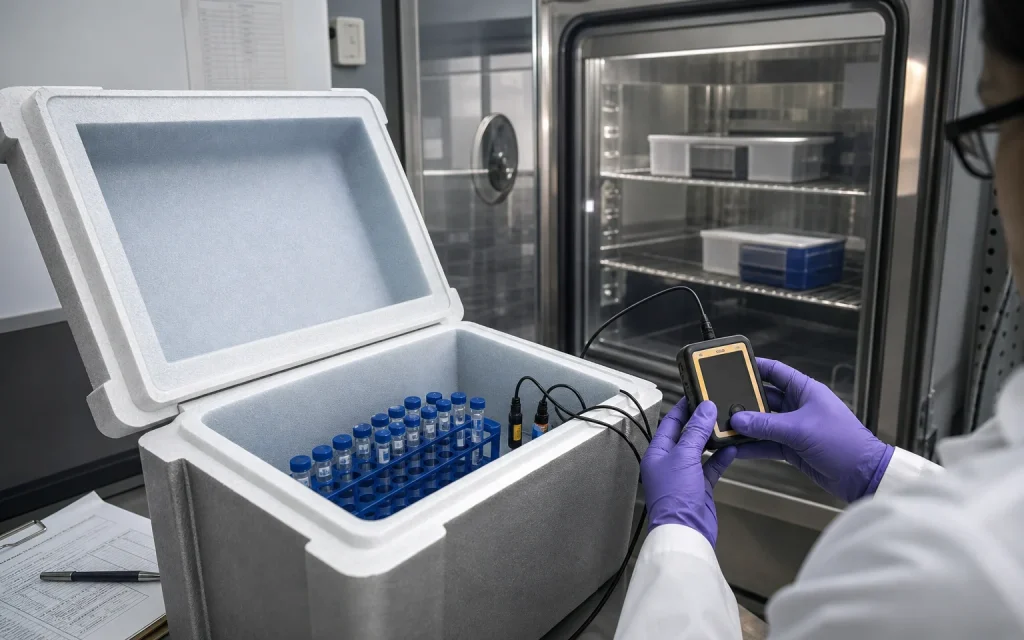
A storage label and a shipping instruction are related but not interchangeable. “Store at −20°C” describes a controlled condition for a defined period. It does not automatically mean that every hour above −20°C damages the material, nor that an unrefrigerated shipment is acceptable. A temperature-excursion decision requires evidence for the particular material, formulation, package and exposure profile.
ICH Q1A(R2) frames stability testing around how quality changes over time under temperature, humidity and light, with the results used to establish retest periods, shelf life and storage conditions. The guideline is written for drug substances and products; its evidence logic remains a useful way to detect unsupported claims on research-material pages.
Four different questions are often collapsed into one
| Claim | Evidence needed | What cannot be assumed |
|---|---|---|
| Long-term storage | Time-point data in the intended container at the labeled condition | A generic freezer recommendation for all peptides |
| Shipping condition | Distribution study or justified excursion data for the shipment profile | That storage temperature must be maintained every transit minute |
| After reconstitution | Solution-specific stability, container and handling data | That dry-powder stability applies in solution |
| Freeze-thaw tolerance | Defined cycles with relevant quality attributes measured | That visual appearance proves no degradation or aggregation |
A stability-indicating method must see meaningful change
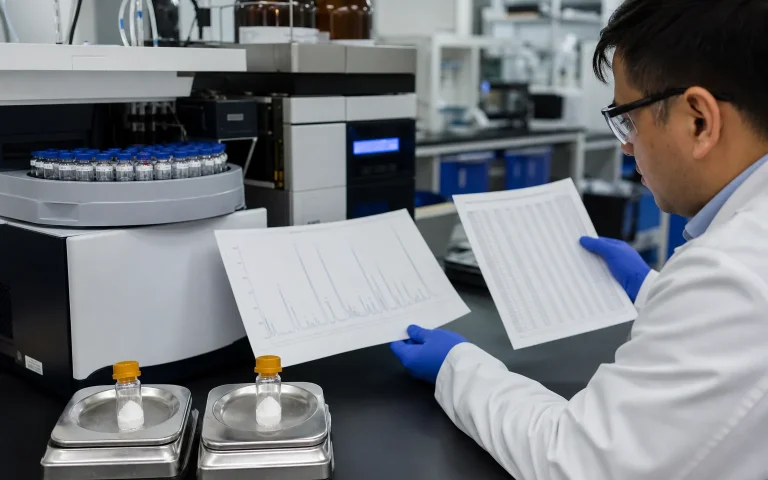
Stability is not established by measuring only the main peak with a method unable to resolve likely degradants. The analytical package should be capable of detecting changes relevant to the material: peptide-related impurities, oxidation, deamidation, clipping, aggregation, content or other attributes justified by risk. Identity, purity and content methods may all contribute.
Forced-degradation experiments can help show that a method separates or detects degradation pathways. They do not by themselves establish a commercial retest period. Real-time and appropriately designed accelerated data are used for that purpose, with protocols, time points, packaging and acceptance criteria defined in advance.
Dry powder and solution are different systems
Water activity, pH, buffer, concentration, oxygen, light, surfaces and agitation can change degradation behavior after reconstitution. A dry lyophilized material may have a long retest period while its solution has a much shorter supported hold time. Copying the dry-storage label into a solution protocol is therefore not justified.
Container closure also matters. Permeability, headspace, adsorption and repeated opening can alter exposure. A stability claim should name the presentation to which it applies.
How to assess a reported temperature excursion
- Preserve the logger record: maximum and minimum temperature, duration, pattern and location in the shipment.
- Identify the exact lot, formulation, physical state and container closure.
- Compare the exposure with protocol-backed excursion or accelerated-stability data—not a generic online table.
- Confirm that the analytical methods are stability-indicating for relevant degradation pathways.
- Evaluate cumulative history; repeated excursions may not be equivalent to one isolated event.
- Document the quality decision and its evidence. If the data do not cover the event, say so.
Why a cold pack is not evidence
A cold pack is a distribution control. Its presence does not establish the temperature experienced by the vial or prove the material remained within specification. Conversely, a warm pack on arrival does not quantify the prior exposure. Logger data, qualified packaging and stability evidence answer those questions.
Statements such as “stable for 30 days at room temperature” need a source that matches the sequence, salt form, formulation, moisture, package, analytical methods and acceptance criteria. A study on a different peptide—or the same peptide in a different solution—cannot be transferred without a scientific bridge.
What a credible public page should say
Publish the labeled storage condition and clarify whether it is based on a specification, supplier statement or reviewed stability program. Describe shipping practice separately. If excursion data are available only on request, say that; if no product-specific conclusion has been verified, do not invent a universal window.
The honest answer after an excursion may be “insufficient data.” That is a quality decision, not a content gap to fill with confident copy. Stability claims become useful when their material, method, time, temperature and packaging boundaries remain visible.
Sources & editorial method
The editorial workflow starts with linked regulatory guidance and peer-reviewed analytical-method records; extracts scope, definitions, required fields and limitations; and separates general method principles from product- and lot-specific claims. AI-assisted drafting was used to structure the first version. Claims, examples and boundaries were checked against the linked records in the site editorial workflow. This is not independent peer review or evidence that any catalog lot has passed the tests described.
4 linked records are listed in the references below. Read the editorial and AI-assistance policy.
How to interpret this article
No universal peptide shipping window is claimed. Excursion decisions require material-, formulation-, package- and method-specific data reviewed for the affected lot.
Research-use boundary: Catalog materials discussed on this website are for laboratory research, development and manufacturing use only, not for human or veterinary use. This content is not medical advice and does not provide administration instructions.
Primary records and authoritative sources
- ICH Q1A(R2): Stability Testing of New Drug Substances and ProductsExplains how temperature, humidity and light studies establish storage and retest or shelf-life claims.
- ICH Q14: Analytical Procedure DevelopmentOfficial analytical-development framework; included as general method guidance only.
- ICH Q7: Good Manufacturing Practice Guidance for Active Pharmaceutical IngredientsSection 11.4 lists batch-specific certificate-of-analysis fields and quality-unit approval expectations.
- Analytical Procedures and Methods Validation for Drugs and BiologicsU.S. Food and Drug Administration. Guidance for Industry, July 2015.
Continue the documentation review
Each guide answers a different analytical question. Use the complete set before treating one number as a complete quality record.
Open the complete Quality & Documentation Hub