


ANALYTICAL METHODS · PRACTICAL GUIDE
Matching Mass Is Not the Whole Sequence: An Introduction to Peptide MS/MS
Use two short sequences to see why matching mass cannot prove matching order.
The words “act” and “cat” use the same letters but mean different things. Peptide sequences can also use the same building blocks in a different order. Their complete masses may match even though their sequences do not.
Start with the three letters
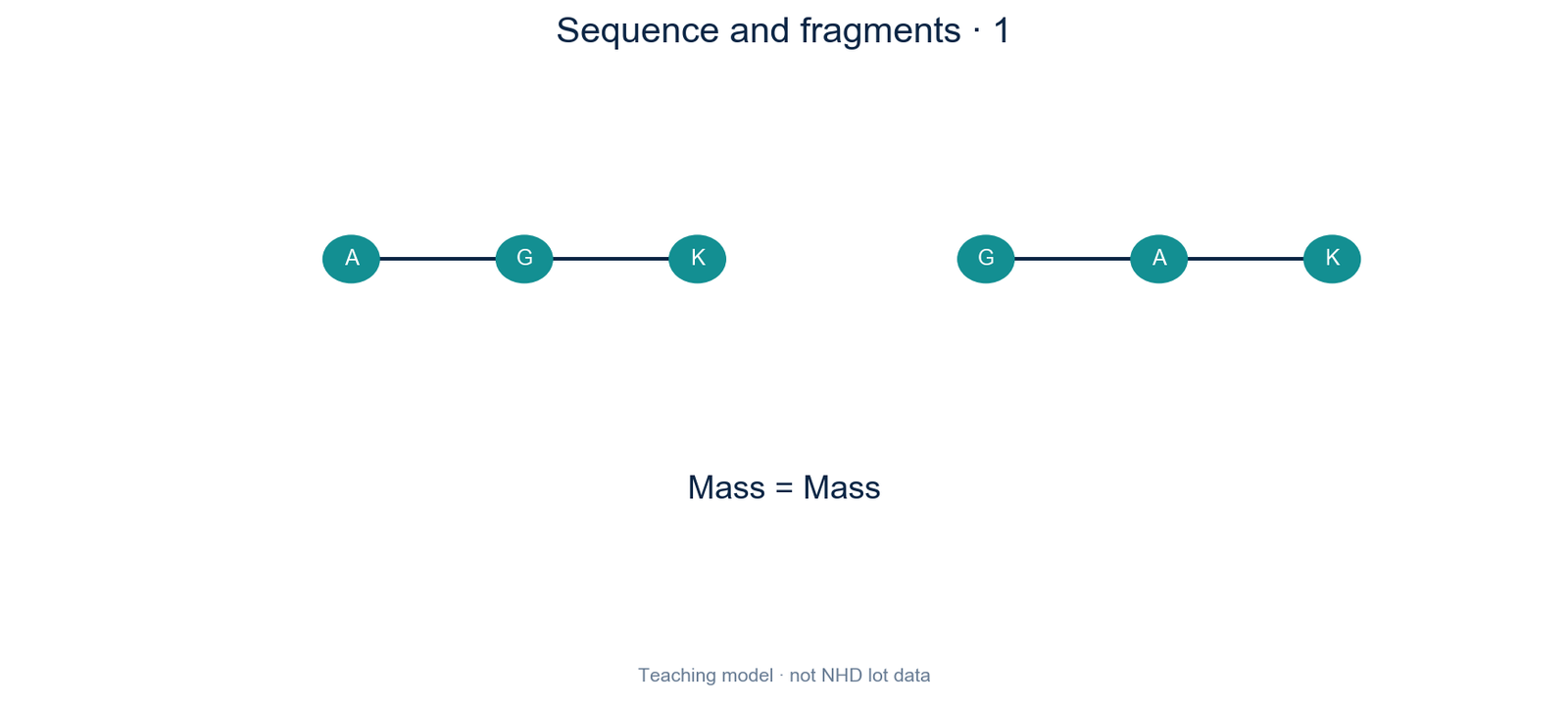
A, G and K are shorthand for alanine, glycine and lysine. AGK and GAK each contain one of each. With matching ends and no other modifications, their overall composition and complete mass match.
What differs is the order. A measurement of total mass cannot reveal every arrangement of the same building blocks.
What extra step does MS/MS add?
MS/MS first selects an ion from the peptide, then breaks it into fragments and measures them. Instead of weighing only the whole chain, it also gathers information about pieces of the chain.
The fragments depend on the molecule and test conditions. A teaching ladder shows the idea; it does not promise that every possible fragment will appear in a real spectrum.
Read a simple fragment ladder
A simplified b-ion ladder follows fragments from the N-terminal end. In the AGK example, the first pieces correspond to A and AG. In GAK, they correspond to G and GA. The first piece can therefore help tell the sequences apart.
Real assignments need the correct fragment chemistry, charge and measured mass. The diagram shows sequence portions, not measured fragment masses.

Some distinctions still need other methods
Leucine and isoleucine have the same elemental composition. A basic fragment-mass ladder may not distinguish them. Ordinary mass matching also does not establish D versus L stereochemistry.
Ask which positions the data support and which remain ambiguous. A report should explain that rather than treating every mass match as complete sequence confirmation.

Separate mass matching from sequence matching
Neither intact mass nor MS/MS automatically gives an HPLC purity or biological activity result. Each measurement should be described for what it actually examines.
See the answer
No. Their first two positions differ. Suitable fragment evidence may help distinguish them.
When a MOTS-c or LL-37 project needs sequence information
If a MOTS-c or LL-37 project needs sequence-level information, ask specifically whether suitable MS/MS data are available. A document reporting intact mass may not include this additional analysis.
Discuss material and document requirements with NHD · Continue with the analytical guide