


Research papers often describe potency and maximum response separately. Those terms are easy to mix up. Understanding them helps explain why a peptide with a lower EC50 may still produce a smaller maximum response in a particular assay.
What the terms mean
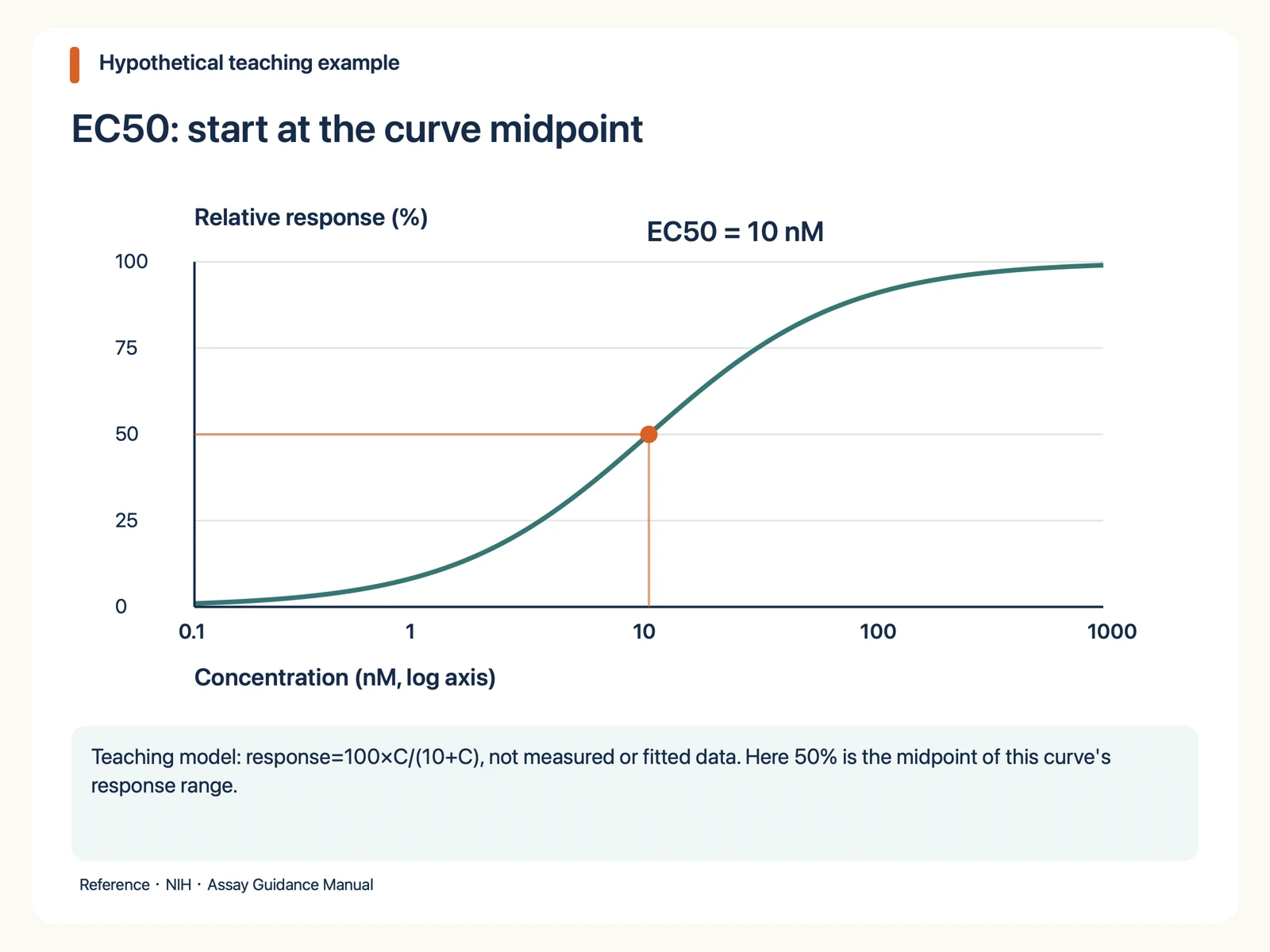
EC50 describes the concentration producing half of the fitted maximum response under the assay definition. Emax is the estimated maximum response. Neither is a universal property independent of the biological system, timing and readout.
A simple hypothetical pair
Peptide A has an EC50 of 2 nM and an Emax of 60 response units. Peptide B has an EC50 of 10 nM and an Emax of 100 units. A reaches half of its own maximum at a lower concentration. B has the larger maximum response. Half-maximal responses are 30 and 50 units, respectively—not the same absolute effect.
Why a fair comparison needs the same assay
A cell-receptor response, bacterial growth endpoint and hormone-release measurement cannot be ranked by concentration alone. Even similar assays may differ in normalization and fitting. The original ipamorelin paper reports potency and maximal responses separately, showing why both pieces matter.
What to look for in the figure
Check concentration range, measured plateau, controls and whether the curve was normalized. If the maximum was not reached, the fitted parameter may be uncertain. Use these values to understand an experiment; they are not product-use amounts or a clinical-benefit ranking.
Related materials and next steps
Explore the NHD catalogue records for LL-37, KPV. Confirm the required molecular form, quantity and lot-document availability before relying on a listing for procurement. A catalogue record does not establish equivalence to a published study material.
Send the product or sequence, quantity and document requirements. For more background, browse the analytical methods guides and research glossary.
Sources and reading scope
- Ipamorelin study reporting potency and maximal response separately
- FDA: ICH Q2(R2), analytical procedure validation
Source links checked 5 October 2026. Research summaries use the accessible original abstract unless a full-text source is explicitly identified. Guidance documents and external supplier explanations are technical references, not NHD batch evidence or a claim of regulatory compliance. Any example introduced as hypothetical or teaching is a calculation, not a measured product result.
NHD catalogue materials are for qualified laboratory research, development and manufacturing enquiries. This article does not provide instructions for human or veterinary use.
Sources & editorial method
AI-assisted writing and source checks; conceptual illustrated cover.
1 linked records are listed in the references below. Read the editorial and AI-assistance policy.
How to interpret this article
Study results and labeled examples are separated. Original-source, arithmetic, readability and internal-link checks; no independent human peer review recorded.
Research-use boundary: Catalog materials discussed on this website are for laboratory research, development and manufacturing use only, not for human or veterinary use. This content is not medical advice and does not provide administration instructions.
Primary records and authoritative sources
- Assay Guidance ManualAssay Guidance Manual
Continue with structured records
Move from this editorial analysis to the product identity, filtered evidence and controlled terminology behind it.




 Tirzepatide
 Retatrutide