Understand net charge and pI, and why a calculated isoelectric point cannot replace a solubility check for your peptide.

Net charge is a total, not one uniform property
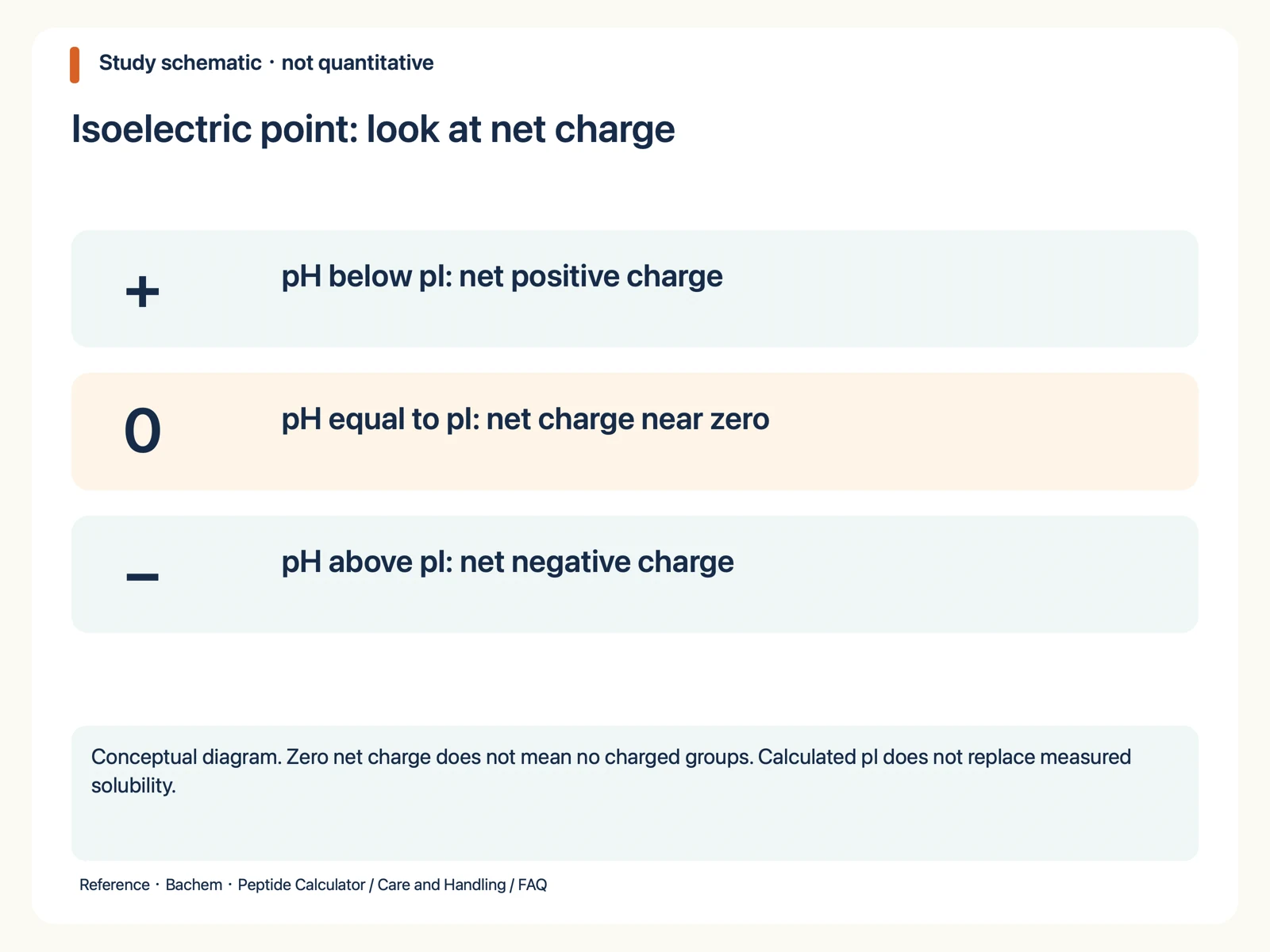
A peptide can contain both positively and negatively charged groups. Net charge combines their contributions. At a particular pH, those contributions approximately balance and the overall net charge approaches zero. That pH is the isoelectric point, usually written pI.
What happens on either side of pI
For common ionizable peptides, pH below pI generally gives a net positive charge; pH above pI generally gives a net negative charge. Zero net charge does not mean no charged groups remain. The figure explains the overall relationship, not measured charge numbers for KPV or LL-37.
Why this matters when preparing solutions
Charge affects interactions with water, other molecules and container surfaces. Some peptides aggregate or dissolve less readily near pI, but this is not a universal rule. Hydrophobicity, length, salt form, concentration and temperature also matter. One pI value cannot determine a complete preparation method.
Calculated pI depends on its inputs
Sequence calculations use selected acid–base constants and model assumptions. Terminal blocking, labels, unusual modifications or metal binding can affect suitability. A calculated value with two decimal places is not a measurement of your sample and does not identify a universally unstable condition.
Make a short preparation record
Record complete material identity, target concentration, solvent or buffer, intended pH and how the solution will be checked. Start with supported material information and an applicable method, then evaluate a small amount before scaling up. Moving away from pI does not override material or assay compatibility.
Ask a specific material question
For a KPV or LL-37 enquiry, include the sequence or catalog reference and intended solution conditions. Ask which identity and material information is available. A pI question alone cannot establish that a particular solvent will work.
References
Published findings, hypothetical teaching examples and material information are distinguished. Read the original methods before attempting replication.
Related research materials
 KPVView material information and specifications, or submit an enquiry.
 LL-37View material information and specifications, or submit an enquiry.
Enquire about products and information →
Research reading and material enquiries only. This page is not personal medical advice or a substitute for batch-specific records.