


ANALYTICAL METHODS · PRACTICAL GUIDE
Residual Solvent ppm: Convert the Report into an Actual Mass
Read weight-based ppm, then calculate the solvent in a small powder sample.
A report says 100 ppm of a solvent. How much is that in a 10 mg powder sample? First check that ppm is expressed by weight. Then the conversion takes only two steps.
What does ppm count?
For a weight-based result, 100 ppm means 100 parts solvent per one million parts sample by weight. One ppm by weight equals 1 µg/g, or 1 mg/kg.
The same abbreviation can have a different basis in another setting. Check the solvent name, sample type and method before converting it.

Convert 100 ppm in a 10 mg sample
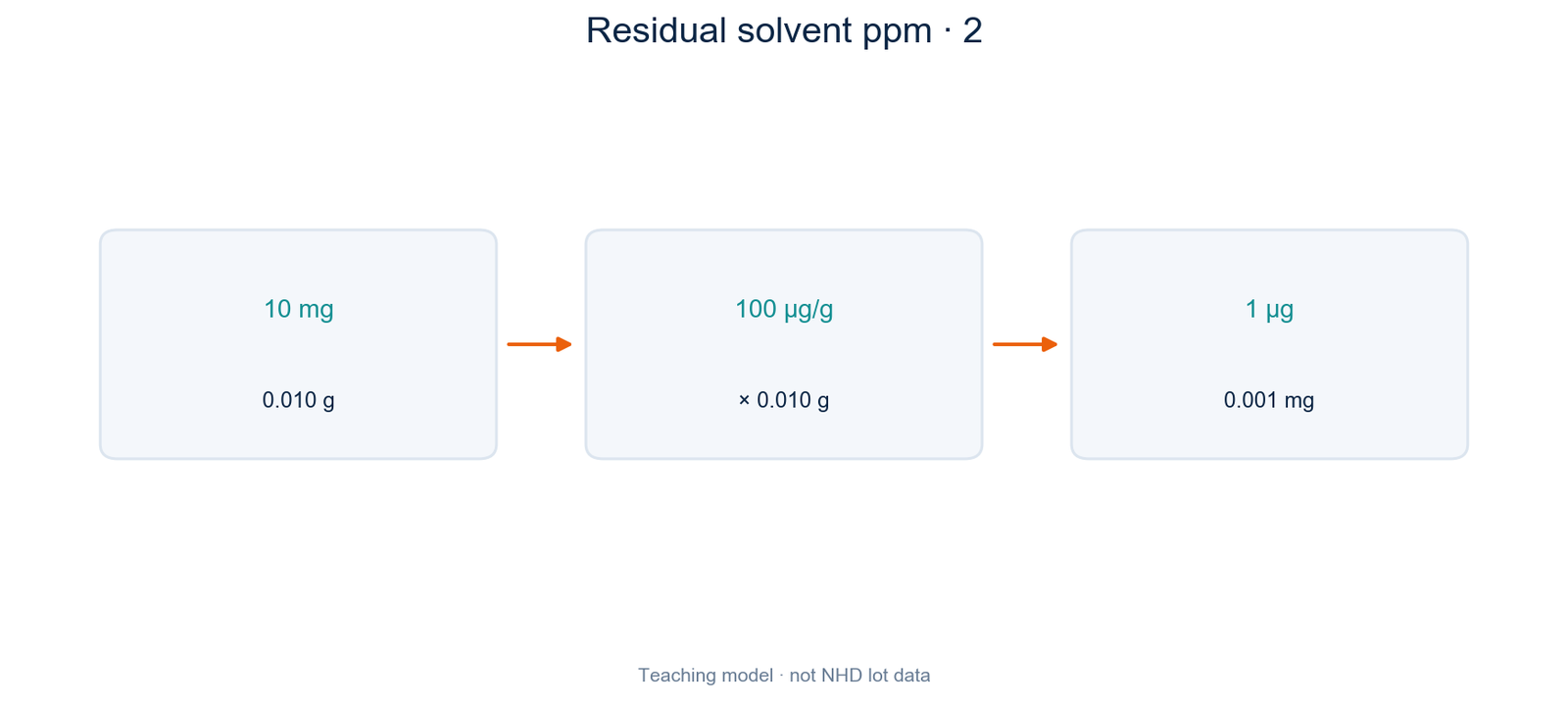
First convert 10 mg to 0.010 g. The result is 100 µg solvent per gram of sample. Multiply: 100 × 0.010 = 1 µg solvent, or 0.001 mg.
A shortcut is solvent µg = ppm by weight × sample mg ÷ 1,000. Forgetting the mg-to-g conversion gives an answer a thousand times too large.
Keep the less-than sign
If the result is less than 100 ppm, the same 10 mg sample contains less than 1 µg of that solvent on this basis. It is an upper-bound statement, not an exact measurement of 1 µg.
Ask how the reporting limit was established if that upper bound is important to your study.
To calculate solution concentration, you need volume
Suppose all of the example 1 µg transfers into a final 2 mL solution without loss. The solvent concentration is then 1 ÷ 2 = 0.5 µg/mL.
Without the final volume and transfer assumptions, powder ppm cannot simply become a solution concentration. ppm is not always interchangeable with mg/L.

Calculate first, then evaluate the research requirement
Suitability depends on the named solvent, material, method and research use. A calculated amount alone does not establish a universal acceptable level.
See the answer
250 × 20 ÷ 1,000 = 5 µg, or 0.005 mg.
Asking about GHK-Cu or MOTS-c solvent results
For GHK-Cu or MOTS-c, specify which solvent you are investigating and confirm whether that test was performed. A general purity statement does not establish a residual-solvent result.
Discuss material and document requirements with NHD · Continue with the analytical guide