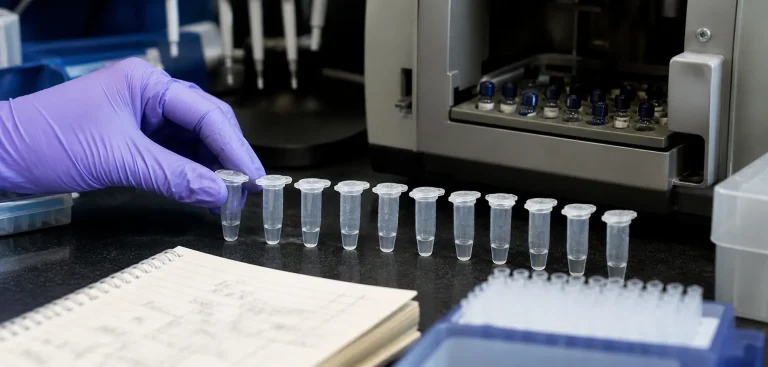
Gonadorelin is synthetic GnRH. Its evidence cannot be summarized without exposure pattern: pulsatile signaling can support gonadotropin release, while sustained stimulation can produce receptor desensitization.
Evidence at a glance
- A 1973 human physiology study found LH rose within two minutes after intravenous releasing hormone, with a median peak near 25 minutes.
- FSH responses were slower and more variable, with a median peak near 45 minutes.
- A 73-patient hypothalamic-amenorrhea series reported 72 pregnancies across 359 pulsatile GnRH cycles; this was not a modern randomized trial.

Study record
The early dose-response work documented rapid pituitary responsiveness and wide interindividual variation. Menstrual-cycle phase influenced responses, demonstrating why a single generic “hormone boost” statement is inadequate.
Results in context
The 1979–1990 amenorrhea series used pulsatile administration in a selected clinical population. The 29% pregnancy-per-cycle figure applies to the favorable subgroup with hypothalamic amenorrhea as the only infertility factor; it is not a universal success rate.
WADA prohibits GnRH/Gonadorelin and related testosterone-stimulating peptides in males. The sports rule is distinct from approved medical use and from research-catalog material.
What the evidence cannot establish
The pregnancy series was historical and nonrandomized.
Exposure pattern, population and monitoring determine relevance.
Do not convert a clinical pump protocol into self-administration guidance.
Sources & editorial method
This article discusses the source records listed below, with the study models and limitations stated alongside the findings. AI-assisted drafting and image generation were used. The reference list identifies the records behind this article; it is not an independent peer review or verification of a supplied catalog lot.
4 linked records are listed in the references below. Read the editorial and AI-assistance policy.
How to interpret this article
Source-checked on 2026-09-02. Null results, sample size, model/population limits, finished-drug scope, regulatory status and product-evidence boundaries are retained. This is not medical advice, a customer case or validation of a catalog lot.
Research-use boundary: Catalog materials discussed on this website are for laboratory research, development and manufacturing use only, not for human or veterinary use. This content is not medical advice and does not provide administration instructions.
Primary records and authoritative sources
- Pituitary responsiveness to luteinizing-hormone releasing factorEarly human dose-response physiology; PMID 4599401.
- Pulsatile GnRH in hypothalamic amenorrheaHistorical 73-patient, 359-cycle series; PMID 8276957.
- PubChem Gonadorelin recordSequence, terminal chemistry, formula and molecular weight; CID 638793.
- WADA 2026 Prohibited ListOfficial list prohibits mechano growth factors.
Continue with structured records
Move from this editorial analysis to the product identity, filtered evidence and controlled terminology behind it.