
Does a higher MOTS-c blood level mean better fitness? A small study suggests the answer depends on which part of fitness you measure. Strength and aerobic capacity were separate questions.
What did the researchers measure?
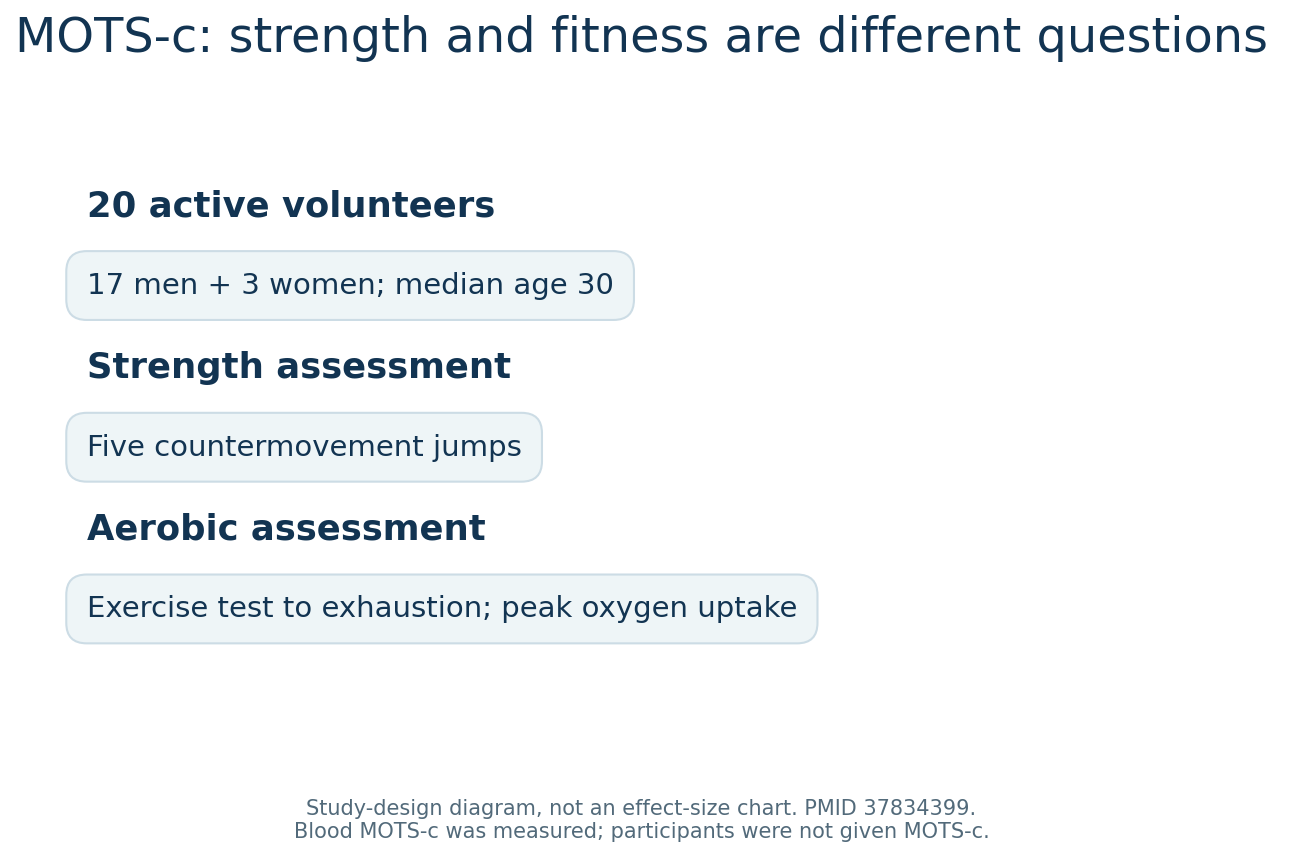
The 2023 preliminary study included 20 physically active volunteers: 17 men and three women, with a median age of 30. They were not following a regular training program or competing professionally. Researchers measured resting serum MOTS-c, body composition, five countermovement jumps and oxygen uptake during an exercise test to exhaustion.
What was linked with MOTS-c?
Higher MOTS-c was associated with jump force and average power, as well as total and leg muscle mass. It was not associated with body-fat percentage or peak oxygen uptake. The study measured naturally circulating peptide; it did not test administered MOTS-c.
Why the distinction matters
A jump asks how forcefully someone can move over a short interval. An exercise test asks a different question about sustained effort. Calling both results “fitness” can make a narrow finding sound broader than it is.
An association also leaves the direction unresolved. Imagine measuring two features at the same visit: finding that they rise together does not reveal which changed first. It cannot tell you that changing one will improve the other.
How to avoid overstating the result
The useful reading is “a candidate blood marker related to selected strength measurements in this small group.” It is not “MOTS-c improves strength in humans.” That second statement would need an intervention and a suitable comparison group.
For a follow-up study, choose the main outcome before collecting data. Separate a strength measurement from an endurance measurement, record training background, and plan enough participants to examine differences between groups. A preliminary association is a starting point for those choices, not a complete performance claim.
Related NHD research material
The NHD MOTS-c product page identifies related laboratory catalog options. For a material enquiry, specify the exact identity, quantity, planned assay and required analytical records. Published results do not validate an NHD batch.
Ask NHD about material options and available documents.
Original research
MOTS-c serum concentration, lower-body strength and maximal oxygen uptake; preliminary human study. Sources checked 10 October 2026.
AI-assisted editorial review checked study numbers, wording and product links; this is not independent peer review. NHD catalog materials are for laboratory research, development and manufacturing, not human or veterinary use. A catalog material is not a clinical trial medicine or a tested finished formulation.
Sources & editorial method
AI-assisted writing
1 linked records are listed in the references below. Read the editorial and AI-assistance policy.
How to interpret this article
AI-assisted source and readability checks, not independent peer review.
Research-use boundary: Catalog materials discussed on this website are for laboratory research, development and manufacturing use only, not for human or veterinary use. This content is not medical advice and does not provide administration instructions.
Primary records and authoritative sources
Continue with structured records
Move from this editorial analysis to the product identity, filtered evidence and controlled terminology behind it.