
Lot-document scope confirmed before quotation · Research use only
  • Specification Review
  • Lot Documents on Request
  • Business Support · Xi’an
  • Destination Eligibility Confirmed
西安诺和达生物科技有限公司
For research, development and manufacturing use only. Not for human or veterinary use.

Metabolic & Weight Loss · Amylin analogue research

Cagrilintide

Scientific Product Dossier

Cagrilintide is a long-acting analogue of amylin, a hormone involved in fullness after eating. Research asks how this signaling pathway affects body weight and metabolic outcomes. Studies of cagrilintide alone and studies combining it with semaglutide answer different questions. This page covers the single ingredient; a blend has a separate catalog entry. Published trial results describe clinical preparations, while the selected NHD variant and its document status must be checked separately for research procurement.

Research use only Lot documents on request
Cagrilintide research product family with 2 catalog variants
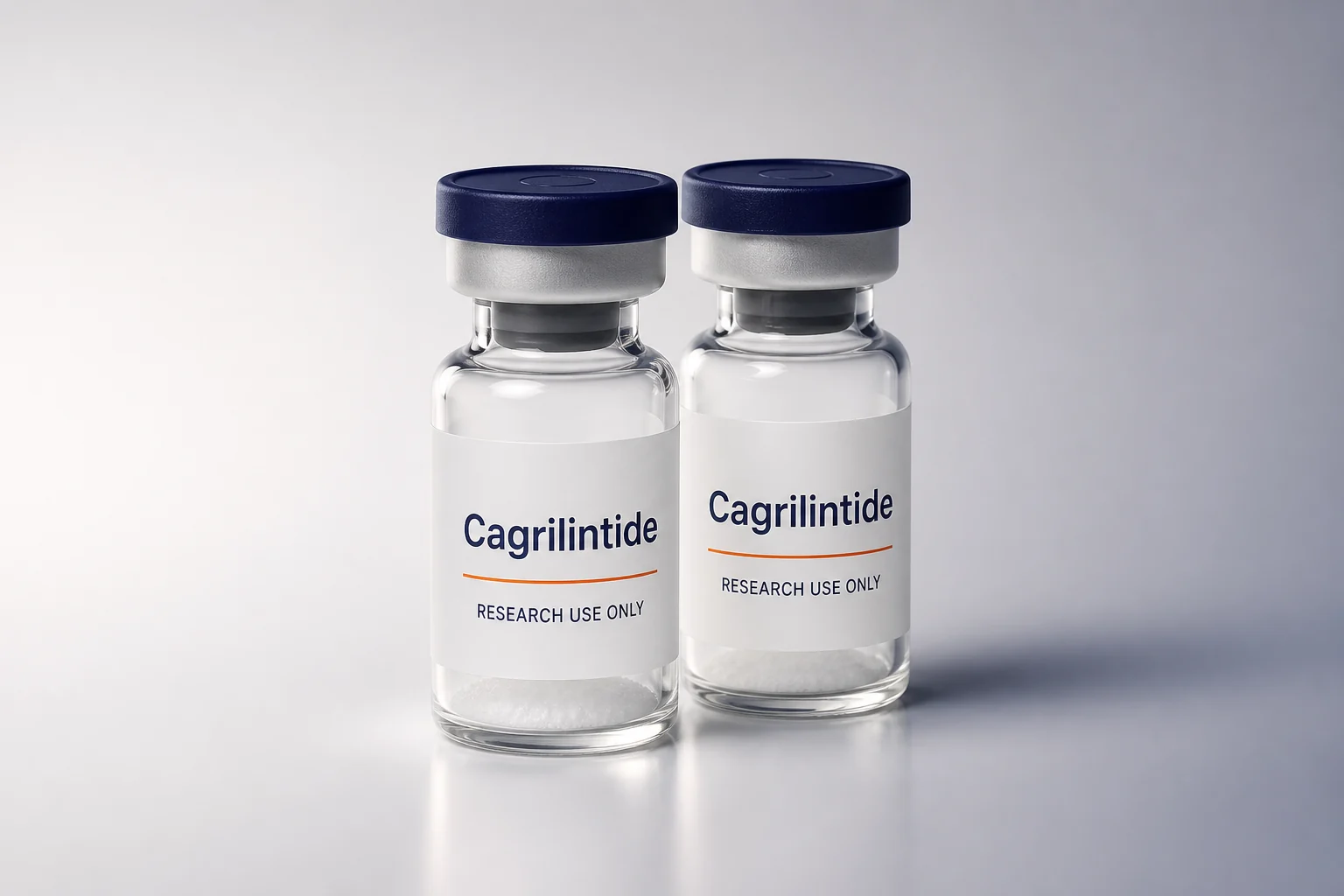
AI-generated packaging mockup for catalog navigation. It is not a photograph of an actual supplied lot; container, label and presentation may vary.

Product family

Compound overview

Shared values below are consolidated from the current catalog record. They are not independent verification or lot results; request the applicable product specification and ask which lot records are available before ordering.

Product identity

Product type
Peptide research compound
Catalog family
Cagrilintide
Research category
Metabolic & Weight Loss
Evidence status
Source-reviewed literature module available below
Intended use
Research, development and manufacturing use only

Literature reference parameters

Compound class
Long-acting acylated amylin analogueInvestigational compound
Key monotherapy trial
Phase 2 · NCT0385604726-week dose-ranging study
Evidence safeguard
Combination results are not single-agent evidenceCagriSema is a separate family and research question

Identity safeguard Reference identifiers above describe the literature compound record. Confirm the supplied form, formula, molecular weight, purity and storage conditions against the applicable product specification and any available lot records.

Mechanism of action

How Cagrilintide is studied

A target-to-pathway view grounded in the linked research records.

Amylin as a natural fullness hormone

Amylin is a peptide the pancreas releases with insulin after a meal. It acts on the lower brain to help end meals and slow stomach emptying. This pathway influences how much and how often a person eats, making it a natural place to study body-weight regulation. Understanding the natural hormone comes first, because it explains why researchers are interested in mimicking it. This is background biology, not a treatment claim.

Why a longer-lasting amylin analogue was designed

Natural amylin is short-lived. Cagrilintide is an acylated analogue; it has a fatty-acid chain attached that is meant to extend its action. A longer-lasting molecule lets researchers study the fullness pathway over time. Its Phase 2 trial measured body-weight change and tolerability over months. Those outcomes belong to the investigational clinical product, not to a research material, whose behavior is not established.

Proposed downstream effects on weight regulation

Sustained amylin-receptor activity is thought to reduce appetite and energy intake through lower-brain fullness signalling, and possibly by slowing stomach emptying. This could lead to modest negative energy balance over time, which the Phase 2 weight outcomes would reflect. This mechanism is not the same as incretin-based drugs, and it is not assumed to add to them. That is why single-agent and combination trials are kept separate.

Why tolerability research matters here

The amylin pathway overlaps with gut signalling, so nausea, constipation, and diarrhoea are biologically plausible. These were among the most frequent events in the monotherapy trial. Studying tolerability alongside weight outcomes shows whether a dose can be sustained long enough for the mechanism to work. It also separates trial-level data from research materials, which were not administered or tested in that human research.

Reported research findings

What published studies report about Cagrilintide

Reported outcomes are paired with their experimental model and evidence boundary.

Phase 2 RCT

Dose-ranging monotherapy study reported weight reduction

At 26 weeks, the trial reported mean body-weight changes from −6.0% to −10.8% across cagrilintide groups, compared with −3.0% for placebo.

Clinical monotherapy result for the studied intervention; not evidence for this catalog lot and not interchangeable with combination-trial outcomes.

Read the primary study
FDA record

Cagrilintide remains unapproved in the United States

FDA states that cagrilintide is not a component of an FDA-approved drug and has not been found safe and effective for any condition.

Investigational status must remain visible wherever trial outcomes are summarized.

Read the primary study
Phase 2 safety

Gastrointestinal events were common

Gastrointestinal adverse events were reported in 41–63% of cagrilintide groups versus 32% with placebo; nausea was reported in 20–47% versus 18%.

Trial-level tolerability data for the studied intervention; not a catalog-lot safety claim.

Read the primary study
Translation boundary: findings are limited to the evidence level stated on each card. Experimental protocol quantities are research details, not usage instructions.

Catalog options

Variant specifications

Pack-level catalog data; lot-level controls remain document-specific.

Catalog no.CGL5
Pack size5 mg × 10 vials
Specification & documents for CGL5

Product specification

Single-component peptide · 5 mg/vial nominal · 10-vial pack · supplied form and release limits controlled by lot specification.

Lot documentation

Document availability and scope must be confirmed for this variant and lot in the written quotation. A catalog description is not a lot-specific test result.

Catalog no.CGL10
Pack size10 mg × 10 vials
Specification & documents for CGL10

Product specification

Single-component peptide · 10 mg/vial nominal · 10-vial pack · supplied form and release limits controlled by lot specification.

Lot documentation

Document availability and scope must be confirmed for this variant and lot in the written quotation. A catalog description is not a lot-specific test result.

Quality system

Quality documentation

A listed document is not proof of availability for this lot. Ask the team to confirm the current COA status and the scope of any other records before ordering.

Lot-specific Certificate of AnalysisAvailability and scope must be confirmed for the selected catalog variant and lot
COA availability unconfirmed Ask about availability
Product Specification SheetAvailability and scope must be confirmed for the selected catalog variant and lot
Confirm before ordering Request
Analytical Method SummaryAvailability and scope must be confirmed for the selected catalog variant and lot
Confirm before ordering Request

Analytical interpretation

Interpret the documents, not just the headline number.

Use the source-reviewed guide to separate chromatographic area purity, quantitative assay, LC-MS identity, composition and stability evidence before comparing variants or requesting a lot record.

Open the Quality & Documentation Hub

HPLC area ≠ assayA dominant peak does not establish target mass fraction.

Intact mass ≠ full sequenceIdentity strength depends on resolution and orthogonal evidence.

Counterions affect contentWater, salt form and solvents change the as-is composition.

Storage needs a data basisShipping practice is not the same as stability evidence.

Evidence map

Research context

Published studies and regulatory records, not customer testimonials or usage guidance.

Phase 2

Dose-ranging monotherapy trial

Randomized, double-blind, placebo-controlled human research evaluating multiple cagrilintide groups over 26 weeks.

View primary record
Registry

NCT03856047 trial record

Primary trial-registry record for the cagrilintide monotherapy study.

View primary record
Evidence boundary: each card states its evidence type. Human trials and regulatory records describe the studied or regulated intervention; preclinical records remain model-specific. None verifies the identity, quality, safety or efficacy of this catalog lot or provides usage instructions.

Literature basis

Curated references

Third-party publications selected for direct relevance.

  1. 01

    Once-weekly cagrilintide for weight management in people with overweight and obesity

    Lau DCW, et al. The Lancet. 2021;398:2160–2172. PMID 34798060 · DOI 10.1016/S0140-6736(21)01751-7

    Phase 2
  2. 02

    Investigation of Safety and Efficacy of Cagrilintide

    ClinicalTrials.gov record NCT03856047.

    Registry
  3. 03

    FDA concerns with unapproved GLP-1 drugs used for weight loss

    U.S. Food and Drug Administration. Content current through May 31, 2026.

    FDA record

Research FAQ

Cagrilintide questions

Concise answers for researchers comparing identity, evidence and catalog variants.

What effects are studied for Cagrilintide?

A 26-week Phase 2 monotherapy trial in adults with overweight or obesity reported greater average weight reduction across cagrilintide groups than with placebo, and a larger reduction at the top dose than an active comparator. That is a clinical result for the studied subcutaneous product. It does not apply to research materials, other routes, or combination studies, which are different interventions.

How should the Cagrilintide research findings be understood?

The amylin pathway overlaps with gut signalling, so nausea, constipation, and diarrhoea are biologically plausible. These were among the most frequent events in the monotherapy trial. Studying tolerability alongside weight outcomes shows whether a dose can be sustained long enough for the mechanism to work. It also separates trial-level data from research materials, which were not administered or tested in that human research.

What is cagrilintide?

Cagrilintide is an investigational, long-acting acylated analogue of the peptide hormone amylin.

Is cagrilintide approved?

No. It remains an investigational compound in clinical development.

Are CagriSema results evidence for cagrilintide alone?

No. Combination trials study cagrilintide with semaglutide and cannot be attributed to cagrilintide monotherapy.

Which quality documents can be requested?

Tell us which records your project requires. Availability and scope must be confirmed for the selected material. Published papers are not batch certificates, and this page does not confirm that a lot-specific COA is available.

How should Cagrilintide be stored?

Request the storage conditions for the exact supplied form and selected variant. A temperature stated for another supplier or a clinical drug preparation is not a verified storage specification for NHD catalog material.

Is Cagrilintide the same material as a Cagrilintide + Semaglutide blend?

No. Cagrilintide is one ingredient. A blend contains both ingredients and needs its own composition and amount basis. A combination-trial outcome does not establish the effect of cagrilintide alone or verify a commercial blend.

What should I include in a research quotation request?

Send the exact product name, selected catalog variant, required quantity, destination and documents needed for the project. Specify whether the amount refers to powder mass or measured peptide content. Availability, price, lead time and document scope require confirmation.

Does a published study replace a lot-specific analytical report?

No. A paper describes the material and methods used in that study. It does not establish the identity, purity or content of a different supplied lot. Ask which records actually apply to the requested material; do not assume a COA is available.

Knowledge center

Related insights

Owned educational content connected to this family.

Knowledge tools

Continue with structured evidence

Move from this dossier into canonical evidence maps, verified status records, analytical interpretation and laboratory calculations.

Internal technical source review

Published-study results are tied to the linked records and kept separate from catalog-lot claims. Imported purity, storage and document-availability templates have been removed pending product- and lot-specific confirmation.

Editorial status: Source review complete · 2026-10-09 · Not independent medical review · Review policy

Technical procurement

Ready to request a quote?

Selected: CGL5 · 5 mg × 10 vials