Lot-document scope confirmed before quotation · Research use only
  • Specification Review
  • Lot Documents on Request
  • Business Support · Xi’an
  • Destination Eligibility Confirmed
西安诺和达生物科技有限公司
For research, development and manufacturing use only. Not for human or veterinary use.

Longevity & Bioregulators · Source-reviewed dossier

PNC-27

Source-Reviewed Research Dossier

PNC-27 is a synthetic peptide studied in cancer-cell experiments. Linked pancreatic- and cervical-cell studies reported cell damage associated with HDM-2, a protein found on the cell surface in those experiments. Researchers also examined holes in cell membranes and changes in mitochondria, structures involved in energy production. Responses differed between the particular cell lines compared. These are laboratory findings, not cancer-treatment results in patients or proof of safety across healthy tissues. NHD supplies PNC-27 for research use.

Research use only Lot documents on request
PNC-27 research product family with 1 catalog variants
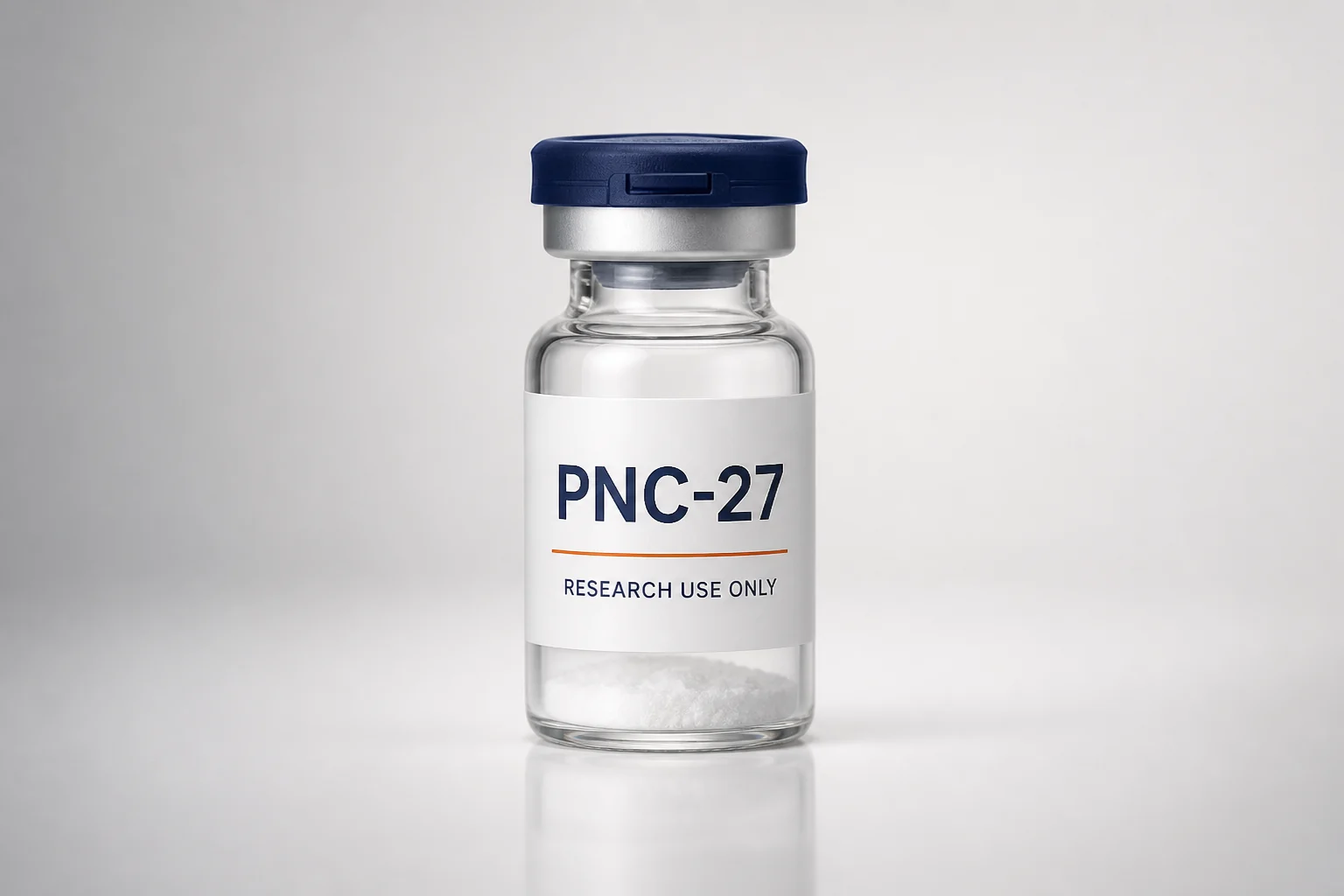
AI-generated packaging mockup for catalog navigation. It is not a photograph of an actual supplied lot; container, label and presentation may vary.

Product family

Compound overview

Shared values below are consolidated from the current catalog record. They are not independent verification or lot results; request the applicable product specification and ask which lot records are available before ordering.

Product identity

Product type
Peptide research compound
Catalog family
PNC-27
Research category
Longevity & Bioregulators
Evidence status
Cell and preclinical evidence; no established human clinical efficacy
Intended use
Research, development and manufacturing use only

Literature reference parameters

Compound or material class
p53-derived anticancer research peptideCatalog-family identity
Evidence scope
Cell and preclinical evidence; no established human clinical efficacyDo not generalize beyond the cited model
Source review
Primary or authoritative records linked belowChecked 2026-09-01

Identity safeguard Reference identifiers above describe the literature compound record. Confirm the supplied form, formula, molecular weight, purity and storage conditions against the applicable product specification and any available lot records.

Mechanism of action

How PNC-27 is studied

A target-to-pathway view grounded in the linked research records.

HDM-2 on the cancer cell surface

HDM-2 is a protein usually found inside cells. Some cancer cells put it on their outer surface. PNC-27 is designed to attach to this exposed HDM-2. Cancer types differ in how much surface HDM-2 they display, so binding is not universal. This attachment is the proposed first step in how the peptide acts.

Pore formation and rapid cell death

After attaching, PNC-27 is thought to insert into the cancer-cell membrane and form pores. These pores let the cell contents leak out, causing a form of cell death called necrosis. In laboratory tests, blocking the HDM-2 binding site stopped the peptide from killing cancer cells, which supports this idea. The effect occurs at the membrane, not inside the cell.

Mitochondrial disruption as a secondary effect

Inside treated cancer cells, PNC-27 was seen near mitochondria, the cell's energy-producing structures. In those cells, mitochondria lost normal function while other parts stayed intact. How much this adds to cell death compared with membrane pores is unclear. This comes only from cell-culture dishes and has not been confirmed in animals or people.

Selective killing in the cells tested

In cervical-cell experiments, PNC-27 killed cancer cells but not untransformed cervical cells from the same tissue. The cancer cells also had more HDM-2 on their surface. This is a controlled laboratory comparison, not proof of selectivity in every tumour or healthy tissue. Whether the peptide reaches tumours and is safe in living systems remains a separate, unanswered question.

Reported research findings

What published studies report about PNC-27

Reported outcomes are paired with their experimental model and evidence boundary.

Cancer-cell study

Membrane interaction and cell death were examined

A 2024 study evaluated PNC-27 interactions and cytotoxicity in experimental cancer systems.

Laboratory cytotoxicity does not establish a therapeutic window in humans.

Read the primary study
Preclinical study

Antitumor activity was tested outside controlled human trials

A 2025 report investigated PNC-27 in additional experimental tumor models.

Model-specific antitumor findings require independent clinical validation.

Read the primary study
Translation boundary: findings are limited to the evidence level stated on each card. Experimental protocol quantities are research details, not usage instructions.

Catalog options

Variant specifications

Pack-level catalog data; lot-level controls remain document-specific.

Catalog no.PNC10
Pack size10 mg × 10 vials
Current variant
Specification & documents for PNC10

Product specification

Single-component peptide · 10 mg/vial nominal · 10-vial pack · supplied form and release limits controlled by lot specification.

Lot documentation

Document availability and scope must be confirmed for this variant and lot in the written quotation. A catalog description is not a lot-specific test result.

Quality system

Quality documentation

A listed document is not proof of availability for this lot. Ask the team to confirm the current COA status and the scope of any other records before ordering.

Lot-specific Certificate of AnalysisAvailability and scope must be confirmed for the selected catalog variant and lot
COA availability unconfirmed Ask about availability
Product Specification SheetAvailability and scope must be confirmed for the selected catalog variant and lot
Confirm before ordering Request
Analytical Method SummaryAvailability and scope must be confirmed for the selected catalog variant and lot
Confirm before ordering Request

Analytical interpretation

Interpret the documents, not just the headline number.

Use the source-reviewed guide to separate chromatographic area purity, quantitative assay, LC-MS identity, composition and stability evidence before comparing variants or requesting a lot record.

Open the Quality & Documentation Hub

HPLC area ≠ assayA dominant peak does not establish target mass fraction.

Intact mass ≠ full sequenceIdentity strength depends on resolution and orthogonal evidence.

Counterions affect contentWater, salt form and solvents change the as-is composition.

Storage needs a data basisShipping practice is not the same as stability evidence.

Evidence map

Research context

Published studies and regulatory records, not customer testimonials or usage guidance.

Cancer-cell study

Membrane interaction and cell death were examined

Laboratory cytotoxicity does not establish a therapeutic window in humans.

View primary record
Preclinical study

Antitumor activity was tested outside controlled human trials

Model-specific antitumor findings require independent clinical validation.

View primary record
Evidence boundary: each card states its evidence type. Human trials and regulatory records describe the studied or regulated intervention; preclinical records remain model-specific. None verifies the identity, quality, safety or efficacy of this catalog lot or provides usage instructions.

Literature basis

Curated references

Third-party publications selected for direct relevance.

  1. 01

    PNC-27 membrane-associated anticancer research

    Preclinical study. 2024. PMID 38802154.

    Cancer-cell study
  2. 02

    PNC-27 experimental antitumor study

    Preclinical study. 2025. PMID 40750238.

    Preclinical study

Research FAQ

PNC-27 questions

Concise answers for researchers comparing identity, evidence and catalog variants.

What effects are studied for PNC-27?

In pancreatic- and cervical-cancer cell experiments, PNC-27 killed cancer cells in dishes. This was linked to HDM-2 on the cell surface. Researchers also looked at pore formation and mitochondrial disruption. These are cell-culture results, not cancer-treatment outcomes in people. They do not show that PNC-27 works or is safe in humans.

How should the PNC-27 research findings be understood?

In cervical-cell experiments, PNC-27 killed cancer cells but not untransformed cervical cells from the same tissue. The cancer cells also had more HDM-2 on their surface. This is a controlled laboratory comparison, not proof of selectivity in every tumour or healthy tissue. Whether the peptide reaches tumours and is safe in living systems remains a separate, unanswered question.

What evidence is available for PNC-27?

Recent records continue to be preclinical; controlled human trial evidence was not identified.

Does the cited research validate this catalog material?

No. The cited records describe their own intervention, formulation, model and controls. They do not verify the identity, purity, sterility, safety or efficacy of a catalog lot.

Which quality documents can be requested?

A lot-specific COA, product specification sheet and analytical method summary can be requested where applicable.

How should PNC-27 be stored?

Store at -20 °C, protected from light and moisture. After reconstitution, aliquot and avoid repeated freeze-thaw cycles. Confirm the applicable storage statement on the product-specific specification and lot documentation.

Knowledge center

Related insights

Owned educational content connected to this family.

Knowledge tools

Continue with structured evidence

Move from this dossier into canonical evidence maps, verified status records, analytical interpretation and laboratory calculations.

Internal technical source review

Claims were checked against the linked primary publication, regulatory label or authoritative compound record. Published findings stay attached to their study model, formulation and route. Catalog identity and lot quality remain controlled by the applicable specification and lot-specific documents.

Editorial status: NHD evidence editorial workflow · 2026-09-01 · Not independent medical review · Review policy

Technical procurement

Ready to request a quote?

Selected: PNC10 · 10 mg × 10 vials