Lot-document scope confirmed before quotation · Research use only
  • Specification Review
  • Lot Documents on Request
  • Business Support · Xi’an
  • Destination Eligibility Confirmed
西安诺和达生物科技有限公司
For research, development and manufacturing use only. Not for human or veterinary use.

Longevity & Bioregulators · Source-reviewed dossier

FOXO4-DRI

Source-Reviewed Research Dossier

FOXO4-DRI is a research peptide designed to make certain aged or stressed cells self-destruct while leaving ordinary cells mostly alone. These cells, called senescent cells, stop dividing but resist dying, and build up with age and after chemotherapy. Researchers study them because they may contribute to tissue decline. The main experiments used cultured senescent cells and live mice. In mice, the peptide improved measures such as physical fitness, fur density, kidney function in one report, and testosterone-related measures in another. These are early animal findings, not proven human treatments. Material sold as a research peptide is a laboratory item. Its identity and quality are covered by its own documents, not by published experiments.

Research use only Lot documents on request
FOXO4-DRI research product family with 1 catalog variants
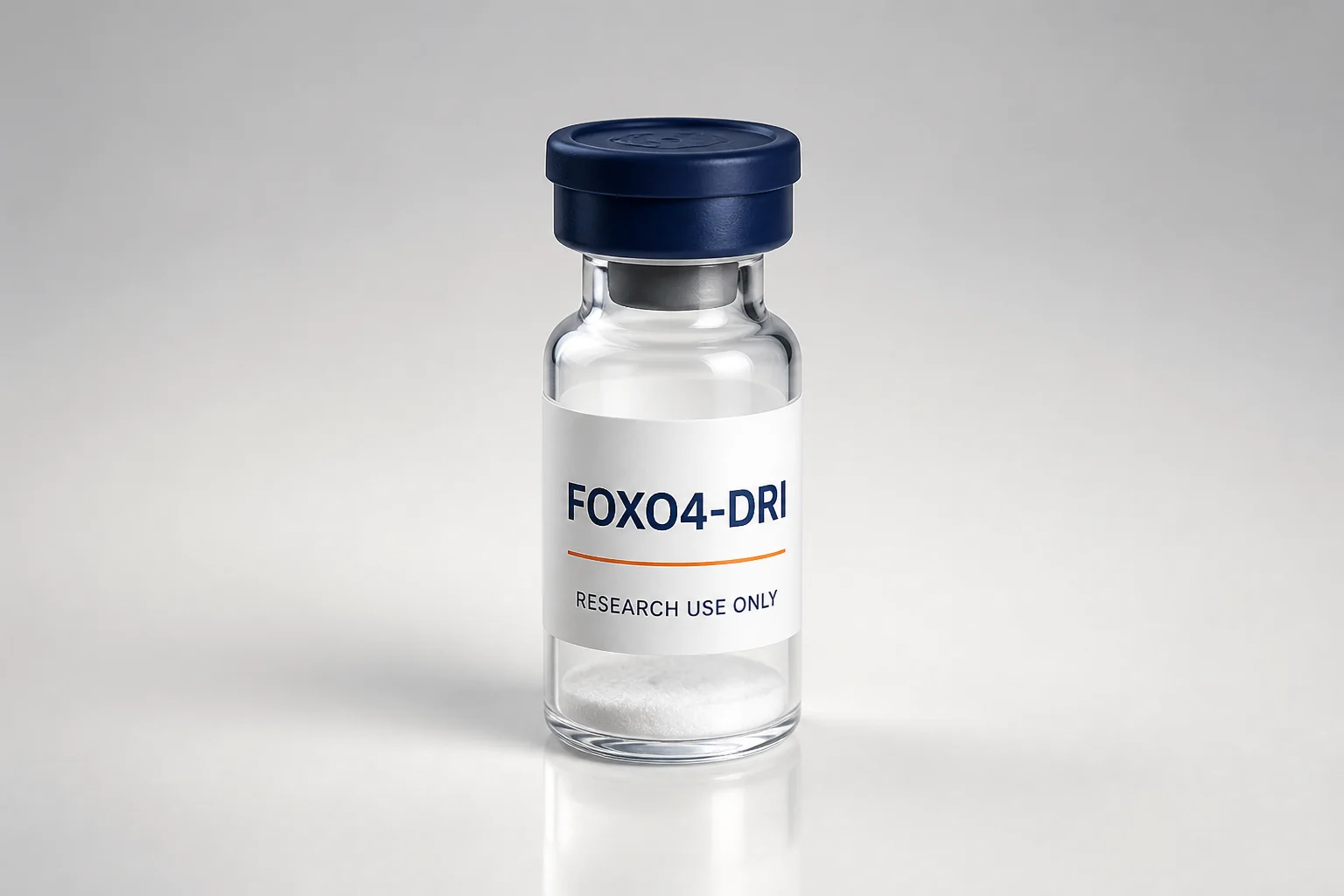
AI-generated packaging mockup for catalog navigation. It is not a photograph of an actual supplied lot; container, label and presentation may vary.

Product family

Compound overview

Shared values below are consolidated from the current catalog record. They are not independent verification or lot results; request the applicable product specification and ask which lot records are available before ordering.

Product identity

Product type
Peptide research compound
Catalog family
FOXO4-DRI
Research category
Longevity & Bioregulators
Catalog sequence
Retro-inverso D-amino-acid FOXO4 p53-interaction peptide
Evidence status
Senolytic cell and mouse evidence; no controlled human efficacy evidence
Intended use
Research, development and manufacturing use only

Literature reference parameters

Compound or material class
Cell-penetrating D-retro-inverso FOXO4–p53 interaction peptideCatalog-family identity
Evidence scope
Senolytic cell and mouse evidence; no controlled human efficacy evidenceDo not generalize beyond the cited model
Source review
Primary or authoritative records linked belowChecked 2026-09-01

Identity safeguard Reference identifiers above describe the literature compound record. Confirm the supplied form, formula, molecular weight, purity and storage conditions against the applicable product specification and any available lot records.

Mechanism of action

How FOXO4-DRI is studied

A target-to-pathway view grounded in the linked research records.

Awakening a self-destruct signal in old cells

In some senescent cells, two proteins, FOXO4 and p53, stay attached inside the cell's control center. This helps the cells survive despite damage. FOXO4-DRI is designed to break that attachment, letting p53 move out and trigger controlled cell death. In the models tested, this happened mainly in senescent cells, not healthy ones, because the two proteins behave differently there. This selectivity remains experimental and has not been confirmed in people.

Why clearing senescent cells is studied

Senescent cells can release inflammatory signals and disturb nearby tissue. Clearing some of them is a research strategy for restoring tissue balance after aging or chemotherapy. In mouse studies, this was linked to better physical measures and organ function. Whether clearing these cells improves human health is not known. Effects likely depend on cell type, timing and context. FOXO4-DRI is a laboratory tool for testing that idea, not a confirmed human therapy.

Effects vary by cell type

The peptide's proposed activity depends on the target cell's biology and state. One study in aged male mice looked at Leydig cells, which produce testosterone, and reported changes in the testicular environment and testosterone-related measures. A separate foundational study in fast-aging and naturally aged mice reported gains in fitness, fur density and kidney function. These come from different models and should not be merged into one expected result, especially not a human one.

Human effects still need direct evidence

Mouse studies describe specific preparations, routes and doses. They cannot guarantee that any independently supplied research product matches those preparations or behaves the same way. A catalog item's identity comes from its own specification and lot records. Those records cover composition and handling; they say nothing about clinical benefit. Published biological findings and catalog identity are separate questions and should be treated as such.

Reported research findings

What published studies report about FOXO4-DRI

Reported outcomes are paired with their experimental model and evidence boundary.

Cell and mouse study

Targeted apoptosis improved selected aging phenotypes in mice

The foundational report tested FOXO4-DRI in senescent cells and naturally aged or chemotherapy-exposed mice.

The study is preclinical and does not define human benefit, dose or long-term safety.

Read the primary study
Aged-mouse study

Leydig-cell function was evaluated in old mice

A later study examined senescent-cell clearance and testosterone-related measures in naturally aged male mice.

A murine endocrine model cannot establish a human hormonal outcome.

Read the primary study
Translation boundary: findings are limited to the evidence level stated on each card. Experimental protocol quantities are research details, not usage instructions.

Catalog options

Variant specifications

Pack-level catalog data; lot-level controls remain document-specific.

Catalog no.F410
Pack size10 mg × 10 vials
Current variant
Specification & documents for F410

Product specification

Single-component peptide · 10 mg/vial nominal · 10-vial pack · supplied form and release limits controlled by lot specification.

Lot documentation

Document availability and scope must be confirmed for this variant and lot in the written quotation. A catalog description is not a lot-specific test result.

Quality system

Quality documentation

A listed document is not proof of availability for this lot. Ask the team to confirm the current COA status and the scope of any other records before ordering.

Lot-specific Certificate of AnalysisAvailability and scope must be confirmed for the selected catalog variant and lot
COA availability unconfirmed Ask about availability
Product Specification SheetAvailability and scope must be confirmed for the selected catalog variant and lot
Confirm before ordering Request
Analytical Method SummaryAvailability and scope must be confirmed for the selected catalog variant and lot
Confirm before ordering Request

Analytical interpretation

Interpret the documents, not just the headline number.

Use the source-reviewed guide to separate chromatographic area purity, quantitative assay, LC-MS identity, composition and stability evidence before comparing variants or requesting a lot record.

Open the Quality & Documentation Hub

HPLC area ≠ assayA dominant peak does not establish target mass fraction.

Intact mass ≠ full sequenceIdentity strength depends on resolution and orthogonal evidence.

Counterions affect contentWater, salt form and solvents change the as-is composition.

Storage needs a data basisShipping practice is not the same as stability evidence.

Evidence map

Research context

Published studies and regulatory records, not customer testimonials or usage guidance.

Cell and mouse study

Targeted apoptosis improved selected aging phenotypes in mice

The study is preclinical and does not define human benefit, dose or long-term safety.

View primary record
Aged-mouse study

Leydig-cell function was evaluated in old mice

A murine endocrine model cannot establish a human hormonal outcome.

View primary record
Evidence boundary: each card states its evidence type. Human trials and regulatory records describe the studied or regulated intervention; preclinical records remain model-specific. None verifies the identity, quality, safety or efficacy of this catalog lot or provides usage instructions.

Literature basis

Curated references

Third-party publications selected for direct relevance.

  1. 01 Cell and mouse study
  2. 02

    FOXO4-DRI and age-related Leydig-cell dysfunction

    Preclinical study. 2020. PMID 31959736.

    Aged-mouse study

Research FAQ

FOXO4-DRI questions

Concise answers for researchers comparing identity, evidence and catalog variants.

What effects are studied for FOXO4-DRI?

In cultured senescent cells, it caused those cells to die while ordinary cells were largely spared. In mice, the foundational study reported better fitness, fur density and kidney function in some aging models. A later study in aged male mice reported changes in the testicular environment and testosterone-related measures. These are animal and cell results only. They do not establish human benefit, dosing or long-term safety.

How should the FOXO4-DRI research findings be understood?

Mouse studies describe specific preparations, routes and doses. They cannot guarantee that any independently supplied research product matches those preparations or behaves the same way. A catalog item's identity comes from its own specification and lot records. Those records cover composition and handling; they say nothing about clinical benefit. Published biological findings and catalog identity are separate questions and should be treated as such.

What evidence is available for FOXO4-DRI?

Foundational cell and aged-mouse studies exist, but controlled human clinical evidence was not identified.

Does the cited research validate this catalog material?

No. The cited records describe their own intervention, formulation, model and controls. They do not verify the identity, purity, sterility, safety or efficacy of a catalog lot.

Which quality documents can be requested?

A lot-specific COA, product specification sheet and analytical method summary can be requested where applicable.

How should FOXO4-DRI be stored?

Store at -20 °C, protected from light and moisture. After reconstitution, aliquot and avoid repeated freeze-thaw cycles. Confirm the applicable storage statement on the product-specific specification and lot documentation.

Knowledge center

Related insights

Owned educational content connected to this family.

FOXO4-DRI editorial illustration

FOXO4-DRI Evidence: Senescent Cells, Mice and Human Unknowns

FOXO4-DRI is an experimental senolytic design supported by cultured-cell and mouse studies. Reports of restored fitness, renal function, testosterone or vascular function remain preclinical.

Updated October 1, 2026
Editorial comic illustration: FOXO4-DRI Identity Guide. Conceptual cover, not experimental imagery.

FOXO4-DRI Identity Guide: D-Retro-Inverso Design and Peptide QC

FOXO4-DRI describes a D-retro-inverso peptide design intended to mimic the side-chain topology of a FOXO4 interaction segment while reversing backbone direction. It is not…

Updated October 1, 2026

Knowledge tools

Continue with structured evidence

Move from this dossier into canonical evidence maps, verified status records, analytical interpretation and laboratory calculations.

Internal technical source review

Claims were checked against the linked primary publication, regulatory label or authoritative compound record. Published findings stay attached to their study model, formulation and route. Catalog identity and lot quality remain controlled by the applicable specification and lot-specific documents.

Editorial status: NHD evidence editorial workflow · 2026-09-01 · Not independent medical review · Review policy

Technical procurement

Ready to request a quote?

Selected: F410 · 10 mg × 10 vials