Lot-document scope confirmed before quotation · Research use only
  • Specification Review
  • Lot Documents on Request
  • Business Support · Xi’an
  • Destination Eligibility Confirmed
西安诺和达生物科技有限公司
For research, development and manufacturing use only. Not for human or veterinary use.

Longevity & Bioregulators · Source-reviewed dossier

NAD+

Source-Reviewed Research Dossier

NAD+ is an endogenous redox cofactor and enzyme substrate central to energy metabolism, DNA repair and signaling. Established NAD biology does not by itself validate intravenous NAD+, anti-aging protocols or a particular catalog formulation.

Research use only Lot documents on request
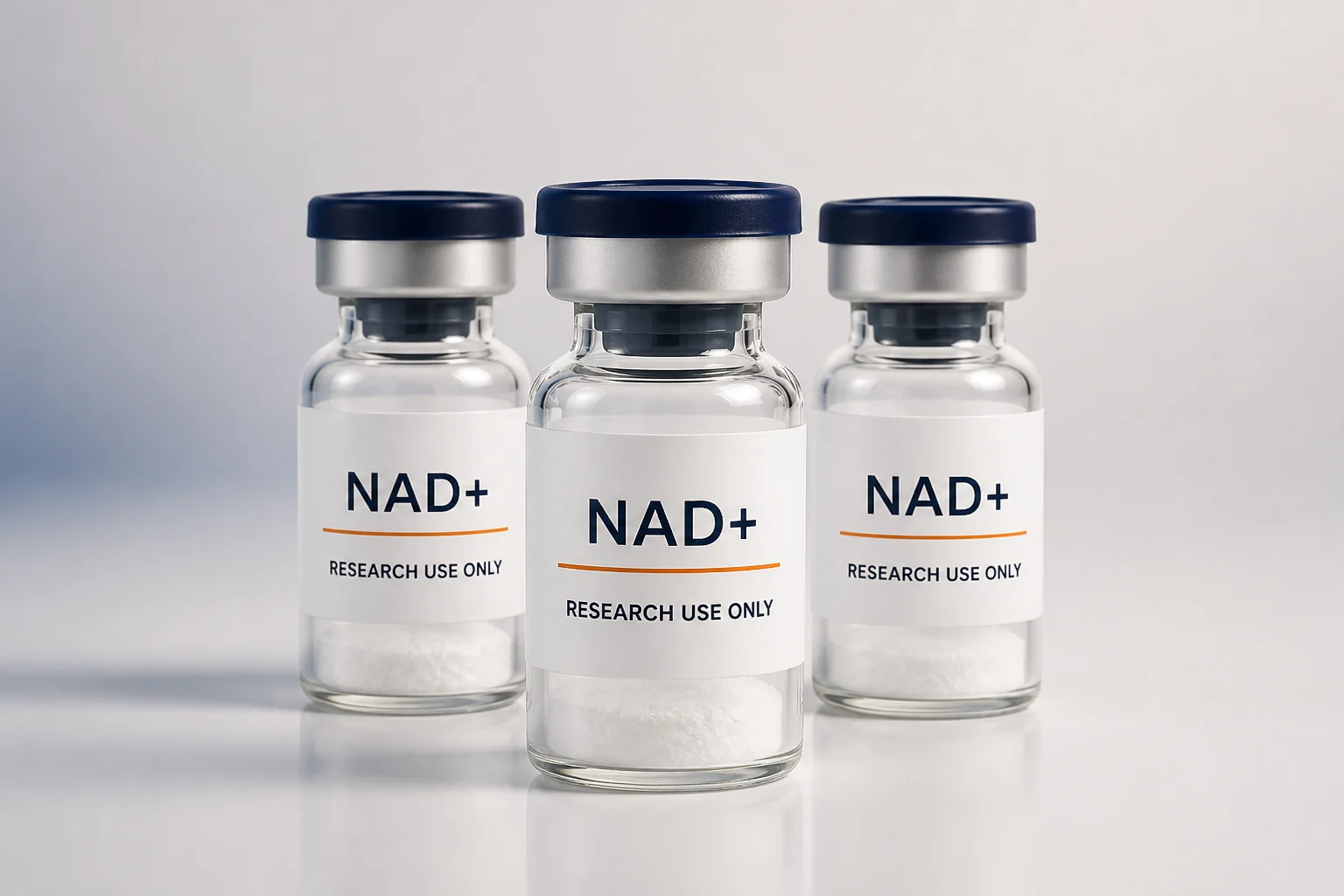
NAD+ research product family with 3 catalog variants
AI-generated packaging mockup for catalog navigation. It is not a photograph of an actual supplied lot; container, label and presentation may vary.

Product family

Compound overview

Shared values below are consolidated from the current catalog record. They are not independent verification or lot results; the current product specification and lot COA control.

Product identity

Product type
Small-molecule research compound
Catalog family
NAD+
Research category
Longevity & Bioregulators
Catalog CAS RN
53-84-9
Catalog molecular formula
C21H27N7O14P2
Catalog molecular weight
663.43 g/mol
Evidence status
Extensive biochemical biology; intervention evidence is precursor-, route- and indication-specific
Intended use
Research, development and manufacturing use only

Literature reference parameters

Compound or material class
Nicotinamide adenine dinucleotide research materialCatalog-family identity
Evidence scope
Extensive biochemical biology; intervention evidence is precursor-, route- and indication-specificDo not generalize beyond the cited model
Source review
Primary or authoritative records linked belowChecked 2026-09-01

Identity safeguard Reference identifiers above describe the literature compound record. The supplied form, formula, molecular weight, purity and storage conditions must be verified against the product-specific specification and lot COA.

Mechanism of action

How NAD+ is studied

A target-to-pathway view grounded in the linked research records.

Nicotinamide adenine dinucleotide research material research basis

NAD+ cycles between oxidized and reduced states in metabolism and is consumed by enzymes including sirtuins, PARPs and CD38.

Evidence and material boundary

Cellular NAD biology, oral precursor studies and direct NAD administration are distinct evidence questions and must not be combined into one efficacy claim.

Reported research findings

What published studies report about NAD+

Reported outcomes are paired with their experimental model and evidence boundary.

Biology review

NAD connects metabolism, signaling and disease biology

A major review described NAD biosynthesis, redox roles and NAD-consuming enzymes across aging and disease research.

Biological centrality is not evidence that supplementation or infusion improves outcomes.

Read the primary study
Cardiovascular review

NAD-related interventions were discussed in cardiac remodeling and aging

A 2022 review examined NAD biology and treatment hypotheses in cardiac remodeling and aging.

A focused review of mechanisms and candidate interventions does not validate direct NAD+ administration or general anti-aging outcomes.

Read the primary study
Translation boundary: findings are limited to the evidence level stated on each card. Experimental protocol quantities are research details, not usage instructions.

Catalog options

Variant specifications

Pack-level catalog data; lot-level controls remain document-specific.

Catalog no.NJ100
Pack size100 mg × 10 vials
Specification & documents for NJ100

Product specification

Small-molecule research compound · 100 mg/vial nominal · 10-vial pack · chemical form, identity and assay controlled by lot specification.

Lot documentation

Request by lot: CoA, identity and assay summary

Catalog no.NJ500
Pack size500 mg × 10 vials
Specification & documents for NJ500

Product specification

Small-molecule research compound · 500 mg/vial nominal · 10-vial pack · chemical form, identity and assay controlled by lot specification.

Lot documentation

Request by lot: CoA, identity and assay summary

Catalog no.NJ1000
Pack size1000 mg × 10 vials
Specification & documents for NJ1000

Product specification

Small-molecule research compound · 1000 mg/vial nominal · 10-vial pack · chemical form, identity and assay controlled by lot specification.

Lot documentation

Request by lot: CoA, identity and assay summary

Quality system

Quality documentation

Document availability is stated honestly and can vary by catalog variant or lot.

Lot-specific Certificate of AnalysisAvailability and scope must be confirmed for the selected catalog variant and lot
Confirm before ordering Request
Product Specification SheetAvailability and scope must be confirmed for the selected catalog variant and lot
Confirm before ordering Request
Analytical Method SummaryAvailability and scope must be confirmed for the selected catalog variant and lot
Confirm before ordering Request

Analytical interpretation

Interpret the documents, not just the headline number.

Use the source-reviewed guide to separate chromatographic area purity, quantitative assay, LC-MS identity, composition and stability evidence before comparing variants or requesting a lot record.

Open the Quality & Documentation Hub

HPLC area ≠ assayA dominant peak does not establish target mass fraction.

Intact mass ≠ full sequenceIdentity strength depends on resolution and orthogonal evidence.

Counterions affect contentWater, salt form and solvents change the as-is composition.

Storage needs a data basisShipping practice is not the same as stability evidence.

Evidence map

Research context

Published studies and regulatory records, not customer testimonials or usage guidance.

Biology review

NAD connects metabolism, signaling and disease biology

Biological centrality is not evidence that supplementation or infusion improves outcomes.

View primary record
Cardiovascular review

NAD-related interventions were discussed in cardiac remodeling and aging

A focused review of mechanisms and candidate interventions does not validate direct NAD+ administration or general anti-aging outcomes.

View primary record
Evidence boundary: each card states its evidence type. Human trials and regulatory records describe the studied or regulated intervention; preclinical records remain model-specific. None verifies the identity, quality, safety or efficacy of this catalog lot or provides usage instructions.

Literature basis

Curated references

Third-party publications selected for direct relevance.

  1. 01

    NAD+ metabolism and the control of energy homeostasis

    Houtkooper RH, et al. Endocr Rev. 2010. PMID 19149596.

    Biology review
  2. 02 Cardiovascular review

Research FAQ

NAD+ questions

Concise answers for researchers comparing identity, evidence and catalog variants.

What is NAD+?

NAD+ is an endogenous redox cofactor and enzyme substrate central to energy metabolism, DNA repair and signaling. Established NAD biology does not by itself validate intravenous NAD+, anti-aging protocols or a particular catalog formulation.

What evidence is available for NAD+?

The evidence base strongly supports biological importance, while clinical intervention claims depend on the exact compound, route, exposure and outcome.

Does the cited research validate this catalog material?

No. The cited records describe their own intervention, formulation, model and controls. They do not verify the identity, purity, sterility, safety or efficacy of a catalog lot.

Which quality documents can be requested?

A lot-specific COA, product specification sheet and analytical method summary can be requested where applicable.

How should NAD+ be stored?

Store at -20 °C, protected from light and moisture. After reconstitution, aliquot and avoid repeated freeze-thaw cycles. Confirm the applicable storage statement on the product-specific specification and lot documentation.

Knowledge center

Related insights

Owned educational content connected to this family.

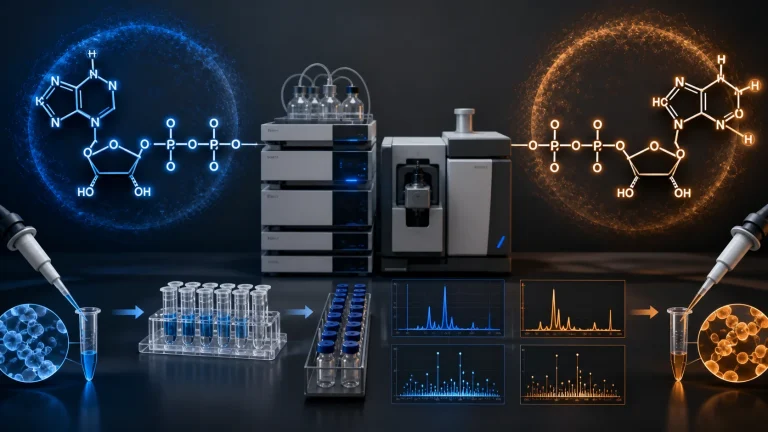
AI-generated illustration: Analytical comparison of oxidized NAD+ and reduced NADH

NAD+ vs NADH: Identity, Measurement and Stability Guide

The plus sign is not decorative: NAD+ is the oxidized form and NADH is the reduced form. Their formulas, spectra, redox behavior and assay…

Updated September 1, 2026

Knowledge tools

Continue with structured evidence

Move from this dossier into canonical evidence maps, verified status records, analytical interpretation and laboratory calculations.

Internal technical source review

Claims were checked against the linked primary publication, regulatory label or authoritative compound record. Published findings stay attached to their study model, formulation and route. Catalog identity and lot quality remain controlled by the applicable specification and lot-specific documents.

Editorial status: NHD evidence editorial workflow · 2026-09-01 · Not independent medical review · Review policy

Technical procurement

Ready to request a quote?

Selected: NJ100 · 100 mg × 10 vials