A fatty liver study may report liver fat reduction, improvement in liver inflammation and fibrosis change at the same time. All three relate to the liver, but they are not the same outcome. Below, a 48-week trial is used to separate these three things clearly.

Start with three terms
Liver fat is how much fat is in the liver; inflammation and liver cell injury are signs that the tissue is affected; fibrosis involves the buildup of scar-like tissue. You can think of them as clutter piling up in a room, damage that is currently happening, and marks left after damage. This analogy only helps understanding; the three do not have a fixed one-to-one correspondence. Imaging results that check liver fat cannot directly replace histological judgment of inflammation and fibrosis.
How the trial compared groups
The phase 2 Survodutide study published in 2024 enrolled adults with biopsy-confirmed MASH and fibrosis stage F1 to F3, compared three study dose groups with placebo, and followed participants for 48 weeks. A total of 293 randomized participants received at least one dose of study treatment. The primary endpoint was histological improvement in MASH with no worsening of fibrosis. Here, "no worsening" does not mean "already reversed." This article reviews that published study, not new approval news from 2026. [1]
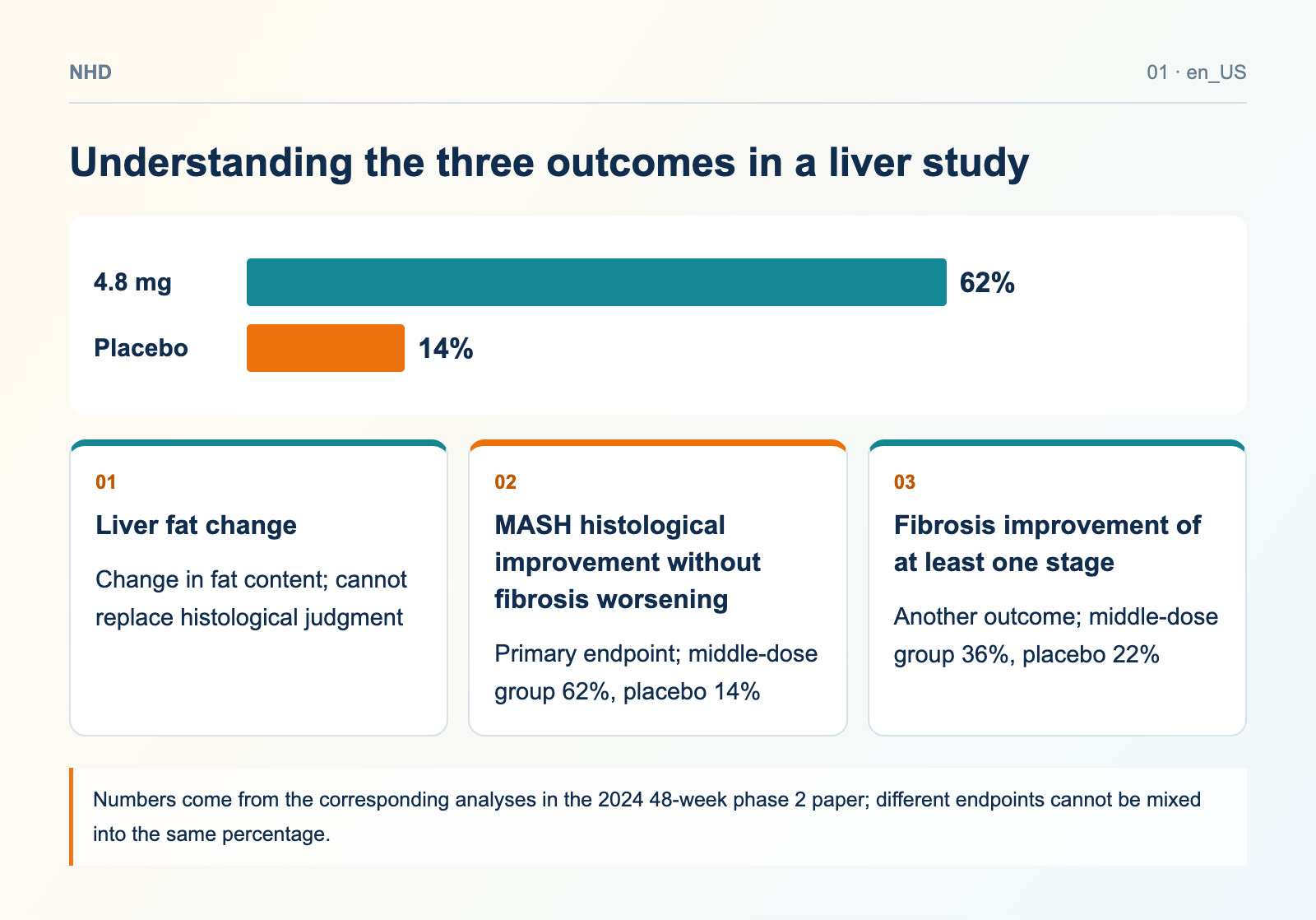
Understanding the three outcomes in a liver study
- Liver fat change: Change in fat content; cannot replace histological judgment
- MASH histological improvement without fibrosis worsening: Primary endpoint; middle-dose group 62%, placebo 14%
- Fibrosis improvement of at least one stage: Another outcome; middle-dose group 36%, placebo 22%
Which outcome does the 62% figure correspond to
In the paper's primary analysis, the proportions of participants reaching the primary endpoint in the three Survodutide groups were 47%, 62% and 43%, respectively, versus 14% in the placebo group. The 62% is the proportion of participants in one study group who met the specified composite condition; it is not a 62% reduction in liver fat for every participant, nor does it mean the liver recovered by 62%. The corresponding group, analysis population and rules for handling missing biopsies must be kept together with the number. The proportions also did not simply rise steadily as the dose increased. [1]
Two other tables answer different questions
The paper also reported the proportion of participants with at least 30% reduction in liver fat and the proportion with fibrosis improvement of at least one stage. For the middle-dose group, for example, these two proportions were 67% and 36%, respectively; in the placebo group they were 14% and 22%. Their judgment criteria and measurement methods differ, so 67%, 62% and 36% cannot be lined up as the same kind of "efficacy ranking." Secondary endpoints should also be read together with the limitations of multiple comparisons and statistical analysis, not by picking only the largest number. [1]
Look at adverse events on the same page
The paper reported that in the pooled Survodutide groups, the proportions of nausea, diarrhea and vomiting were higher than in the placebo group: 66% vs 23%, 49% vs 23%, and 41% vs 4%, respectively. These numbers come from the treatment and observation conditions of this study, not from safety testing of catalog materials. When evaluating a study, benefits, tolerability, discontinuation, analysis methods and follow-up time should be considered together; this article does not provide medication or dosing advice. [1]
How to bring the paper's questions into material procurement
First state clearly that the study object is Survodutide, then confirm the specific form, specification, quantity and analytical documentation needed. The clinical formulation in the paper does not automatically equal any catalog material with the same name. When requesting a quote, you can say: "I need Survodutide material for experimental research; please confirm the supply form, corresponding specification and available batch documentation." The product page is responsible for material information, and the original paper is responsible for clinical study results; the two records should be kept separately.
Original sources
Check the study conditions and material records separately. Calculations labeled as examples are not batch test results.
 Survodutide