
SS-31 is studied for its interaction with a lipid called cardiolipin in the inner mitochondrial membrane. This guide explains that relationship in plain language, then separates the proposed mechanism from the outcomes measured in each experiment.
Start with the energy-producing membrane
Mitochondria help cells turn nutrients into usable energy. ATP is one of the main molecules used to carry that energy. A useful analogy is an assembly line: several linked steps pass electrons along, helping the mitochondrion produce ATP. If one part of that chain changes, the result can appear as a change in oxygen consumption or ATP production. Those measurements tell researchers about the experimental system; they are not a direct measure of how energetic a person feels.
Cardiolipin is part of the membrane, not another peptide
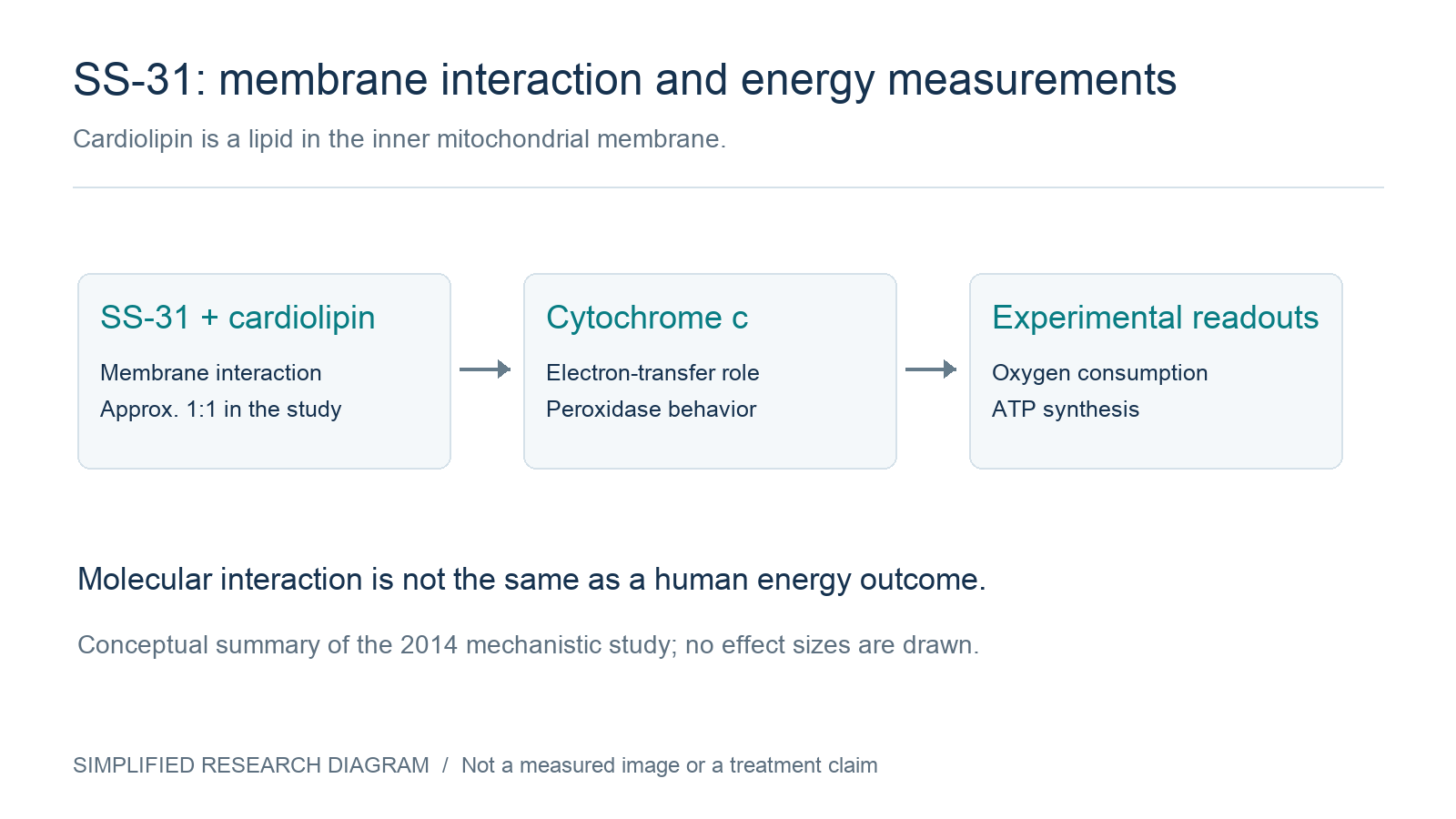
Cardiolipin is a lipid associated with the inner mitochondrial membrane. SS-31 is the peptide being investigated. The 2014 Birk study used artificial membrane preparations and mitochondrial preparations to examine their interaction. In that setup, the researchers reported an approximately 1:1 interaction ratio. The number describes a molecular interaction in the experiment. It is not a mixing instruction or a recommended amount for use.
One protein can behave in two different ways
Cytochrome c normally participates in electron transfer. Under particular interactions with cardiolipin, it can also show peroxidase activity, involving oxidation reactions. Birk and colleagues reported that SS-31 limited that peroxidase behavior while helping preserve electron transfer. Their mitochondrial experiments also measured respiration and ATP synthesis. This is the more precise research story behind the loose phrase “supports mitochondrial energy.” Read the original study.
Why a single potency number can mislead
A related 2013 paper reported a peroxidase-inhibition EC50 of 3.5 ± 0.03 micromolar in one cell-free setup, versus 0.8 ± 0.06 micromolar in permeabilized mitochondria. EC50 means the concentration associated with half of the measured maximal effect in that assay. The two values concern different experimental settings. They do not show that SS-31 has one fixed potency in every cell, tissue or person. Read this study.
Read the outcome next to the model
For an energy-related paper, ask what the authors measured: oxygen consumption, ATP production, membrane properties, or a clinical outcome. These endpoints belong to different levels of evidence. Also check whether the reported improvement occurred under a challenged condition or at baseline. A change in an isolated mitochondrial preparation does not by itself establish an improvement in human fatigue, exercise performance or aging.
How this connects to an SS-31 enquiry
For a laboratory project, the relevant conversation is about the specified peptide form and the records supporting material identity. Describe your research question alongside the required quantity and analytical scope. For a separate discussion of the clinical and finished-drug context, see our SS-31 and finished-drug evidence guide. Clinical formulation evidence should not be treated as proof about a catalogue research batch.
From membrane interaction to a measured outcome
| Check | What it tells you |
|---|---|
| Mechanism | Interaction with cardiolipin helps explain why mitochondrial biology is studied. |
| Laboratory endpoint | An experiment may measure membrane behavior, respiration or another defined signal. |
| Clinical endpoint | A patient study must measure its own outcome; a mechanism does not substitute for it. |
For laboratory procurement, review the related NHD catalog material and confirm the selected variant, amount basis and available records. Send a research enquiry with those requirements; the cited experiment is not a test of an NHD lot.
Explore the related NHD product
See the SS-31 (Elamipretide) product record for catalogue information. Send your quantity and document requirements for a quote. Availability and the scope of any lot documents need confirmation.
Original studies
- Cardiolipin interaction, electron transport and ATP synthesis — 2014 original paper
- Peroxidase assays and mitochondrial experiments — 2013 original paper
Sources checked 5 October 2026. This explanation uses the accessible original abstracts and figure descriptions. The diagram is a simplified explanation, not an experimental image. NHD catalogue materials are for qualified laboratory research, development and manufacturing enquiries, not human or veterinary use.
Sources & editorial method
AI-assisted writing; deterministic explanatory diagram.
0 linked records are listed in the references below. Read the editorial and AI-assistance policy.
How to interpret this article
AI-assisted editorial review; not independent human peer review. Experimental endpoints and catalogue material are distinguished.
Research-use boundary: Catalog materials discussed on this website are for laboratory research, development and manufacturing use only, not for human or veterinary use. This content is not medical advice and does not provide administration instructions.
Continue with structured records
Move from this editorial analysis to the product identity, filtered evidence and controlled terminology behind it.