For research, development and manufacturing use only. Not for human or veterinary use.
Mitochondrial research · Elamipretide / SS-31
SS-31 (Elamipretide)
Scientific Product Dossier
SS-31, also called elamipretide, is a small peptide studied for its interaction with cardiolipin, a lipid in the inner mitochondrial membrane. That membrane helps cells make usable energy. Research findings depend on the disease model, preparation and measured endpoint. Catalog SS-31 and a regulated finished drug are different products. The sections below explain the mitochondrial research and show the catalog information to check before placing a research enquiry.
Research use only Lot documents on request
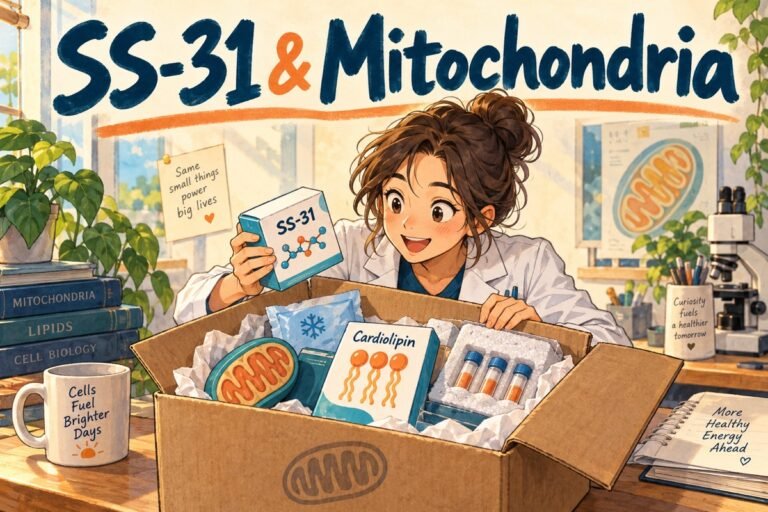
AI-generated packaging mockup for catalog navigation. It is not a photograph of an actual supplied lot; container, label and presentation may vary.
Product family
Compound overview
Shared values below are consolidated from the current catalog record. They are not independent verification or lot results; request the applicable product specification and ask which lot records are available before ordering.
Product identity
Product type
Peptide research compound
Catalog family
SS-31 (Elamipretide)
Research category
Longevity & Bioregulators
Evidence status
Source-reviewed literature module available below
Intended use
Research, development and manufacturing use only
Literature reference parameters
Compound class
Mitochondrial cardiolipin-binding tetrapeptideCompound-level research classification
Evidence status
Approved finished drug exists for a narrow indication; catalog remains RUOSource-reviewed through 2026-08-28
Primary evidence anchor
SPIBA-201 / TAZPOWER · 12-patient crossover studySee linked references and study articles
Identity safeguard Reference identifiers above describe the literature compound record. Confirm the supplied form, formula, molecular weight, purity and storage conditions against the applicable product specification and any available lot records.
Mechanism of action
How SS-31 (Elamipretide) is studied
A target-to-pathway view grounded in the linked research records.
Cardiolipin interaction
Cardiolipin is a special fat on the inner mitochondrial membrane that supports energy production. The FDA describes elamipretide as a mitochondrial cardiolipin binder. Researchers suggest that interacting with cardiolipin may help steady this membrane, which is why it is studied where mitochondria do not work well. Binding alone does not prove benefit in people, and what happens afterward in the body is still being studied.
Mitochondrial function context
Mitochondria are the cell's power plants, and their inner membrane needs cardiolipin to work normally. In Barth syndrome, a gene defect leads to abnormal cardiolipin, which is thought to contribute to muscle weakness, fatigue and heart problems. Because elamipretide interacts with cardiolipin, scientists use it to explore whether supporting this membrane affects mitochondrial and muscle function. This is an idea being tested, not a proven effect, and results from one rare disease should not be assumed to apply to other groups.
The medicine and the research material
The FDA accelerated approval applies only to Forzinity, a finished drug, for a defined condition and patient weight. Approval decisions are tied to that application, formulation and clinical dataset. Catalog SS-31 is a research compound supplied for laboratory and development use, not the approved medicine. Findings from the Forzinity clinical program do not automatically apply to catalog material, other salt forms, blends, routes or doses. Catalog and clinical products are distinct categories when reading published evidence.
Reported research findings
What published studies report about SS-31 (Elamipretide)
Reported outcomes are paired with their experimental model and evidence boundary.
Randomized crossover
Primary endpoints were not met
The 12-patient randomized portion did not show superiority on 6-minute walk distance or the Barth syndrome fatigue score.
All participants were male; one US site; extremely small rare-disease dataset.
Translation boundary: findings are limited to the evidence level stated on each card. Experimental protocol quantities are research details, not usage instructions.
Single-component peptide · 10 mg/vial nominal · 10-vial pack · supplied form and release limits controlled by lot specification.
Lot documentation
Document availability and scope must be confirmed for this variant and lot in the written quotation. A catalog description is not a lot-specific test result.
Catalog no.2S50
Pack size50 mg × 10 vials
Specification & documents for 2S50
Product specification
Single-component peptide · 50 mg/vial nominal · 10-vial pack · supplied form and release limits controlled by lot specification.
Lot documentation
Document availability and scope must be confirmed for this variant and lot in the written quotation. A catalog description is not a lot-specific test result.
Quality system
Quality documentation
A listed document is not proof of availability for this lot. Ask the team to confirm the current COA status and the scope of any other records before ordering.
Lot-specific Certificate of AnalysisAvailability and scope must be confirmed for the selected catalog variant and lot
Interpret the documents, not just the headline number.
Use the source-reviewed guide to separate chromatographic area purity, quantitative assay, LC-MS identity, composition and stability evidence before comparing variants or requesting a lot record.
Evidence boundary: each card states its evidence type. Human trials and regulatory records describe the studied or regulated intervention; preclinical records remain model-specific. None verifies the identity, quality, safety or efficacy of this catalog lot or provides usage instructions.
Literature basis
Curated references
Third-party publications selected for direct relevance.
Reid Thompson W, et al. Genetics in Medicine. 2021. PMID 33077895.
Human trial
Research FAQ
SS-31 (Elamipretide) questions
Concise answers for researchers comparing identity, evidence and catalog variants.
What effects are studied for SS-31 (Elamipretide)?
In Barth syndrome, a 12-patient randomized trial did not meet its two main goals: walking distance and a fatigue symptom score. During longer open-label follow-up, participants showed improvements in walking distance, fatigue score, knee-extensor strength and some heart measures. The FDA cited knee-extensor strength from that follow-up when granting accelerated approval to Forzinity, and required a confirmatory randomized trial. These results apply to the studied clinical product and population, not to catalog SS-31.
How should the SS-31 (Elamipretide) research findings be understood?
The FDA accelerated approval applies only to Forzinity, a finished drug, for a defined condition and patient weight. Approval decisions are tied to that application, formulation and clinical dataset. Catalog SS-31 is a research compound supplied for laboratory and development use, not the approved medicine. Findings from the Forzinity clinical program do not automatically apply to catalog material, other salt forms, blends, routes or doses. Catalog and clinical products are distinct categories when reading published evidence.
Are SS-31, elamipretide and Forzinity interchangeable names?
SS-31 and elamipretide refer to the peptide research lineage; Forzinity is a specific FDA-approved finished drug. A catalog SS-31 lot is not automatically that drug.
What did the randomized Barth syndrome trial show?
The 12-patient randomized crossover portion did not meet its 6-minute-walk or fatigue primary endpoints.
How is product identity verified?
Family-level identifiers organize the catalog. Confirm the supplied form, identity and release criteria using the applicable product specification and ask which lot records are available.
Which quality documents can be requested?
Tell us which records your project requires. Availability and scope must be confirmed for the selected material. Published papers are not batch certificates, and this page does not confirm that a lot-specific COA is available.
How should SS-31 (Elamipretide) be stored?
Request the storage conditions for the exact supplied form and selected variant. A temperature stated for another supplier or a clinical drug preparation is not a verified storage specification for NHD catalog material.
Does a mitochondrial mechanism establish a general energy benefit?
No. A mechanism explains a possible biological pathway. Demonstrating an effect requires a defined experiment and endpoint. Findings in a specific disease study do not establish a general benefit for catalog material.
What should I include in a research quotation request?
Send the exact product name, selected catalog variant, required quantity, destination and documents needed for the project. Specify whether the amount refers to powder mass or measured peptide content. Availability, price, lead time and document scope require confirmation.
Does a published study replace a lot-specific analytical report?
No. A paper describes the material and methods used in that study. It does not establish the identity, purity or content of a different supplied lot. Ask which records actually apply to the requested material; do not assume a COA is available.
Knowledge center
Related insights
Owned educational content connected to this family.
Elamipretide now has an FDA-approved finished product for a narrow Barth syndrome indication, but the approval rests on an unusual rare-disease dataset. The randomized…
Updated October 1, 2026
ArticleFDA label/approval distinction and research-material quality…
SS-31 and elamipretide are names used around the same mitochondrial-targeted peptide, but Forzinity is a specific FDA-approved finished drug with an approved application, formulation,…
Updated October 1, 2026
ArticleMechanistic study with separate clinical context
SS-31 is studied for its interaction with a lipid called cardiolipin in the inner mitochondrial membrane. This guide explains that relationship in plain language,…
Updated October 9, 2026
ArticlePrimary research with study-specific limitations
Published-study results are tied to the linked records and kept separate from catalog-lot claims. Imported purity, storage and document-availability templates have been removed pending product- and lot-specific confirmation.
Editorial status: Source review complete · 2026-10-09 · Not independent medical review · Review policy