Read the published GHK-Cu colorimetry data without confusing detection limits, linear ranges and smartphone-sensor conditions.

How a color reaction becomes a measurement
Laccases participate in oxidation reactions. This 2026 paper investigated laccase-like catalytic behavior of GHK-Cu in its test system and used color changes for sensing. It does not mean GHK-Cu becomes a natural laccase, or that any colored sample reveals the amount of any compound present.
Check which compound and matrix were measured
For epinephrine, the linear range was 20–240 µM and the detection limit 9.5 µM. For 2-aminophenol, the ranges were 14–100 µM in pure water and 2–120 µM in seawater, with detection limits of 2.56 and 1.65 µM. The figure separates these conditions instead of ranking different tasks as one assay.

| Condition | Linear range (µM) | Detection limit (µM) |
|---|---|---|
| Epinephrine | 20–240 | 9.5 |
| 2-aminophenol · pure water | 14–100 | 2.56 |
| 2-aminophenol · seawater | 2–120 | 1.65 |
Detection is not the same as reliable quantification
A linear range describes where the established linear response relationship applies. A detection limit concerns distinguishing a low-level signal from background. A detection limit below the linear range does not establish equally reliable quantification there. Calibration, precision and validation in the intended samples still matter.
The smartphone sensor used a different setup
The paper also developed a cotton-based sensor with smartphone reading for 2-aminophenol in seawater. Its detection limit was 0.033 mM, or 33 µM. Do not treat this and the solution assay's 1.65 µM as repeated measurements of one method: the support, reading system and calibration differ. The figure includes only solution colorimetry.
Applying the idea to another sample
Identify the analyte, matrix, possible interferents, required range and reading equipment. Validation in seawater does not automatically cover blood, culture medium or cosmetic samples. A different matrix needs its own suitability assessment, rather than a claim based only on the reported detection limit.
What the material enquiry should clarify
The GHK-Cu page supports material and quotation enquiries; it is not a validated sensing-kit offer. Attach the publication and specify the chemical identity, form and information needed. Method performance depends on the complete validated system, not the peptide name or a purity percentage alone.
References
Published findings, hypothetical teaching examples and material information are distinguished. Read the original methods before attempting replication.
Related research materials
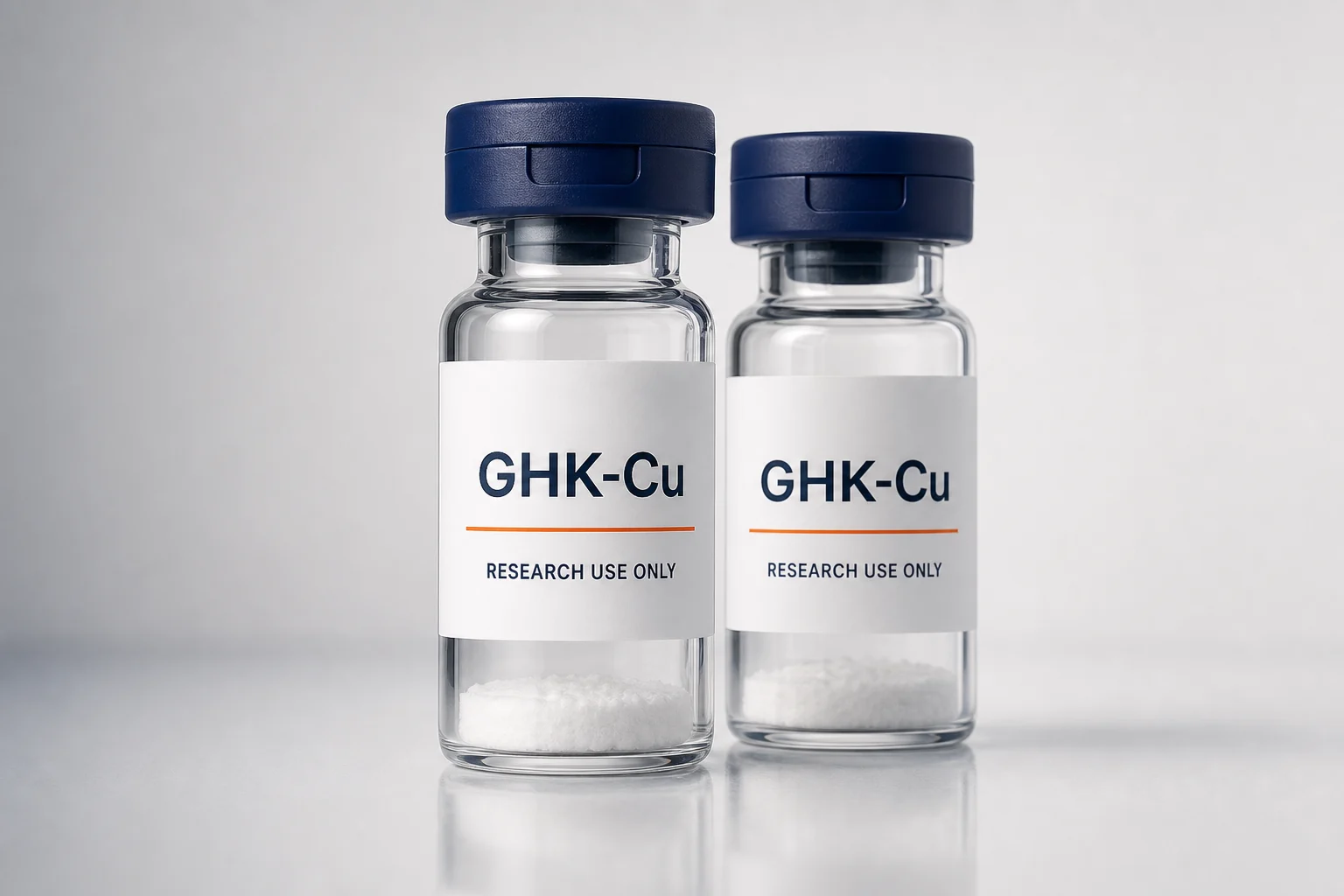 GHK-Cu
Enquire about products and information →
Research reading and material enquiries only. This page is not personal medical advice or a substitute for batch-specific records.