GHK, copper and cis-urocanic acid illustrate why solution composition and pH matter when interpreting copper-peptide research.

Different ways of binding
The same components can occur in different binding states. Coordination chemistry asks which sites bind a metal and which forms occur under particular conditions. Think of an equilibrium between binding arrangements, rather than one fixed pattern in every solution.
The three components in the study
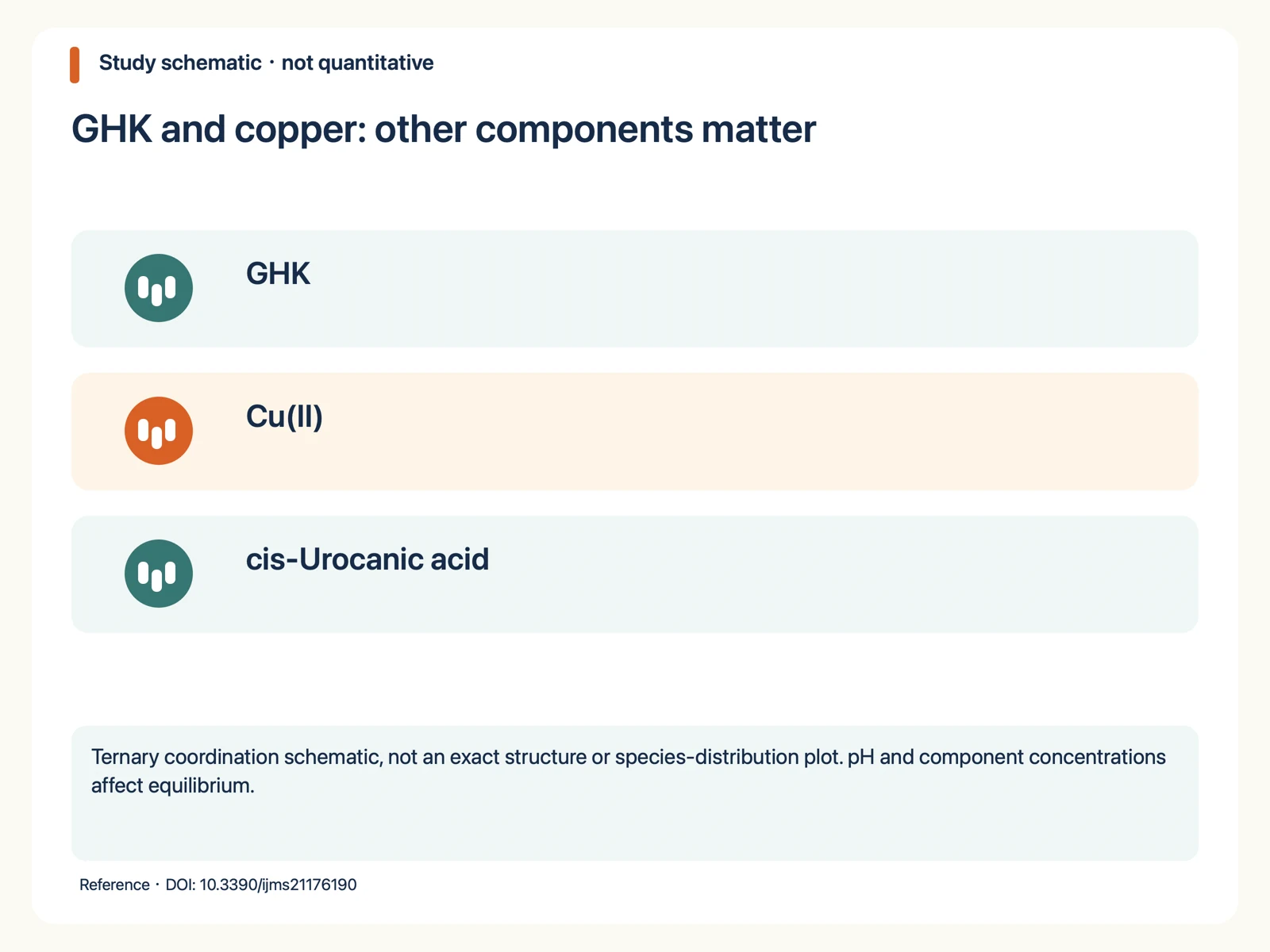
The 2020 paper examined GHK, Cu(II) and cis-urocanic acid. GHK is glycyl-histidyl-lysine; cis-urocanic acid can also interact with copper. Ternary refers to the three participating components in the investigated complex, not to GHK containing three amino acids.
Why pH matters
pH affects protonation at potential binding sites and can change coordination equilibria. Other ligands, concentrations and component ratios also matter. A statement that GHK-Cu is stable at a particular pH needs to define stability, identify the test solution and state what else was present.
A binding change is not automatically degradation
Coordination changes, peptide-chain degradation, precipitation and biological-response changes are different questions. A spectral change may reflect a new environment without showing that the chain has broken. An unchanged appearance also does not prove the material is unchanged. Choose measurements that address the actual question.
Keep a useful solution record
Record material form, component concentrations, pH, buffer, preparation time and observation method. Before comparing papers, check for cis-urocanic acid or other copper-binding components. The figure identifies participants; it is not an exact structure or an unverified species-distribution curve.
Clarify the intended material
The GHK-Cu page supports identity and specification enquiries. If the experiment depends on a particular copper-to-peptide ratio or coordination system, state that separately. A catalog name does not replace measurement of the intended solution state.
References
Published findings, hypothetical teaching examples and material information are distinguished. Read the original methods before attempting replication.
Related research materials
 GHK-Cu
Enquire about products and information →
Research reading and material enquiries only. This page is not personal medical advice or a substitute for batch-specific records.