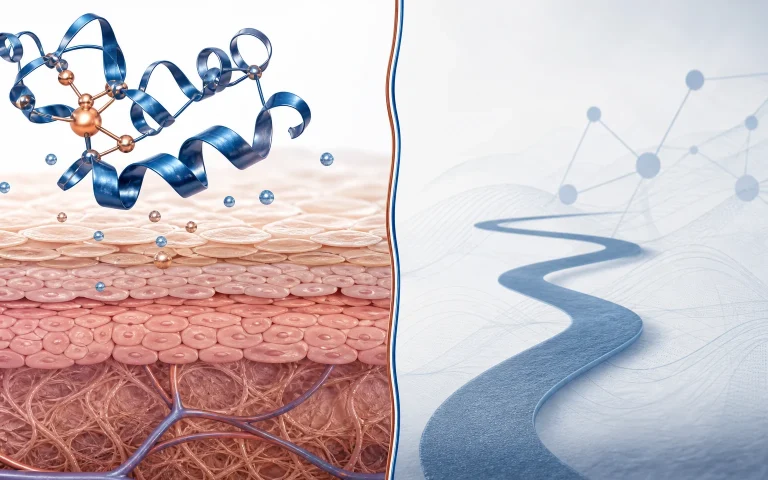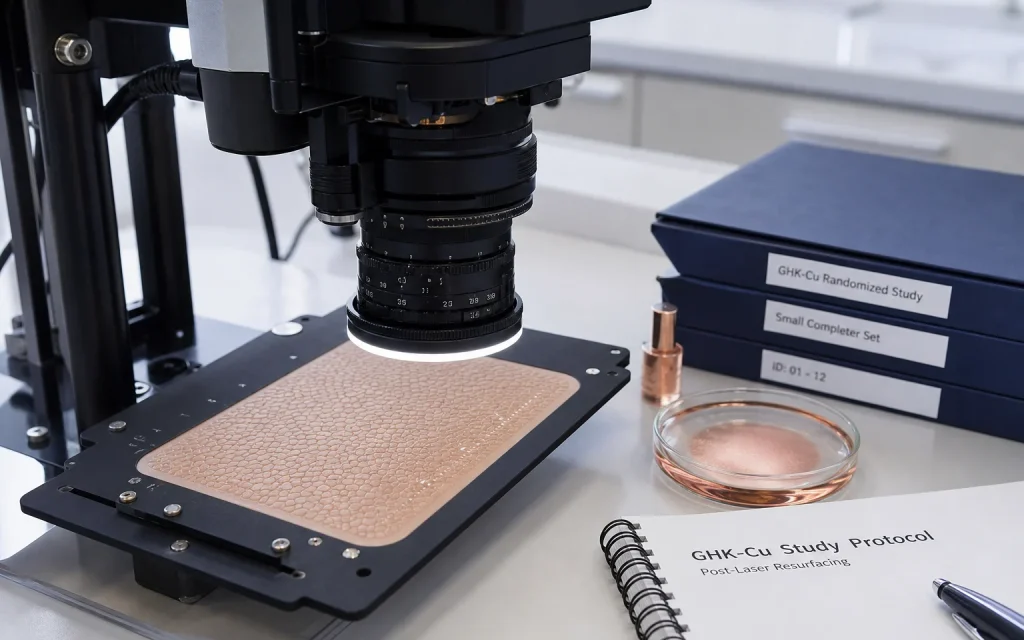
The most directly relevant randomized topical GHK-Cu study was small: 13 patients completed it. Objective assessments did not find significant differences in erythema resolution, wrinkles or overall skin quality between groups.
What the record shows
- Thirteen participants completed the post-laser study.
- Computer analysis and blinded evaluation found no significant difference in erythema resolution.
- A questionnaire favored GHK-Cu for perceived overall skin quality (p = 0.04), while objective group comparisons remained null.

Study record
All participants improved after laser resurfacing. That before-versus-after change cannot be attributed to GHK-Cu because the procedure itself was shared by both groups.
Results in context
The only reported between-group signal was in the patient questionnaire. With 13 completers and several endpoints, that result should be treated as exploratory rather than promoted as proof of wrinkle repair.
Earlier wound research includes animal models. Those experiments can support mechanistic questions but cannot substitute for controlled topical human outcomes.
What this study cannot answer
The sample was too small for a precise estimate of modest effects or uncommon harms.
Topical product data cannot establish the safety of injectable GHK-Cu.
Sources & editorial method
The editorial workflow starts with linked peer-reviewed papers, trial registries or regulatory records; extracts the population or model, endpoints, numerical results and limitations; and separates the studied intervention from catalog material. AI-assisted drafting was used to structure the first version. Claims, figures, evidence labels and limitations were checked against the linked records in the site editorial workflow. This is not independent peer review.
3 linked records are listed in the references below. Read the editorial and AI-assistance policy.
How to interpret this article
Source-checked on 2026-08-28. Null findings and study limitations are retained. This is not independent peer review, medical advice, a customer case, or validation of a catalog lot.
Research-use boundary: Catalog materials discussed on this website are for laboratory research, development and manufacturing use only, not for human or veterinary use. This content is not medical advice and does not provide administration instructions.
Primary records and authoritative sources
- Effects of topical copper tripeptide complex on laser-resurfaced skinMiller TR, et al. Archives of Facial Plastic Surgery. 2006. PMID 16847171.
- GHK-Cu wound research in a rat modelPreclinical context; PMID 8227353.
- Certain Bulk Drug Substances That May Present Significant Safety RisksU.S. FDA. Current compounding safety-information page.
Continue with structured records
Move from this editorial analysis to the product identity, filtered evidence and controlled terminology behind it.