


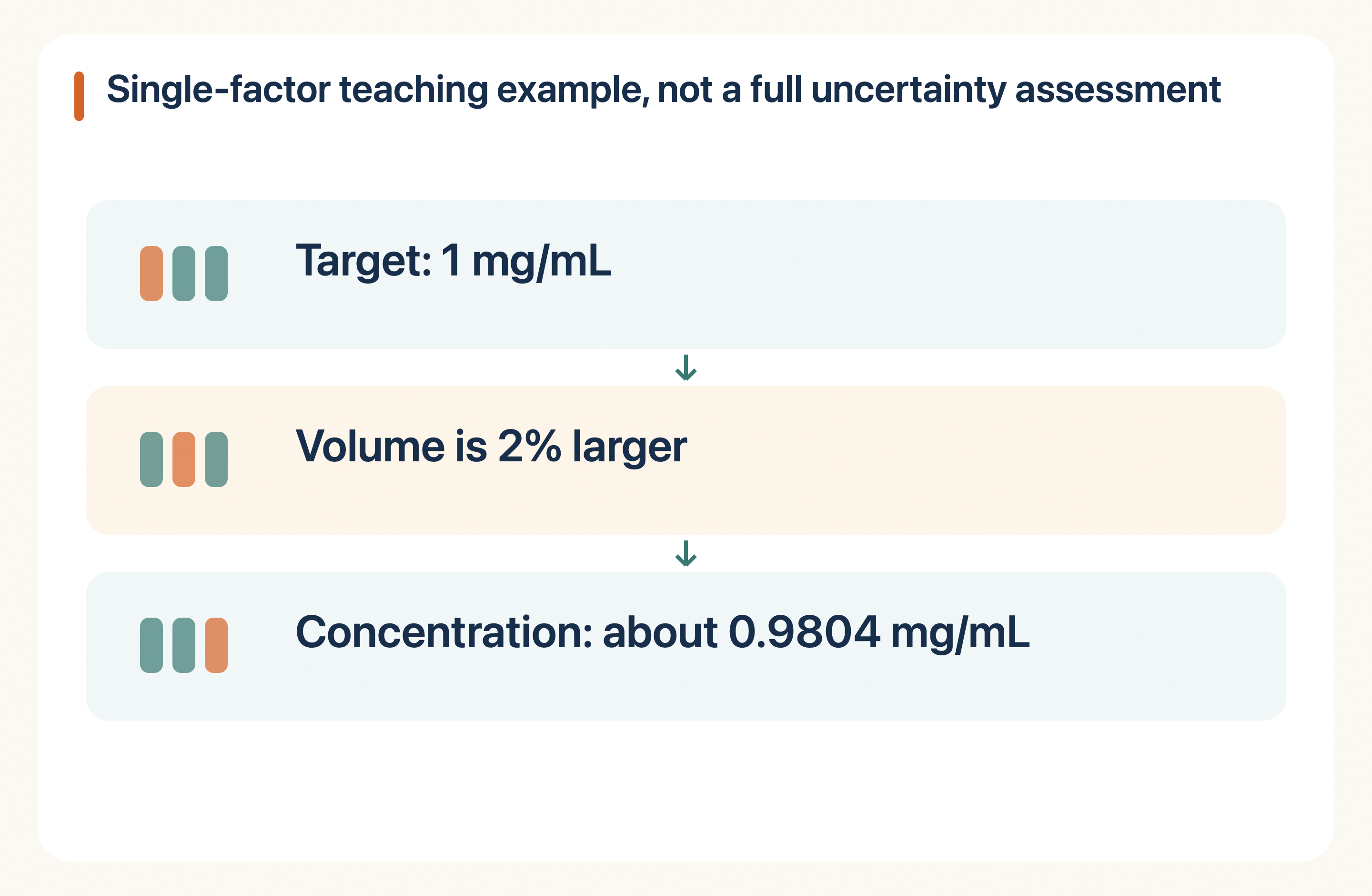
A calculator can display many digits even when its inputs are uncertain. The useful concentration statement reflects the quality of the mass, content and volume measurements, not the number of digits on the screen.
Identify the inputs
A concentration may depend on weighed mass, a measured content fraction and final volume. For molar concentration, molecular mass is also part of the calculation. Each input has its own measurement basis. A missing content result is an unknown, not a precise value of 100%.
A simplified uncertainty example
Suppose the independent relative standard uncertainties for mass, content and volume are 1%, 5% and 1%. A first-order combination gives the square root of (1² + 5² + 1²), or about 5.2%. Thus a calculated 100 micromolar concentration would have about 5.2 micromolar combined standard uncertainty under those assumptions.
What the assumptions exclude
This teaching calculation assumes independent inputs and a suitable measurement model. It excludes unmeasured losses, degradation and uncertainty that was never quantified. Standard uncertainty is not the same as a guaranteed tolerance or an expanded uncertainty. NIST explains the general combination framework.
What to write in your record
Save the values used, their units and the content basis. Report a sensible number of significant figures. If a nominal calculation is all the evidence supports, label it nominal. A calculator result should help organize the evidence, rather than make uncertain inputs appear exact.
Related materials and next steps
Explore the NHD catalogue records for KPV, MOTS-c (Human). Confirm the required molecular form, quantity and lot-document availability before relying on a listing for procurement. A catalogue record does not establish equivalence to a published study material.
Send the product or sequence, quantity and document requirements. For more background, browse the analytical methods guides and research glossary.
Sources and reading scope
Source links checked 5 October 2026. Research summaries use the accessible original abstract unless a full-text source is explicitly identified. Guidance documents and external supplier explanations are technical references, not NHD batch evidence or a claim of regulatory compliance. Any example introduced as hypothetical or teaching is a calculation, not a measured product result.
NHD catalogue materials are for qualified laboratory research, development and manufacturing enquiries. This article does not provide instructions for human or veterinary use.
Sources & editorial method
AI-assisted writing and source checks; conceptual illustrated cover.
2 linked records are listed in the references below. Read the editorial and AI-assistance policy.
How to interpret this article
Study results and labeled examples are separated. Original-source, arithmetic, readability and internal-link checks; no independent human peer review recorded.
Research-use boundary: Catalog materials discussed on this website are for laboratory research, development and manufacturing use only, not for human or veterinary use. This content is not medical advice and does not provide administration instructions.
Primary records and authoritative sources
- ICH Q2(R2) Validation of Analytical ProceduresICH Q2(R2) Validation of Analytical Procedures
- The International System of Units (SI), 9th editionThe International System of Units (SI), 9th edition
Continue with structured records
Move from this editorial analysis to the product identity, filtered evidence and controlled terminology behind it.



 KPV
 BPC-157