


If an experiment changes after a new peptide batch arrives, the batch may be relevant, but it is not automatically the cause. A planned comparison can help separate material differences from changes in the assay.
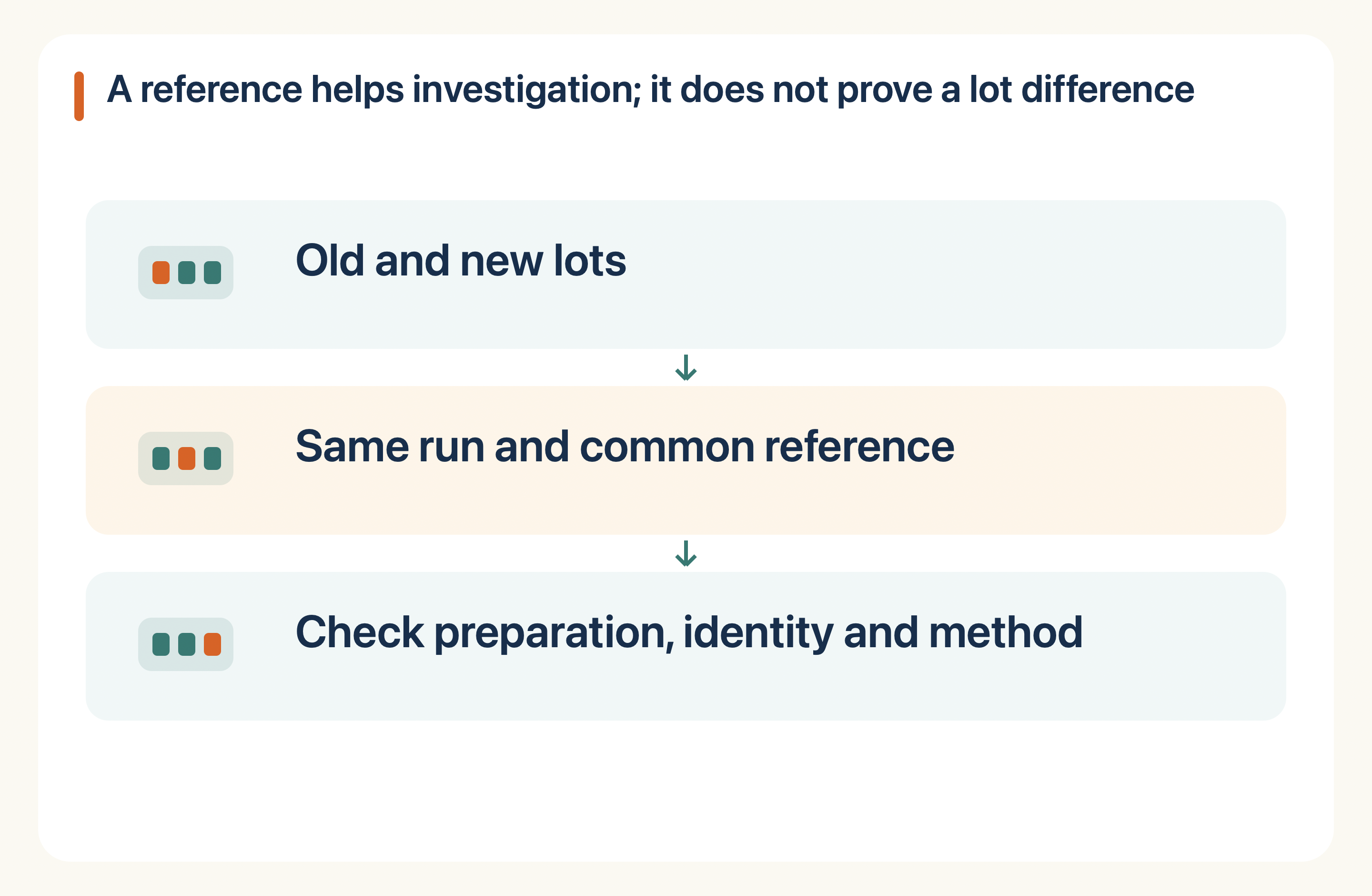
Keep the old and new material identifiable
Record the batch numbers, quantity basis, storage and handling history. Compare the available identity, impurity-profile and content results. Two lots with the same HPLC area purity can still differ in other measured attributes.
Use one shared comparison
For example, test old and new lots on the same plate at 3 predefined research concentrations, with 3 replicate wells each. That creates 18 material wells before controls: 2 lots × 3 concentrations × 3 replicates. This is an illustrative layout, not a validated universal design or an instruction for product use.
Controls make the result easier to read
Include the relevant blank or vehicle control and an assay-performance control where suitable. Randomize placement when appropriate. Define the comparison and decision before viewing the result; changing the rule afterwards can make a noisy difference look convincing.
Avoid over-interpreting a single run
Replicate wells capture some within-run variation but do not replace independent repeat experiments. If the result differs, investigate the assay and material evidence together. Send the supplier the exact lot identifiers, observed issue and requested analytical comparison rather than a general claim that the peptide stopped working.
Related materials and next steps
Explore the NHD catalogue records for GHK-Cu, KPV. Confirm the required molecular form, quantity and lot-document availability before relying on a listing for procurement. A catalogue record does not establish equivalence to a published study material.
Send the product or sequence, quantity and document requirements. For more background, browse the analytical methods guides and research glossary.
Sources and reading scope
Source links checked 5 October 2026. Research summaries use the accessible original abstract unless a full-text source is explicitly identified. Guidance documents and external supplier explanations are technical references, not NHD batch evidence or a claim of regulatory compliance. Any example introduced as hypothetical or teaching is a calculation, not a measured product result.
NHD catalogue materials are for qualified laboratory research, development and manufacturing enquiries. This article does not provide instructions for human or veterinary use.
Sources & editorial method
AI-assisted writing and source checks; conceptual illustrated cover.
1 linked records are listed in the references below. Read the editorial and AI-assistance policy.
How to interpret this article
Study results and labeled examples are separated. Original-source, arithmetic, readability and internal-link checks; no independent human peer review recorded.
Research-use boundary: Catalog materials discussed on this website are for laboratory research, development and manufacturing use only, not for human or veterinary use. This content is not medical advice and does not provide administration instructions.
Primary records and authoritative sources
- ICH Q2(R2) Validation of Analytical ProceduresICH Q2(R2) Validation of Analytical Procedures
Continue the documentation review
Each guide answers a different analytical question. Use the complete set before treating one number as a complete quality record.
Open the complete Quality & Documentation HubContinue with structured records
Move from this editorial analysis to the product identity, filtered evidence and controlled terminology behind it.



 BPC-157
 MOTS-c (Human)