


Cognitive & Neuropeptides · Source-reviewed dossier
Dermorphin
Source-Reviewed Research Dossier
Dermorphin is a short peptide first found in frog skin. It binds the mu-opioid receptor, the same target as morphine, and produces strong pain relief in animal experiments. Researchers study it to understand how peptides activate this receptor and to design analogues with different stability or effect profiles. Reports describe potent, long-lasting pain relief in animals and some entry into the brain after dosing outside the central nervous system. Rodents given dermorphin repeatedly showed less tolerance and dependence than those given morphine. These are mostly receptor and animal findings. Opioid-class risks such as breathing depression and dependence remain important limits. This material is for research use only.
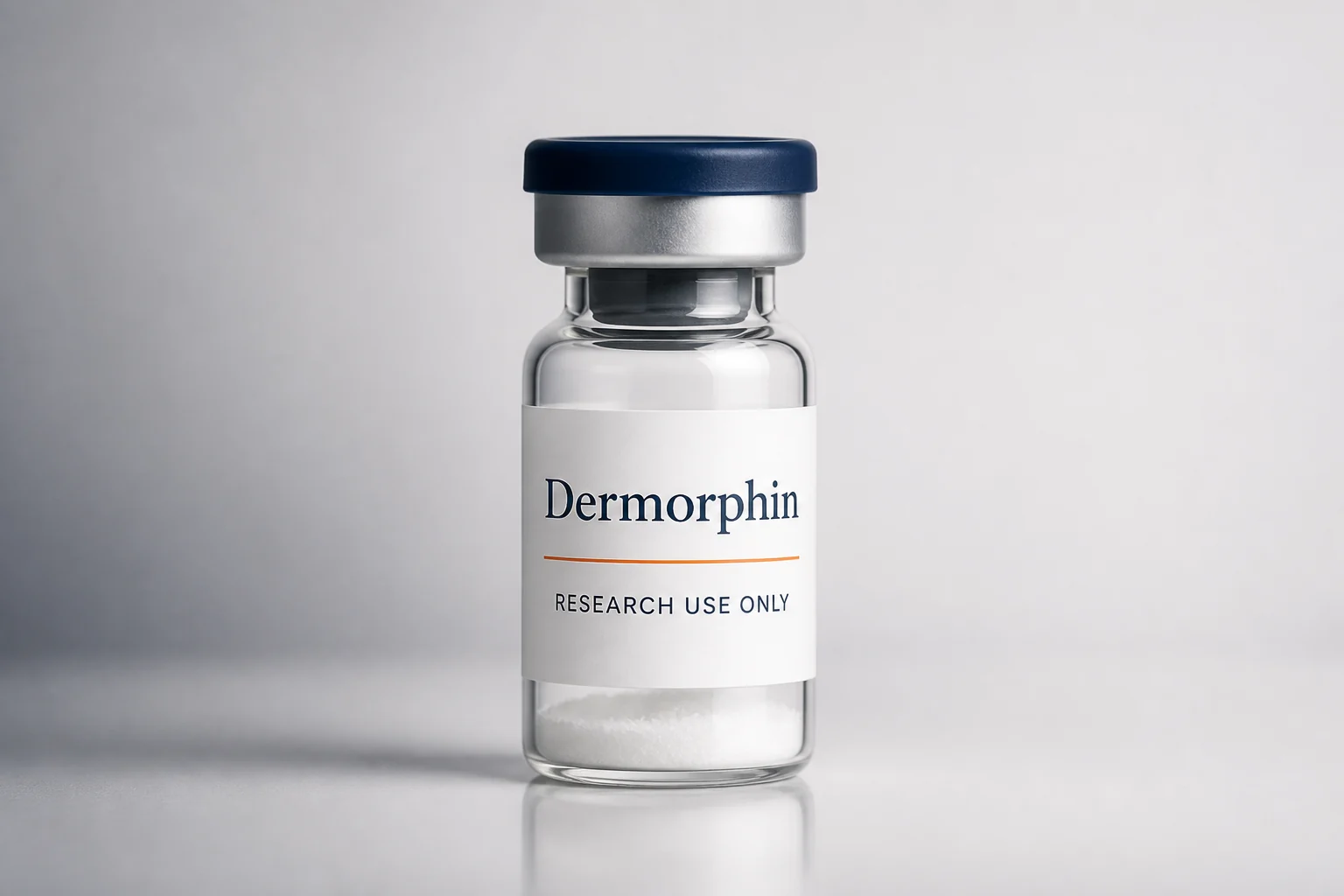
Compound overview
Shared values below are consolidated from the current catalog record. They are not independent verification or lot results; request the applicable product specification and ask which lot records are available before ordering.
Product identity
- Product type
- Peptide research compound
- Catalog family
- Dermorphin
- Research category
- Cognitive & Neuropeptides
- Catalog CAS RN
- 77614-16-5
- Catalog molecular formula
- C40H50N8O10
- Catalog molecular weight
- 802.88 g/mol
- Catalog sequence
- Tyr-D-Ala-Phe-Gly-Tyr-Pro-Ser-NH2
- Evidence status
- Receptor and animal analgesia research; no approved human product
- Intended use
- Research, development and manufacturing use only
Literature reference parameters
- Compound or material class
- Frog-skin-derived μ-opioid peptideCatalog-family identity
- Evidence scope
- Receptor and animal analgesia research; no approved human productDo not generalize beyond the cited model
- Source review
- Primary or authoritative records linked belowChecked 2026-09-01
Identity safeguard Reference identifiers above describe the literature compound record. Confirm the supplied form, formula, molecular weight, purity and storage conditions against the applicable product specification and any available lot records.
How Dermorphin is studied
A target-to-pathway view grounded in the linked research records.
Reported research findings
What published studies report about Dermorphin
Reported outcomes are paired with their experimental model and evidence boundary.
Dermorphin analogues show strong μ-opioid activity
A review summarized sequences, receptor pharmacology and biological activity across the dermorphin peptide family.
Family-level potency data do not define human safety.
Read the primary studyShort dermorphin analogues were studied for prolonged analgesia
A review described tetrapeptide analogues with potent, long-lasting analgesic activity in experimental systems.
Analogue findings are sequence-specific and predominantly preclinical.
Read the primary studyCatalog options
Variant specifications
Pack-level catalog data; lot-level controls remain document-specific.
Specification & documents for DR5
Product specification
Single-component peptide · 5 mg/vial nominal · 10-vial pack · supplied form and release limits controlled by lot specification.
Lot documentation
Document availability and scope must be confirmed for this variant and lot in the written quotation. A catalog description is not a lot-specific test result.
Quality documentation
A listed document is not proof of availability for this lot. Ask the team to confirm the current COA status and the scope of any other records before ordering.
Analytical interpretation
Interpret the documents, not just the headline number.
Use the source-reviewed guide to separate chromatographic area purity, quantitative assay, LC-MS identity, composition and stability evidence before comparing variants or requesting a lot record.
Open the Quality & Documentation HubHPLC area ≠ assayA dominant peak does not establish target mass fraction.
Intact mass ≠ full sequenceIdentity strength depends on resolution and orthogonal evidence.
Counterions affect contentWater, salt form and solvents change the as-is composition.
Storage needs a data basisShipping practice is not the same as stability evidence.
Evidence map
Research context
Published studies and regulatory records, not customer testimonials or usage guidance.
Dermorphin analogues show strong μ-opioid activity
Family-level potency data do not define human safety.
View primary recordShort dermorphin analogues were studied for prolonged analgesia
Analogue findings are sequence-specific and predominantly preclinical.
View primary recordCurated references
Third-party publications selected for direct relevance.
-
01
Peptide-family review
The dermorphin peptide family
Review. 1996. PMID 8981054.
-
02
Analogue review
Dermorphin tetrapeptide analogs as potent and long-lasting analgesics
Review. 2011. PMID 21126548.
Dermorphin questions
Concise answers for researchers comparing identity, evidence and catalog variants.
What effects are studied for Dermorphin?
The main reported effect is strong activation of the mu-opioid receptor, which in animal and receptor models leads to powerful pain relief, often described as stronger than morphine. Reviewers also note that some family members can reach the brain after dosing outside the central nervous system, and that rodents given dermorphin repeatedly showed less tolerance and dependence than those given morphine. These are experimental findings tied to specific sequences, models, and routes. They do not establish safe or effective human use, and opioid-class risks such as breathing depression and dependence remain serious limits.
How should the Dermorphin research findings be understood?
The receptor-level story is convincing but is not a health claim. Reviews describe pain relief in rodents and primates, sometimes after dosing outside the central nervous system, and less tolerance or dependence in chronically treated animals than with morphine. These are model-bound observations. Opioid-class risks, including breathing depression and dependence, remain key interpretive limits. A research catalogue peptide, its salt form, a modified analogue, and a finished medicine are different materials; findings for one do not automatically apply to another. Lot identity and quality are governed by the product specification and lot documents, not by potency in animal assays.
What evidence is available for Dermorphin?
The literature is preclinical and review-based, without an approved dermorphin medicine.
Does the cited research validate this catalog material?
No. The cited records describe their own intervention, formulation, model and controls. They do not verify the identity, purity, sterility, safety or efficacy of a catalog lot.
Which quality documents can be requested?
A lot-specific COA, product specification sheet and analytical method summary can be requested where applicable.
How should Dermorphin be stored?
Store at -20 °C, protected from light and moisture. After reconstitution, aliquot and avoid repeated freeze-thaw cycles. Confirm the applicable storage statement on the product-specific specification and lot documentation.
Knowledge tools
Continue with structured evidence
Move from this dossier into canonical evidence maps, verified status records, analytical interpretation and laboratory calculations.
Claims were checked against the linked primary publication, regulatory label or authoritative compound record. Published findings stay attached to their study model, formulation and route. Catalog identity and lot quality remain controlled by the applicable specification and lot-specific documents.
Technical procurement
Ready to request a quote?
Selected: DR5 · 5 mg × 10 vials