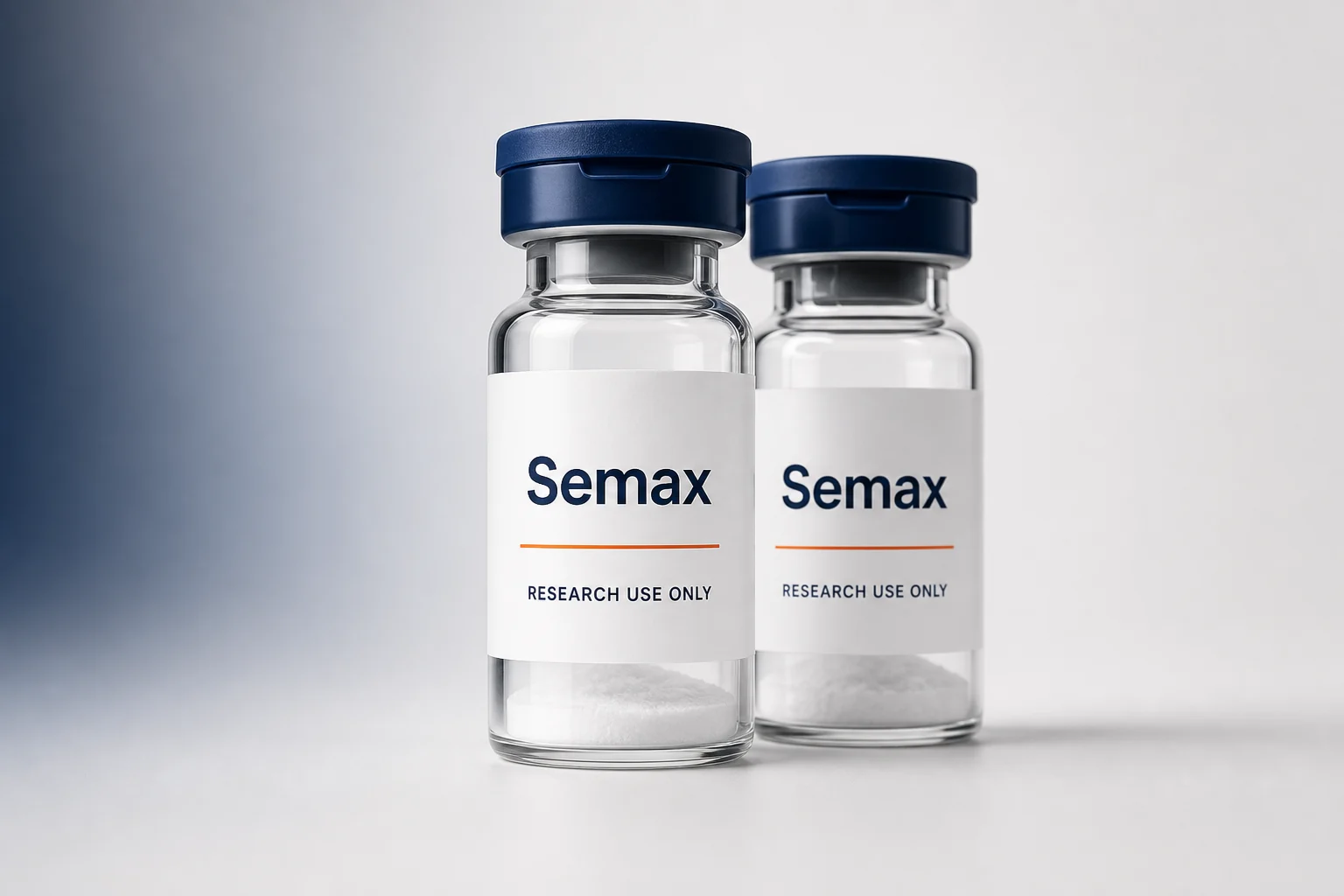
Semax Evidence in 2024–2025: Rat Stroke and Mouse Spinal-Cord Models
Recent Semax papers report molecular and functional findings in rats, female mice and cell models. They expand mechanism hypotheses but do not supply the…
Updated October 1, 2026Cognitive & Neuropeptides · Source-reviewed dossier
Source-Reviewed Research Dossier
Semax is a lab-made peptide based on a small piece of ACTH, a hormone the body uses in stress and energy regulation. Researchers study it mainly to understand how brain and spinal-cord tissue reacts to injury. In a rat stroke study, it partly restored gene activity disturbed by reduced blood flow. In a mouse spinal-cord injury study, it improved movement recovery and reduced a harmful form of cell death. All these findings come from rodents or cells, tied to specific injury models, and do not show that Semax improves memory or recovery in people. This material is for laboratory research only.
Shared values below are consolidated from the current catalog record. They are not independent verification or lot results; request the applicable product specification and ask which lot records are available before ordering.
Product identity
Literature reference parameters
Identity safeguard Reference identifiers above describe the literature compound record. Confirm the supplied form, formula, molecular weight, purity and storage conditions against the applicable product specification and any available lot records.
A target-to-pathway view grounded in the linked research records.
Reported research findings
Reported outcomes are paired with their experimental model and evidence boundary.
A 2025 mouse study linked Semax with Oprm1-related deubiquitination and functional-recovery outcomes after spinal-cord injury.
The result is sex-, species- and injury-model-specific.
Read the primary studyA 2024 study reported partial compensation of ischemia-disrupted brain gene expression after ACTH-like peptide exposure.
Gene-expression normalization in rats is not a clinical outcome.
Read the primary studyCatalog options
Pack-level catalog data; lot-level controls remain document-specific.
Single-component peptide · 5 mg/vial nominal · 10-vial pack · supplied form and release limits controlled by lot specification.
Document availability and scope must be confirmed for this variant and lot in the written quotation. A catalog description is not a lot-specific test result.
Single-component peptide · 10 mg/vial nominal · 10-vial pack · supplied form and release limits controlled by lot specification.
Document availability and scope must be confirmed for this variant and lot in the written quotation. A catalog description is not a lot-specific test result.
A listed document is not proof of availability for this lot. Ask the team to confirm the current COA status and the scope of any other records before ordering.
Analytical interpretation
Use the source-reviewed guide to separate chromatographic area purity, quantitative assay, LC-MS identity, composition and stability evidence before comparing variants or requesting a lot record.
Open the Quality & Documentation HubHPLC area ≠ assayA dominant peak does not establish target mass fraction.
Intact mass ≠ full sequenceIdentity strength depends on resolution and orthogonal evidence.
Counterions affect contentWater, salt form and solvents change the as-is composition.
Storage needs a data basisShipping practice is not the same as stability evidence.
Evidence map
Published studies and regulatory records, not customer testimonials or usage guidance.
The result is sex-, species- and injury-model-specific.
View primary recordGene-expression normalization in rats is not a clinical outcome.
View primary recordThird-party publications selected for direct relevance.
Preclinical study. 2025. PMID 40692165.
Preclinical study. 2024. PMID 39767736.
Concise answers for researchers comparing identity, evidence and catalog variants.
Two published experiments are the backbone here. In rats after experimental stroke, Semax partly corrected gene-activity changes in the brain. In mice with spinal-cord injury, it improved movement scores and reduced a damaging form of cell death, apparently through the Oprm1 gene and a protein-clearing pathway. Both were controlled laboratory models with specific species, sex, injury type and timing.
After experimental stroke in rats, many genes change their activity. When Semax was given, a large share of those disturbed patterns moved back toward normal, especially genes tied to immune signalling and nerve communication. The effect depended on how much time had passed since the stroke. Gene readout changes are laboratory measurements, not proof of better recovery or function.
The accessible evidence is mainly animal and molecular research, with limited controlled human replication.
No. The cited records describe their own intervention, formulation, model and controls. They do not verify the identity, purity, sterility, safety or efficacy of a catalog lot.
A lot-specific COA, product specification sheet and analytical method summary can be requested where applicable.
Store at -20 °C, protected from light and moisture. After reconstitution, aliquot and avoid repeated freeze-thaw cycles. Confirm the applicable storage statement on the product-specific specification and lot documentation.
Knowledge center
Owned educational content connected to this family.
Recent Semax papers report molecular and functional findings in rats, female mice and cell models. They expand mechanism hypotheses but do not supply the…
Updated October 1, 2026
Semax is the synthetic heptapeptide Met-Glu-His-Phe-Pro-Gly-Pro, also written ACTH(4–7)-Pro-Gly-Pro. It should not be confused with semaxanib, an unrelated small molecule with a similar name.
Updated October 1, 2026
"Neurotrophic factors increase" sounds like a complete conclusion, but the paper may have measured gene transcription, protein levels, or other readouts. You need to…
Updated October 13, 2026
One time point is like a photograph. It shows the state at that moment but cannot show when a response began or whether it…
Updated October 15, 2026Knowledge tools
Move from this dossier into canonical evidence maps, verified status records, analytical interpretation and laboratory calculations.
Claims were checked against the linked primary publication, regulatory label or authoritative compound record. Published findings stay attached to their study model, formulation and route. Catalog identity and lot quality remain controlled by the applicable specification and lot-specific documents.
Technical procurement
Selected: XA5 · 5 mg × 10 vials
Tell us what you need. Your enquiry will be routed to the appropriate contact for catalog numbers, availability and quotation details.